17 April 2016

SAFETY IN SHIP-BREAKING: 14 government high officials face contempt rule

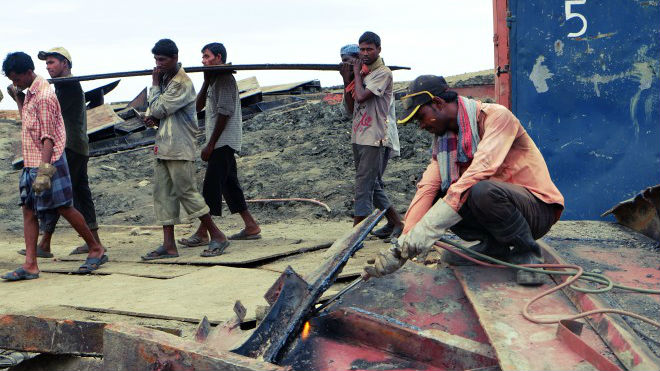
The High Court yesterday issued a contempt rule against 14 top government officials and the president of Bangladesh Ship Breakers Association for not implementing its directive on forming a committee for impartial supervision of ship breaking activities.

The court also asked them to explain why proceedings should not be initiated against them and why they should not be punished for deliberately and persistently ignoring safety of workers and protection of environment in gross violation of its March 2009 judgment.

The HC bench of Justice Syed Muhammad Dastagir Husain and Justice AKM Shahidul Huq came up with the rule following a contempt petition filed by Bangladesh Environmental Lawyers Association (Bela).  

The HC in March 2009 had directed the respondents to form a committee to ensure impartial supervision of ship breaking activities, according to a Bela press release.

The court in 2011 ordered them to submit a report to it on whether the ship breaking yards were operating in compliance with its directives, conditions of environmental certificate and related laws.

As the committee is yet to be formed, accidents at ship breaking yards have been causing deaths. Ninety-three workers have died and the Department of Environment (DoE) has fined seven ship breaking yards for not complying with the conditions of environmental certificate since the HC delivered the directives in 2009, the press release said.    

Environment and Forest Secretary Kamal Uddin Ahmed, Industries Secretary Mosharraf Hossain Bhuiyan, Labour and Employment Secretary Mikail Shipar, Shipping Secretary Shafique Alam Mehedi, Director General of the Department of Shipping Commodore M Zakiur Rahman Bhuiyan and DoE Director General Raisul Alam Mondal are among the government officials who have been made respondents to the contempt rule.


Fida M Kamal, Syeda Rizwana Hassan and M Shafiul Alam appeared for Bela.

Source: the daily star. 12 April 2016
http://www.thedailystar.net/backpage/14-govt-high-officials-face-contempt-rule-1208011

Bangladesh High Court Summons Shipbreakers

workers

On Tuesday, the Bangladesh High Court issued a contempt rule asking 14 government officials and the president of the Bangladesh Ship Breakers Association (BSBA) to explain why they have not implemented the Court’s judgement dating March 2009.

NGO Shipbreaking Platform reports that the Court now demands arguments from the respondents as to why they should not be held responsible for contempt of the court’s rulings and “for deliberately and persistently ignoring safety of the workers and safety and integrity of the environment.”

The government was also meant to form an independent committee for the impartial supervision of the shipbreaking activities. The court decision is the result of a contempt petition submitted by the Bangladesh Environmental Lawyers Association (BELA), the Platform member organisation that has been fighting in the courts against the shipbreaking industry’s violation of the law since 2003.

The government officials and the president of the BSBA do not have to appear in Court in person yet, but will have to submit written answers. If the court deems their answer not satisfactory they may then be summoned to court.

"This step taken by the High Court fundamentally challenges the apathy of the government agencies in regulating the shipbreaking sector as well as the strong culture of impunity the owners of shipbreaking yards enjoy due to their political connections,” says advocate Rizwana Hassan, Chief Executive of BELA and initiator of the petition. “This must end. We cannot accept any more deaths of laborers, and someone has to finally take responsibility for the fatal accidents.”

BELA has also asked the Court to suspend the activities of 42 shipbreaking yards. In the case of 37 yards, BELA has accused the companies of unsafe working conditions resulting in accidents and deaths, and for seven yards BELA has provided information on how these companies violate the requirements for their environmental clearances. BELA is gathering more evidence so the number of yards to be closed is likely to rise even further.

“Despite the high-profile Court order given in March 2009, both the shipbreaking industry and responsible ministries have remained inactive in addressing the pressing issues related to both occupational health and safety and to environmental pollution and hazardous waste dumping,” says Patrizia Heidegger, Executive Director of the NGO Shipbreaking Platform. “We insist that they will not be allowed to get off lightly yet another time.”

In March 2009, the High Court had ruled that the government is to set up a committee to ensure the impartial supervision of the shipbreaking industry. The Court also found that the shipbreaking yards did not hold the necessary environmental clearance to operate. As a consequence, the yards were temporarily shut down. The Court demanded that the government comply with the requirements under the Basel Convention on the Control of Transboundary Movements of Hazardous Wastes and their Disposal. This included the respect for Prior Informed Consent (PIC), that is, the approval by Bangladesh of the import of ships based on the amount of toxics on board the end-of-life vessels.

The political clout of the shipbreaking industry, amongst them members of Parliament and other powerful politicians as well as some of the most influential industrialists in the country, managed hastily issued environmental clearances for their yards, says the platform. It also alleges that for the import of end-of-life vessels to Bangladesh, the authorities blindly accept fake certificates stating that all the old ships are free of hazardous waste.

The independent Committee, which according to the Court should also include non-government organizations and labor unions, has never been made functional. BELA argues that at least 93 workers have died since the 2009 Court order. All this has passed without consequences.

Both the shipbreaking industry and the government of Bangladesh are now asked to give account of their actions. If they fail to produce sufficient arguments, responsible persons are likely to be sentenced and yards may be closed down.

Source: maritime-executive. 13 April 2016

European Commission releases technical guidance for ship recycling facilities

The European Commission (EC) has released technical guidance for ship recycling facilities, subject to approval by the European Union (EU) Ship Recycling Regulation.

This step is said to replicate the petition of the environmental and human rights non-governmental organisations (NGOs) to shift ship recycling to a platform that can ensure sustainable practices.

The facilities that seek to feature in the EU-approved list will be required to fulfill safe working conditions, pollution control including proper downstream waste management, and enforcement of international labour rights.

NGO Shipbreaking Platform policy director Ingvild Jenssen said: "Recycling yards that want to make it on the EU list of approved facilities need to meet high environmental and safety standards.

"The EC is clear in its message: an unprotected beach is never going to be an appropriate place for a high-risk heavy industry involving hazardous waste management."

The EU list of approved ship recycling facilities will serve as a global reference point for sustainable ship recycling, and will reward companies who already have or intend to invest in the infrastructure and the employment of fully trained workers promoting safe and environmentally sound recycling practices.

The list is anticipated to feature yards responsible shipping companies such as Hapag Lloyd, Wilhelmsen, Grieg and Royal Dutch Boskalis work with in Europe, China and Turkey after they comply with the requirements and in some cases also improving their practices in order to meet the European standard.

For ship owners, the EU list will serve as a guarantee that their end-of-life vessels do not pose any harm to workers and the environment.

The NGOs can submit complaints and concerns to the EC, supported by the 'independent verifiers with qualifications' and audits by the EC or agents acting on its behalf, regarding the functioning of a facility, and advise for an on-site visit to establish whether the facility should be removed from the list.

The establishment of good practices related to ship repair facilities has paved the way for the establishment of new facilities.

Source: ship-technology. 14 April 2016

Idle container ship fleet remains at ‘alarmingly high’ level


The fleet of idled container ships is edging higher with more than 200 unemployed vessels above 3,000 20-foot-equivalent units, according to Alphaliner.

The idled container ship capacity remains at an “alarmingly high” level of 1.48 million TEUs, equivalent to 7.4 percent of the global fleet, as demand shows no sign of picking up, the industry analyst said.

Demand for charter ships, which is usually strengthening at this time of the year, has been faltering in the past weeks, “dashing hopes of seeing overcapacity decrease in the foreseeable future.”

There were 325 jobless ships above 500 TEUs as of April 4, just three more than two weeks earlier, but the increasing size of idled vessels is boosting the unemployment rate in capacity terms.

The six-year high of 346 idled ships in late February had a combined capacity of 1.43 million TEUs, accounting for 7.1 percent of the global fleet.

The unemployment pool includes 91 ships of 3,000 TEUs to 5,099 TEUs, 54 of 5,100 TEUs to 7,499 TEUs and 55 of 7,500 TEUs and more.

The “unprecedented” number of ships of more than 3,000 TEUs without work is prompting owners to consider scrapping relatively young tonnage, Alphaliner notes.

Six 5,400 TEUs to 6,500 TEUs ships have already been broken up this year, including the 15-year-old, 6,479-TEU DS Kingdom, the largest-ever container vessel sold for demolition. The ship, which had been laid up in Asia since mid-November, is also among the youngest container vessels to be scrapped.

Four sister ships, all built in 2011, have been idled for between four and nine months as a result of “the disastrous charter market for over-Panamax tonnage, which is crippled by unprecedented oversupply.”

A further 10 Panamax units of 3,300 TEUs to 4,800 TEUs have also been scrapped since the beginning of the year and prospects for this size of ship remain “grim” in the run up to the opening of the new Panama Canal locks in June.

With 130,000 TEUs already sold for demolition in the first quarter of the year, Alphaliner said 2016 could be a record year for scrapping.

Source:  joc.com. 14 April 2016

04 April 2016

Violence reaches new level: shipbreaking yard’s private security personnel fire shots and injure seven people

Chittagong/Brussels, 4 April 2016 – In the morning of 28 March, shipbreaking worker Sumon was killed on a private road inside Kabir Steel yard located North of Bangladesh’s major port city, Chittagong. His brother, who works at the yard as well, was seriously injured in the same accident. According to local sources, Sumon was run over by a truck transporting steel plates from the yard. When a local government representative reached the yard to claim the legal compensation owed to the victim’s family, the yard management refused to take responsibility for the accident with the argument that the truck was owned and operated by another company.

(Pictured: Chittagong Medical College Hospital. Copyrights: NGO Shipbreaking Platform, 2014)
At around 11 a.m., locals together with family members gathered outside the yard in protest and blocked traffic on the highway. They claimed, according to the English daily newspaper The Daily Star that the company was withholding Sumon’s body inside the yard. The private security personnel employed by the shipbreaking yard started shooting at the group. According to Bangladeshi newspapers, one of Kabir Steel’s guards injured seven people.

“This course of action represents unnecessary use of violence against unarmed protestors,” says Patrizia Heidegger, Executive Director of the NGO Shipbreaking Platform, “and it shows the climate of violence surrounding the shipbreaking yards. Locals and workers protesting the conditions in the yards obviously put their lives in danger in an atmosphere in which shipbreaking yards feel entitled to shoot at people.”

Tariqul Islam of the local police station said that the accused security guards were detained. Moreover, the Financial Express Bangladesh reported that the police seized a gun and several rounds of bullets at the yard.

“The incident shows how non-transparent this industry is. The NGO Shipbreaking Platform and its local members now expect that the police investigates this case properly. We demand rightful punishment of those responsible for the blood shed”, says Rizwana Hasan, Chief Executive of the Bangladesh Environmental Lawyers Association.

Muhammed Ali Shahin, the Platform’s Bangladesh coordinator, adds: “We expect that the family of the dead worker receives its due compensation as fast as possible instead of being caught up in an argument between two companies pushing away responsibility”. So far, the compensation claim has not been settled.

Kabir Steel’s shipbreaking yard is part of the large industrial conglomerate of Kabir Group of Industries. The NGO Shipbreaking Platform has documented several severe and fatal accidents in the yard over the last years. In 2014 alone, when the yard had the highest recorded number of accidents amongst all Bangladeshi shipbreakers, at least 2 workers were killed and six more severely injured at Kabir Steel’s shipbreaking yard and re-rolling mill in four different accidents. This included the case of three workers who suffered severe burn wounds all over their bodies after an explosion on a Norwegian-owned oil tanker used by Teekay Corporation. In another accident in the same yard, on 30 March 2016, cutter helper Md. Abdus Salam fell down from a beached vessel due to the lack of safety measures at work. As a result, he suffered serious injuries including several fractures in his arms and legs.

“The sad accidents record is proof of the fact that Kabir Steel does not ensure safer working conditions, does not comply with proper safety procedures, uses untrained workers, lacks proper infrastructure to guarantee occupational health and safety and does not organise the legally binding Safety Committee at yard level”, criticises Repon Chowdhury, Executive Director of the Platform member Bangladesh Occupational Safety, Health and Environment Foundation.

The Platform welcomes that IndustriAll Global Union has sent a letter to the Prime Minister of Bangladesh. It joins the trade union’s call for proper investigation and for the rightful punishment of both negligent yard owners and of security guards for the bodily assault of protestors.

Sumon and the other workers at Kabir Steel have been hired to dismantle the Greek-owned and Greek-flagged bulk carrier Alpha Friendship. The Athens-based owner Alpha Tankers obviously does not take care of responsible ship recycling. The Platform will take up this case to illustrate the necessity for the EU and its Member States to better regulate ship owners’ sub-standard shipbreaking practices.


Source: NGO Shipbreaking Platform. 04 April 2016