17 August 2015

Bangladesh shipbreaking cartel scares away scrap ship sellers

As scrap prices dwindle, five unnamed members of the Bangladesh Ship Breakers Association (BSBA) have formed a pricing cartel to control prices on available tonnage into Chittagong, which commentators say will result in fewer vessels heading to Bangladesh for demolition in the near future.

The cartel hopes to secure fairly priced ships for its buyers. Many shipbreaking yards in Bangladesh have posted huge losses over the past year.

“It remains to be seen just how long this cartel will last, bearing in mind some of the prices quoted on certain units appear to be about $50/LDT behind what Indian and Pakistani buyers are offering. Therefore, we expect most of the dwindling supply of vessels to be diverted away from Bangladeshi shores in the foreseeable future,” GMS, the world’s largest cash buyer of ships, commented today in its weekly market report.

Only seven vessels have been sold for demolition in Bangladesh over the past four weeks, compared with 21 vessels in the preceding four-week period.

During the past week, Bangladeshi buyers have been offering $250/ldt for general cargo vessels, $30/ldt lower than India and $25/ldt less than in Pakistan.

For tankers, Bangladesh has been offering $280/ldt, again $20/ldt to $30/ldt lower than its competitors on the subcontinent.

“If end buyers are keen to acquire new vessels, a review of the system may be required yet again,” GMS said.

Source: splash 247. 17 August 2015

Norwegian Shipowners to stop beaching

In an op-ed in Dagens Næringsliv, the largest daily business paper in Norway, Norwegian Shipowners Association and their CEO Sturla Henriksen say a definite NO to shipbreaking on beaches. -This is a major victory for Bellona and all other NGOs fighting against dangerous dismantling of ships, ​​Bellona advisor Sigurd Enge said.

– The turnaround by the Norwegian Shipowners shows us that they now agree with the principle advocated by NGOs for years.  Hazardous “beaching” should not take place in 2015. It is a dinosaur way of doing things, knowing that there are modern and safe solutions,  Enge said.

Bellona advisor Sigurd Enge is clear that it is a brave decision that  the Norwegian shipowners make today.

Norway becomes the first country in the world to discourage shipowners to scrap ships on beaches.

-This news will make headlines globally , the Bellona advisor said.

-On behalf of the NGO Shipbreaking Platform I am happy to announce that the Norwegian Shipowners’ Association now is on our team. This is a breakthrough in the international efforts to end the “beaching”. Bellona will definitely say “Look to Norway” when it comes to taking a stand against this old fashioned way of dismantling ships , Enge said.

-This decision gives us more energy, and other countries should copy the Norwegians, the Bellona advisor said.

Bellona is particularly pleased that the NSA now wants to take an ambitious and serious corporate social responsibility. Bellona now expects that this decision will strengthen the growing market for serious shipbreaking.

10 year long struggle crowned with victory

Bellona has since 2005 been working against hazardous shipbreaking on the beaches of India, Pakistan and Bangladesh.

The environmental foundation has repeatedly pressured governments and shipowners to stop the practice. In total, around 150 ships controlled by Norwegian shipowners have been scrapped on beaches since 2009 and until today.

-This has been 150 ships too many. This practice has been a dark chapter in Norwegian maritime traditions, and I am very happy that it seems to have come to an end today, Enge said.

In recent years, we have seen that the number of Norwegian ships on beaches is decreasing. In 2014, for the first time, no Norwegian ships were scrapped on beaches in Bangladesh and Pakistan. Only seven Norwegian controlled vessels were scrapped on Indian beaches in 2014.

-This shows that good advocacy is actually helping, Sigurd Enge said.

Far from the end – the international struggle continues

Bellona and strong international partners in the NGO Shipbreaking Platform will continue to monitor the situation on the beaches of Southeast Asia.

-There is a huge international struggle to continue this practice, Enge said. He refers specifically to the disclosure earlier in August, where two John Fredriksen-controlled ships from Golden Ocean ended up on beaches in Bangladesh and Pakistan.

NGO Shipbreaking Platform is a collection of 19 international environmental and human rights organizations. In its latest quarterly report for Q2 2014, the platform reports at least six casualties.

The fresh quarterly report shows that European shipping companies continue to send their ships for scrapping in Asia. In the second quarter, a total of 52 ships ended up on beaches in India, 42 in Bangladesh and 37 in Pakistan.

-We expect that Norwegian shipowners now will follow the strong advice made by the Sturla Henriksen and the Norwegian Shipowners Association, Enge said.

-I guarantee that Bellona will continue to name and shame Norwegian shipowners who now choose to close their eyes and ears, and literally stick their heads in the sand, Enge concluded.

Press contact: Head of Communications, Magnus Borgen, +47 97728476/ magnus@bellona.no

Bellona

Source: Bellona. 17 August 2015

16 August 2015

HUNT BEGINS FOR A NEW ADDRESS FOR DARUKHANA:

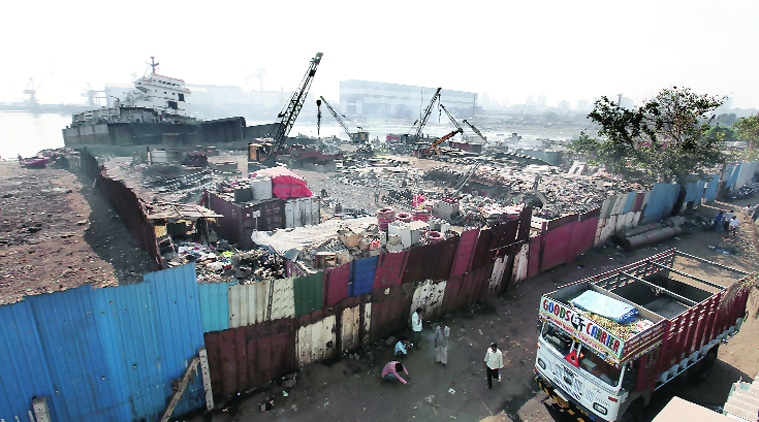
The shipbreaking yard at Darukhana, Mazgaon. High toxicity levels in the area mean it will take up to five years for soil quality to be restored for habitation.

Efforts to redevelop port land gain pace

At a meeting in Delhi, the state government suggested three sites - Raigad, Ratnagiri, and Kalyan. The Mumbai Port Trust has sought more options.

In what is being seen as a precursor to the redevelopment of the port land, the state and the central governments have begun discussions on relocation of Darukhana, the shipbreaking yard on the city's eastern seafront.

At a top-level meeting in Delhi earlier this month, the state government suggested three sites where the century-old yard could move. However, the Mumbai Port Trust, which controls the yard, sought more options. The sites suggested were Raigad, Ratnagiri, and Kalyan.

The meeting was headed by Joint Secretary, Shipping, Barun Mitra and the state government was represented by senior Mumbai Port Trust officials and Maharashtra Maritime Board CEO Asheesh Sharma.

The Mumbai Port Trust, spread across 1080 acres - that's 50 Oval maidans - is the city's last chance to save itself from crumbling under its own weight. The disastrous consequences of having wasted the opportunity of utilising the mill land for creating open spaces and affordable housing are already visible.

Apart from the shipbreaking yard, Darukhana also houses a vibrant market for scrap obtained from the ships dismantled at the yard.

Mumbai Port Trust chairman Ravi Parmar admitted that shipbreaking is not sustainable at Darukhana because of its proximity to residential areas and the pressure to move it elsewhere will rise gradually.

"Shipbreaking is a hazardous activity. But we do not allow breaking of passenger ships here. Also, big ships are not dismantled here. They go to Alang in Gujarat. Gradually, the number of ships coming to Darukhana has gone down," he said.

Referring to the meeting in Delhi, Maharashtra Maritime Board CEO Asheesh Sharma said the sites suggested by the state government where the shipbreaking activity could be shifted to were not acceptable to the Port Trust. "Ultimately, it is a call that the Port Trust will have to take following discussions with its stakeholders," he said.

Sharma said that the Port Trust has been directed by the Union Shipping Ministry to open internal discussions aimed at moving the shipbreaking activities out of Mumbai. "Whatever site they select, we will be available to help them in the transition," he said.

While shipbreakers don't seem to be worried about the move out of Mumbai, the Transport and Dock Workers Union is dead against the idea. Ship breaker Abdul Karim Jakha said the taxes are so high in Mumbai that a bulk of shipbreaking activity has already moved to Alang. "There are 19 plots in Mumbai, but only four or five are occupied at any given point of time," he said.

Kersi Mehta, working president of the Transport and Dock Workers Union and a Mumbai Port Trust trustee, said the workers' future must not be sacrificed for providing Mumbai recreational space.

The Union Shipping Ministry is likely to review the matter of shifting Darukhana out of Mumbai in a fortnight.

Source: Mumbai mirror. 16 August 2015

Platform News - Shipbreaking at SAIL Amsterdam 2015: CSR Netherlands explains sustainable recycling to children and parents at pop-up scrap yard

Brussels, 11 August 2015 – The NGO Shipbreaking Platform applauds CSR Netherlands, a Dutch-based network of companies, NGOs and researchers advocating for corporate social responsibility, for using SAIL Amsterdam 2015 to encourage children to learn more about sustainable ship recycling and about the conditions in which old ships are dismantled in South Asia. CSR Netherlands will set up a pop-up scrap yard from 19 to 23 August during SAIL Amsterdam, the Netherlands’ largest public event and the world’s largest free nautical event. Children will be encouraged to discover ship recycling by working with proper tools and dismantle small boats that have been decommissioned. They will help to sort scraps, as well as to label and separate the materials.

The pop-up scrap yard will show the reality on the ground in South Asia and illustrate the working conditions at the scrapping beaches in Bangladesh, India and Pakistan. Impressive pictures taken by French photographer Pierre Torset showing toiling children, the dumping of hazardous waste and unprotected workers will be displayed as well.

“We hope that through this workshop, parents and children alike will learn more about the importance of sustainable ship recycling, and also about the adverse impacts of substandard beach-breaking on the workers and the environment in South Asia,” says Patrizia Heidegger, Executive Director of the NGO Shipbreaking Platform, a coalition of 19 organisations working to promote safer and cleaner ship recycling. “In Bangladesh, we still find teenagers who work in the shipbreaking yards day and night, for little pay, and in dangerous working conditions. They are exposed to risks that could be avoided if the ships were dismantled in a proper way. It is often companies from Europe that send these ships, looking to make the biggest profit, with little regard for the workers or the environment.”

CSR Netherlands is part of an international corporate social responsibility (ICSR) umbrella programme financed by the Dutch Ministry of Foreign Affairs. Its role in the programme is to work with a group of small and medium-sized businesses and important stakeholders from six industries including the maritime sector to develop social and technical innovations and new sustainable production methods and to ensure optimum collaboration with chain partners. The experience gained during this programme will serve as an example and an inspiration to the industry as a whole.

“We want people to see that safety-conscious scrapping of vessels is possible, and that most of the materials can be reused,” explains Mieke Bakker, Maritime Sector Manager at CSR Netherlands.

CONTACT US:
For general information about shipbreaking:
Patrizia Heidegger
Executive Director
NGO Shipbreaking Platform

For more information about the event in Amsterdam, please contact CSR Netherlands:
Mieke Bakker
Maritime Sector Manager

Rowena Achterkamp
Maritime project manager
+31(0)6-21255160

Brussels to Host 3rd Ship Recycling Summit


Join ACI's 3rdShip Recycling Summit taking place in Brussels on the 2nd and 3rd December 2015 and hear Tom Peter Blankestijn, Managing Director, Sea2Cradle, who will present on Toxic Ship Recycling focusing on:
- Showing the preparation (IHM)
- Having a match between vessel and yard on the particulars of the IHM
- Creation of the SRP
- The actual recycling / demolition itself taking into account all the materials hazardous / non hazardous

Early Confirmed Speakers Include:
Henning Gramann, CEO, GSR Services GmbH
Wolfram Guntermann, Director Environmental Fleet Management, Hapag-Lloyd AG
Patrizia Heidegger, Executive Director, NGO Shipbreaking Platform
Wolfgang Hintzsche, Capt., B.Sc., Marine Director, VDR - German Shipowners' Association
Roy Watkinson, President, Roy Watkinson Environmental Consulting
Marc Van De Poel, Operations Director, Vandepoel Consultants
Nikos Mikelis, Non Executive Director GMS Inc, Mikelis Consulting
Antonio Barredo, Managing Director, DDR VESSELS XXI, S.L.
Gudrun Janssens, Senior Policy Advisor, OVAM | Public Waste Agency Of Flanders

Key Topics
What to Do With the Used Vessels?
Most Important Regulations Currently Applicable to Ship-owners
European Commission’s List of Authorized Ship Recycling Facilities
Common Ship Recycling vs Compliant Ship Recycling
Strategies on How to Convert Old Assets Into New Revenue
How to Capitalize on Toxic Ship Recycling?
Innovative Technological Solutions For Ship Recycling Facilities
How to Wisely Invest In Eco-Ships?
Cash Buyers’ Involvement and Their Role in Ship Deployment Process
Ship Deployment Logistics – Best Advice for Small, Medium & Big Shipping Companies
Financial Institutions’ View on Investing in Ship Recycling Industry
Ship Brokers Perspective on Legal Adjustments
Market News, Short & Long Term Future Trends Predictions
Making the Compliant Recyclers Ship-owners First Choice
What Affects the Scrap Value of Vessels and How to Maximize on the Available Opportunities
Successfully Ended Ship's Life Cycle - Case Studies

Speaking Opportunities:
Agnieszka Niemczewska
+48 6164 670 45

Sponsorship Opportunities:
Sam Cormack
+44 20 3141 0626

Registration or More Information:
Melanie Mulazzi

on: +44 20 3141 0605