16 March 2016

The Sustainable Shipping Initiative holds landmark forum to facilitate change in ship recycling:

London - The Sustainable Shipping Initiative (“SSI”) – a pioneering coalition of companies from across the global shipping industry – is today holding its second roundtable with key industry stakeholders to discuss the challenges and barriers to achieving sustainable ship recycling, and how they can be overcome. Improving the health, safety and environmental standards associated with ship recycling is a key SSI work stream, and an important element of the SSI’s recently launched Roadmap, which charts the key milestones which must be met to create a sustainable shipping industry by 2040.

Held under Chatham House rules, participants include members of the SSI, as well as representatives from regulatory bodies, ship owners, ship breaking and ship recycling companies, as well as NGOs, industry bodies and class societies; key stakeholders from across the value chain who are central to developing sustainable standards within ship recycling.

“This forum is an example of how the SSI and its members are working together with the industry to help facilitate understanding and change in key areas that will further shipping’s progress towards sustainability,” said Alastair Fischbacher, CEO, the Sustainable Shipping Initiative.

“Ship recycling is a critical part of the shipping lifecycle, but also one of the industry’s most contentious and complex issues, with diverse opinions on what should be done to improve its sustainability. Our forum has been designed to stimulate open, and transparent debate, so that we can work with the industry to find consensus and common ground to develop tangible plans that can be put into action.”

While the Hong Kong Convention for the Safe and Environmentally Sound Recycling of Ships (HKC) is yet to be formally ratified, several yards in Alang, India, have received accreditation with the standards of the HKC, which is a positive step. However, this is a foundation to develop from, and significant progress needs to be made in further improving safe, environmentally and socially responsible ship recycling. The SSI is looking to encourage and support sustainable ship recycling, which incorporates not only the requirements of the HKC but also social best practice, environmental compliance and health and safety standards which meet member and external scrutiny.

Alastair Fischbacher concluded: “We are hopeful that progress will be made, and that we can build on the momentum from 2015. We look forward to working with our members, as well as those within the industry who are committed to developing sustainable ship recycling practices. These kind of initiatives espouse what the SSI was established for, and showcase the commitment and drive of our members in actively engaging and collaborating with the industry to drive change, and achieve our vision of a sustainable shipping industry by 2040.”

Source: AJOT. 9 March 2016

ABS Releases New Guide for Hazardous Materials Inventory:

ABS, a leading provider of classification and technical services to the global marine and offshore industries, has published a new edition of the ABS Guide for the Inventory of Hazardous Materials. The Guide provides ABS requirements for reviewing and verifying the initial Inventory of Hazardous Materials (IHM) for newbuilds and existing vessels and defines obligations for maintenance, verification and endorsement for vessels in service.

“It is important for guidance to stay ahead of requirements,” says Chief Technology Officer Howard Fireman. “By looking forward and determining how upcoming regulatory changes will impact owners and operators, ABS provides the essential information required to achieve regulatory compliance.”

Implementing the requirements in the IHM Guide permits early compliance with the requirements of Part I of the IHM set forth by the IMO Hong Kong Ship Recycling Convention, which is yet to be ratified. Early adoption at the time of new construction will simplify future compliance during the vessel’s operating life.

The newly released Guide incorporates the requirements of IMO Resolution MEPC.269(68), 2015 Guidelines for the Development of the Inventory of Hazardous Materials.

The IHM Guide applies to a vessel of 500GT or greater operating outside the boundary line of a sovereign state whose flag it is entitled to fly. It also applies to semisubmersibles, floating craft, floating platforms, self-elevating platforms, Floating Storage Units (FSUs), and Floating Production Storage and Offloading Units (FPSOs) and for vessels stripped of equipment or being towed.

Source: Hellenic shipping news. 1 March 2016

Plans to scuttle decommissioned HMAS Tobruk off Tasmanian coast may be scrapped:

A decommissioned Royal Australian Navy ship could be sold for scrap overseas rather than being scuttled as a diving wreck in Tasmania or Queensland.

HMAS Tobruk bows out

Key points:

HMAS Tobruk was decommissioned last year after 35 years service
Tas and Qld have bid to have it scuttled as a diving wreck
Council officials fear it will be sold for scrap
HMAS Tobruk was retired last year after 35 years of service, including many humanitarian missions.

The Break O'Day Council on Tasmania's east coast wants the ship to be scuttled at Skeleton Bay, near St Helens, a plan that it said would attract thousands of divers each year.

A group in southern Queensland is also vying to have the ship sunk off the coast between Bundaberg and Hervey Bay.

HMAS Adelaide scuttled

HMAS Tobruk Skeleton Bay project manager Peter Paulsen said he was worried neither group would get a look in.

"The real fear that we have at the moment is that the [Defence] Minister [Marice Payne] is seriously keeping alive the option of scrapping," he said.

"I just feel like the vessel is sitting in Garden Island like it's sitting on death row, waiting for a decision.

"The last thing that we want to see is this vessel sent off to the bone yards of India. It would be an absolute insult.

"This makes us all very nervous. It needs to have the opportunity to serve another life as a dive wreck or as an artificial reef."

Break O'Day Mayor Mick Tucker said it would be an asset to the region in Tasmania's north west.

"We would feel that the benefits for Tasmania far outweigh seeing the boat sent overseas to one of the countries to get cut up and come back as a tin of fruit," he said.

"It would be absolutely devastating."

HMAS Adelaide was the last navy ship to be sunk off the Australia coast in 2011.

It cost about $8 million, most of which was funded by the Federal Government.

Mr Paulsen said he believed it was only fair the Federal Government foot the bill to scuttle the HMAS Tobruk.

"We're not asking for anything that hasn't been achieved in the past," he said.

"The last three vessels to be sunk in Australia ... were gifted to their respective states, along with a very comfortable cheque.

"For a region like St Helens where you've got this nice little isolated corner of the state, that would be a fantastic boost to the entire region."

Mr Tucker said there was no reason for Tasmania to be ignored.

"Every [other] state in Australia has a navy dive wreck. Tasmania does not have one," he said.

"It would once again show the contempt of Tasmania being left off the map.

"We need to have the same opportunity and be treated equal as every other state in Australia. We deserve to have the economic benefit."

The federal Defence Department has been contacted for comment.

Source: abc.net. 2 March 2016

Ballast Water Management Convention edges closer:

This week, both Fiji and Belgium signed up to the IMO’s Ballast Water Management (BWM) Convention. Finland is also believed to be close to ratifying the convention.

Although the two IMO members states bring the number of states ratifying the convention to 49, with an aggregate of 34.82% of the world's merchant fleet tonnage, the percentage is still slightly below the threshold of 35%, which would trigger its entry into force.

If Finland signs, this will still leave an estimated 0.04% shorts, Lloyd’s Register said at a presentation this week.

The BWM Convention will enter into force 12 months after ratification by 30 States, representing 35% of world merchant shipping tonnage. ?

As for Belgium, the country also deposited its instrument of accession to the Hong Kong Ship Recycling Convention, bringing the number of contracting states up to four. The Hong Kong convention will enter into force 24 months after the date on which 15 States, representing not less than 40% of world merchant shipping by gross tonnage, become party to the treaty.

In addition, the combined maximum annual ship recycling volume of those states must, during the preceding 10 years, constitute not less than 3% of their combined merchant shipping tonnage.

IMO secretary general, Kitack Lim, has encouraged other states that had not already done so, to ratify both the BWM and Hong Kong treaties, in order to bring them into force.

At this week’s Navigate/IPTA chemical/products carrier conference, in a keynote speech, he also called upon states to ratify the HNS Convention (Hazardous and Noxious Substances by Sea Convention), which has been around since 1996.

A 2010 protocol to the convention has been signed by Canada, France, Germany, Greece, the Netherlands, Norway, and Turkey, thus far.

Source: tanker operator. 11 March 2016

The nature of shipbreaking is casting a shadow over the shipping industry:

The shipbreaking industry is a lucrative business, but unless the international community hastens to adopt more effective safety regulations, it will have a negative impact on the shipping sector at large

The shipbreaking industry is a lucrative business, but unless the international community hastens to adopt more effective safety regulations, it will have a negative impact on the shipping sector at large

Every year, thousands of shipping vessels succumb to rust, corrosion and metal fatigue; no longer deemed fit for purpose. When their time eventually comes, these goliaths of the sea are broken down in an attempt to recoup as much money from their demise as possible – a process known as shipbreaking. Ship breakers strip out absolutely everything: nothing is wasted. Any parts that can be sold for re-use aboard another vessel are salvaged first, with the remaining morsels extracted and sold for scrap.

Shipbreaking is an extremely profitable business. Scrapping companies pay roughly $400 per tonne, and so, considering the sheer size of the ships that come ashore to be dismantled, the process can easily add up to scrappers collectively paying a total of anywhere between $3m and $10m for a single vessel.

Shipbreaking takes place all over the world, but the manner in which it is carried out differs considerably: in developed countries, the process is handled the by the book, with scrapping companies forced to adhere to strict environmental guidelines outlined by the United Nations Environmental Programme’s (UNEP) 2003 Basel Convention, which stresses the importance of controlling the trans-boundary movements of hazardous wastes and their disposal.

As a consequence of the comprehensive enforcement of these rules, ship breakers in developed countries must ensure that practically every part of the decommissioned vessel is recycled, with only the small amount of unrecyclable materials left over as waste. The guidelines also ensure that before workers begin the process of dismantling a ship, all potentially dangerous materials, including any toxic or flammable gases and liquids, are removed. This procedure is carried out not only to protect the surrounding environment from leakages or contamination during the scrapping process, but also as a safety precaution for those tasked with carrying out the heavy lifting.

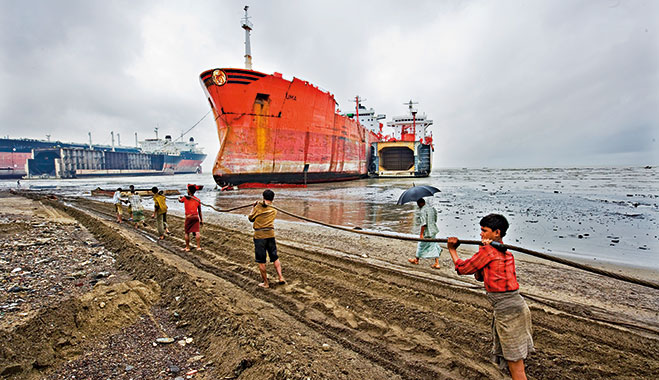
Unfortunately, the vast majority of shipbreaking does not occur on the beaches and dry docks of developed nations: more than two thirds of the industry is based in developing countries, specifically India, Pakistan, Bangladesh and China (see Fig. 1). These countries have historically struggled to meet the international standards of practice, with employees forced to deal with working conditions that threaten their health and safety each and every day. What’s more, many of the workers that are tasked with carrying out this difficult and precarious process receive very little in the way of training, and are poorly paid for their labour.

“Without a voice in the workplace, daily abuses go unchallenged”, Nazim Uddin, the leader of the Bangladeshi shipbreaking union, explained in a report conducted by the global workers union IndustriALL. “Shipbreaking workers have miserable conditions. Workers are paid daily – no work, no pay. They receive no paid leave at all, no bonus, no gratuity, and have no job guarantee. Employers pay no compensation to the killed workers’ families. The High Court rules that each killed worker’s family should be compensated BDT 500,000 ($6,400), but employers do not respect this.”

In response to such allegations, major industry bodies, governments and numerous non-profit entities have campaigned tirelessly in the hope of getting South Asian scrap yards to adhere to international guidelines in an attempt to reduce shipbreaking’s environmental impact, and to improve the lives of workers involved in the industry.

All hands on deck
One of the loudest voices in the battle to improve the conditions in the ship recycling sector belongs to the International Chamber of Shipping (ICS). This organisation has helped to raise awareness about the sub-standard practices that take place within the shipbreaking industry, along with the environmental impact that these have and the dangers that they pose to workers.

“The industry accepts its responsibility to promote the safe and environmentally sustainable disposal of ships in the world’s ship recycling yards, the majority of which are located in developing countries”, Peter Hinchliffe, ICS Secretary General, said in a statement. “Adherence to these transitional measures should be seen as a sign of good faith prior to the entry into force of the IMO regime. But they will also help companies avoid falling foul of the separate EU ship recycling regime, which started to take effect on 31 December, and which is also relevant to ships flying non-EU flags.”

More recently, the ICS has reached out to its members around the world, encouraging them to follow a new set of transnational measures. This will in turn help those members to comply with the International Maritime Organisation (IMO) Hong Kong Convention once the global regime comes into force. The ICS has expressed its hope that the measures it has outlined will help ship owners ensure that when their vessels reach the end of their life on the high sea, they will be recycled in the appropriate manner and scrapped by ship breakers using the correct procedures.

“The transitional measures demonstrate that the shipping industry is playing its full part”, Hinchliffe added in his statement. “It is disappointing that after six years the Hong Kong Convention has still only been ratified by a handful of IMO Member States. Governments need to make this a far more urgent priority if they are serious about improving conditions in ship recycling yards on a global basis.”

As such, despite increased regulatory pressure and the support of international trade associations like the ICS, conditions in many South Asian scrap yards are still abysmal, and have shown little sign of improving.

Graveyard shift
The men whose job it is to dismantle these end-of-life ships once they have run ashore on the beaches of South Asia are more often than not poor, unskilled migrants. The vessels in question are usually full the brim with toxic materials, and the workers must contend with a range of highly flammable gases and liquids. To make matters worse, these unqualified workers are rarely supplied with adequate levels of safety equipment or the essential tools that could make the shipbreaking process altogether far safer and simultaneously reduce the toll it takes on their physical health.

According to the website Shipbreaking in Bangladesh, which is owned and operated by the non-profit social development organisation Young Power in Social Action (YPSA), in order to make up for the lack of equipment that they receive, workers in shipbreaking yards often resort to crude, improvised methods in order to try and protect themselves: “When a new ship arrives, there are containers, chambers and tanks which contain oil, petroleum and poisonous gases”, according to the website.

“One method used for checking the level of danger in these parts of the ship is to lower down chickens [on] a string to check whether there are dangerous gases. If the chickens survive, the first workers will enter to clean for oil, petroleum and other flammable substances. The flammable substances are often burned off before the cutters enter to rip the ship apart. Gas explosions [are] a common phenomenon.”

If the threat of explosions and poisonous gases wasn’t bad enough, workers are also at risk of being crushed to death by cranes and other heavy lifting equipment, which are placed on slick, muddy sand that is unable to adequately support them. The terrible conditions that these labourers work in combined with the lack of adequate safety equipment and the complete disregard for international regulations has led to thousands of ship breakers losing their lives.

The Gadani shipbreaking yard in Pakistan is one of the world’s largest ship recycling facilities. According to an IndustriALL article, its 15,000-strong workforce regularly works 12 hours a day, seven days a week, under horrendous conditions, while their pay is around PKR 12,000 a month – a figure that the union equates to around $113. The organisation also claims that workers at Gadani have no access to clean drinking water or first aid. The net impact of all this is that at this specific ship recycling yard, more than 19 people lose their lives every year.

Changing the tide
In order to bring an end to the needless loss of life and reduce the environmental impact of the industry, campaigners are urging countries around the world to implement guidelines outlined in the Hong Kong Convention, which was adopted by the IMO in 2009. However, so far only Norway, the Republic of Congo and France have fully ratified the convention, while Italy, St Kitts and Nevis, Turkey and the Netherlands have expressed their willingness to adopt the guidelines outlined in the agreement.

“Ship building for 130,000 workers in South Asia is predominantly done in medieval conditions”, said Jyrki Raina, General Secretary of IndustriALL, in the same article. “It is shameful that five years have passed since the Hong Kong Convention’s adoption and only three countries have ratified… The Hong Kong Convention will change lives.”

For the convention to enter into force, 15 states, representing 40 percent of the world’s merchant shipping (by gross tonnage), must be on board. As such, this initial undertaking is evidently not good enough. More widespread support is clearly required if these life-changing policies are ever to be put into effect.

Source: world finance. 10 March 2016