07 April 2015

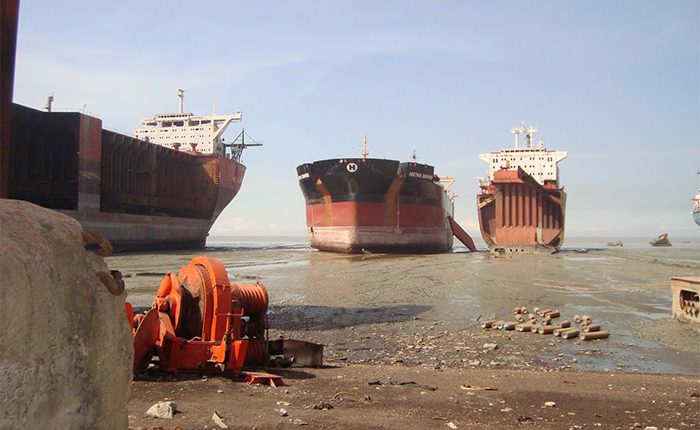
The European Union is banning the practice of dismantling old ships on beaches in South Asia. Last year alone, 641 tankers, cruise liners and other old vessels were rammed onto beaches in India, Bangladesh and Pakistan and stripped down by hundreds of unskilled workers, Reuters reports. Chemicals leak into the ocean when the tide comes in. It's estimated that about 470 workers have died in the past 20 years in accidents in Alang-Sosiya, the world’s largest stretch of ship-breaking beaches, in Gujarat.

General view of the Galloo ship recycling plant in Ghent from a French seismic vessel, February 25, 2015. (FRANCOIS LENOIR/REUTERS)
General view of the Galloo ship recycling plant in Ghent from a French seismic vessel, February 25, 2015. (FRANCOIS LENOIR/REUTERS)

Workers dismantle steel plates of a decommissioned ship at the Alang shipyard in the western Indian state of Gujarat, March 27, 2015. (AMIT DAVE/REUTERS)
A worker uses a cutting torch on a large block cut from a vessel at the Galloo ship recycling plant in Ghent March 23, 2015. (FRANCOIS LENOIR/REUTERS)

Workers pause as they dismantle parts of a French seismic vessel at the Galloo ship recycling plant in Ghent, March 24, 2015. (FRANCOIS LENOIR/REUTERS)

A worker dismantles a part of a decommissioned ship at the Alang shipyard in the western Indian state of Gujarat, March 27, 2015. (AMIT DAVE/REUTERS)

A crane is seen lifting a container near a French seismic vessel which is soon to be dismantled at the Galloo ship recycling plant in Ghent, March 23, 2015. (FRANCOIS LENOIR/REUTERS)

Workers carry a rope line to fasten a decommissioned ship at the Alang shipyard in the western Indian state of Gujarat, March 27, 2015. (AMIT DAVE/REUTERS)

A worker uses a cutting torch to dismantle the hull of a barge covered in barnacles near French navy vessels at the Galloo ship recycling plant in Ghent, March 24, 2015. (FRANCOIS LENOIR/REUTERS)

Source: the globe and mail. 31 March 2015

32 multinational companies say ‘no!’ to substandard shipbreaking practices:

Major companies such as H&M, Tetra Laval, ABB, Philips, Volvo and Volkswagen do not want to be associated with substandard shipbreaking practices in South Asia and have asked their forwarders – the shipping companies they use to transport their goods – to adopt sustainable ship recycling policies.

In January, the NGO Shipbreaking Platform published its annual list of global dumpers including 641 ships that were sold for substandard shipbreaking on the tidal beaches of India, Pakistan and Bangladesh. Several of these ships were owned by companies that the members of the Clean Shipping Network (CSN), a network of 32 multinationals, use to transport their products. MSC, Hanjin, MOL, Yang Ming, Conti, G Bulk and Danaos were some of the ship owners that last year made a deliberate choice to sell their end-of-life vessels to a substandard shipbreaking yard for the sake of higher profits – a choice of profits at the cost of people and the environment.

Report on ship recycling policy asked
CSN members have now reacted to this irresponsible practice with a statement condemning the breaking of ships on tidal beaches. In the statement, shipping companies mentioned on the Platform’s list of dumpers are asked to review their policies and practices regarding the selling and recycling of end-of-life vessels. The shipping companies are also asked to report on their ship recycling policy in the Clean Shipping Index questionnaire, a tool used by leading international cargo owners to evaluate the environmental performance of their providers of sea transports.

Eleven of the CSN members even went one step further by sending a letter directly to their business partners in the maritime industry stating that working with companies that do not deal responsibly with their end-of-life fleet is unacceptable for them. They warned that sustainable ship recycling is an issue they will consider when signing agreements with shipping companies, and stated that poor performance in the field of environment and social policies have consequences for their business decisions.

Raised awareness on impacts on environment
“We believe collaboration is a must to bring about systematic change to the sea transport industry. The Clean Shipping Network members use the procurement process to enhance sustainable development and to raise awareness on how the shipping industry impacts the environment”, says Sara Sköld, Director of the Clean Shipping Index.

With increasing pressure from also their customers, many ship owners will have to seriously consider revising their ship recycling practices. Currently thirteen large shipping companies follow sustainable ship recycling policies, including Royal Dutch Boskalis, Canadian CSL Group and Singapore-based China Navigation Company. More recently, German Hapag-Lloyd joined the group of ship owners that opt for ship recycling off the beach. They did so on principle, even if they have to compromise on their profits – just as the other progressive ship owners committed to the proper end-of-life management of their fleet, they simply do not want to be responsible for polluting sensitive coastal zones and putting workers lives at risk during dirty and dangerous shipbreaking on tidal beaches.

Source: Hellenic shipping news. 6 April 2015

Shippers weigh in opposing beach ship breaking:

Known examples of beneficial cargo owners declining to deal with or place conditions on an ocean carrier over environmental concerns are not easy to find.

But in a possible sign that environmental agendas may soon creep into ocean carrier contracting, 32 BCOs, as a group, signed a statement condemning beach ship breaking in India, Bangladesh and Pakistan. To add extra emphasis, 11 of the named BCOs sent individual letters to carriers expressing their opposition to the practice.


The 11 companies — H&M, Stora Enso, ​Tetra Pak, Perstorp, Scania, KappAhl, Lindex, NEC, New Wave Group, Preem and Absolut — wrote to shipping companies protesting beach ship breaking as hazardous to safety and the environment, according to the Clean Shipping Index. The index is a tool used by cargo owners to evaluate the environmental performance of their ocean transport providers.

The letters to carriers come as ship breakers in South Asia are under pressure on a few key fronts, including a coming European Union ban on beach ship breaking that would favor European, Turkish and Chinese ship breakers over beach breakers in South Asia, and pressure on steel prices tied to the economic slowdown in China.

Out of a total of 1,026 ships dismantled globally in 2014, 641 ships, or 74 percent of total gross tonnage scrapped, were sold to facilities in India, Pakistan and Bangladesh. In those countries, ships are dismantled on tidal beaches amid dangerous working conditions, allowing chemicals to leak into the ocean, according to the NGO Shipbreaking Platform, an advocacy group. India remained the world’s largest ship recycling nation last year, with 300 ships demolished, according to Tradewinds. Pictures of ship breaking on the beach can be seen here.

“South Asia is still the preferred dumping ground for most ship owners as environmental, safety and labour rights standards are poorly enforced there,” Patrizia Heidegger, executive director of the NGO Shipbreaking Platform, said in January. Shipowners have an incentive to send ships to the beaches because it’s more profitable. Depending on raw-material prices, ship owners can realize up to $500 per tonne of steel from an Indian yard, compared with $300 in China and just $150 in Europe, according to Reuters.

The 32 members of the Clean Shipping Index in a statement on March 18 said they “strongly condemn and distance themselves from such ship breaking practices.”

The new European rules aim to stop what Karmenu Vella, European commissioner for the Environment and Maritime Affairs, called "the shameful practice of European ships being dismantled on beaches,” as reported by Reuters on March 31. The European rules will mandate that EU-registered ships be recycled only at facilities deemed sustainable, a list of which expected to be published next year and will likely include facilities China, Turkey, North America and the European Union, but not South Asia where beach ship breaking occurs.

Haiderali G. Meghani, the director of International Steel Corporation, a large ship recycling firm based in Alang, India said concerns about poor safety and environmental standards in India were misplaced. "We are almost near to European standards," he said told Reuters.

“These ship breaking industries (on the beach) have put food on the table for many thousands of poor families and numerous communities have mushroomed in the vicinity of these ship breaking yards....which support their livelihoods,” Capt. Rabinder Singh, an India native and currently Singapore-based marine surveyor and consultant with Sukhpal Maritime Transport, told JOC.com.

Among the BCOs that reached out to carriers was the clothing retailer H&M. According to the company’s global logistics transport manager, Mats Samuelsson, “We want to use our scale to bring about systemic change to our industry and across our entire value chain. The biggest climate impact along the value chain occurs outside of our operations. This is why we work upstream with our transport providers alike to help them cut their climate impacts,” he said in a statement on the Clean Shipping Index website.

Although most BCO members of the Clean Shipping Index, didn’t send individual letters to shipping lines, they are still raising the issue with their carriers in different ways.

“Some have bilateral meetings and discussions with the concerned carriers and some deal with this in the procurement process – and others do a combination of this. Some have decided to use the letter from the network and create their own version of it,” Sara Sköld, director and environmental specialist, told JOC.com in an email.

One apparel company and Clean Shipping Network, Lindex, says on its website that 85 percent of its products are shipped by ocean freight and that the ocean mode "has the potential to work as a transportation with low environmental impact."

Still, publicly proclaiming support for an environmental objective and actually declining to use certain shipping companies or putting conditions on their performance that impact the commercial relationship are two different things. Chas Deller, a partner in 10XOCEANSOLUTIONS Inc., which advises shippers in contract negotiations, said he had never heard of actual decisions being made by BCOs based on carriers' response to their environmental-related questions on Requests for Proposals.

“Fact is, most carriers skip the actual questions in the RFP  and give their own " chapter and verse" answers in their own standard format,” said Deller, who who retired last year as head of global ocean freight procurement for UTi Worldwide in September after 39 years with the company, told JOC.com. “With the current alliance structure it's almost impossible for a BCO to control which carrier within the alliance will be ‘carrying’ your freight at any given time —very hard to enforce.”

If contracts between large retailer, manufacturing and other BCOs are to reflect environmental priorities such as ship breaking, they need to happen now, since most 2015-2016 contracts in the Asia-U.S. market take effect on May 1 and are currently being negotiated.

The NGO Shipbreaking Forum said the carriers that sent the most of the 641 “end of life” ships to the beaches in South Asia last year were German ship owner Ernst Komrowski, with 14 (all formerly on charter to Maersk Line), Hanjin, with 11 ships and Mediterranean Shipping Co. in third place with an unspecified number. It cited Maersk and Hapag-Lloyd, as having committed themselves to the recycling of vessels in modern facilities off the beach. A difficulty in accountability results from shipowners selling old ships to middlemen who in turn send them to the beaches.

A Hong Kong convention on ship recycling has the support of some container carriers, but has the disadvantage of not yet being ratified as opposed to the EU ban, which was adopted in December, 2013. "The Hong Kong Convention is the ideal standard for ship recycling and should not be undermined [by the EU SRR]," said Yang Ming chairman Frank Lu at the Tradewinds Ship Recycling Forum in Singapore on 11 March, as reported by IHS Maritime 360, a sister brand of JOC.com within IHS Maritime & Trade.

The Hong Kong convention is designed to ensure that ship recycling does not threaten human health, safety, and the environment, whereas the EU rule mandates that European-flagged ships are recycled in pre-approved yards, which doesn’t include beach facilities.

Source: JOC.com. 5 April 2015

EU to ban scrapping ships on South Asian beaches:

New rules to benefit European, Turkish and Chinese recyclers.

BRUSSELS — European, Turkish and Chinese recyclers are set to benefit from strict new EU rules on breaking up old ships, but the practice of dismantling them on beaches in South Asia — at great human and environmental cost — will still be hard to stop.

Of 1,026 ocean-going ships recycled in 2014, 641 were taken apart on beaches in India, Bangladesh and Pakistan, according to figures from the NGO Shipbreaking Platform, which campaigns for an end to the hazardous practice.

Tankers, cruise liners and other old vessels are rammed onto beaches and stripped down by hundreds of unskilled workers using simple tools such as blowtorches. Chemicals leak into the ocean when the tide comes in.

There is also a human cost: the Tata Institute of Social Sciences in Mumbai estimates that some 470 workers have died in the past 20 years in accidents in Alang-Sosiya, the world’s largest stretch of ship-breaking beaches, in Gujarat. Some 35,000 mostly migrant and unskilled workers operate there.

The new rules aim to stop what Karmenu Vella, European Commissioner for the Environment and Maritime Affairs, called “the shameful practice of European ships being dismantled on beaches”.

They will require that EU-registered ships be recycled only at sustainable facilities, and a list of these is expected to be published next year. It is likely to include yards in China, Turkey, North America and the European Union, but not South Asia. “The European list will split the market into a safe market and a substandard market,” said Patrizia Heidegger of Shipbreaking Platform.

It will be the first large-scale implementation of the International Maritime Organisation’s 2009 Hong Kong convention on ship recycling, which until now has only been ratified by three countries — Congo Republic, France and Norway.

The incentive to part with an old vessel at a South Asian facility is huge. Rules on disposing of asbestos, for example, are generally more lax, meaning the profits for breaking up a ship are higher.

Depending on raw-material prices, ship owners can make up to $500 per tonne of steel from an Indian yard, compared with $300 in China and just $150 in Europe.

To counter this, the European Commission is looking at ways to reward ship owners for recycling at approved facilities, although details are still to be decided.

Indian shipyard owners see the new rules as a ploy to fill empty yards in Europe. Fewer than four per cent of all retired ocean-going ships passed through European facilities in 2014.

Haiderali G. Meghani, director of International Steel Corporation, a large ship recycling firm based in Alang, said concerns about poor safety and environmental standards in India were misplaced. “We are almost near to European standards,” he said.

The European rules have one big loophole: owners can change a ship’s flag or sell it on to a third party outside Europe, who can then scrap it at a non-approved facility. But ship owners are likely to face harsh criticism if they resort to such practices under the new regime.

Source: khaleej times. 6 April 2015

06 April 2015

India's Alang will suffer if EU ship breaking law passed:

• New law will require that EU-registered ships be recycled only at sustainable facilities
• South Asian ship breakers unlikely to be included on list of approved facilities
• Shipyards in North America, Europe, China and Turkey to benefit

india alang will suffer if eu ship breaking law passed

BRUSSELS, EU - European, Turkish and Chinese ship breakers are set to benefit from strict new EU laws on scrapping old ships, potentially significantly impacting South Asian beach scrap yards.

Of 1,026 ocean-going ships scrapped in 2014, 641 were broken up on beaches in India, Bangladesh, and Pakistan, according to figures from the NGO Shipbreaking Platform.

Cargo ships and cruise liners that have reached the end of their useful life are driven at full speed onto beaches and stripped down by hundreds of unskilled workers using simple tools with little health and safety measures or environmental protections.

Chemicals routinely leak into the ocean when the tide comes in and there is a huge human cost, according to the Tata Institute of Social Sciences in Mumbai, which estimates that during the last 20 years 470 workers have been killed in Alang-Sosiya, the world's largest stretch of ship-breaking beaches.
Almost half of all scrapped ships are sent to the beaches of Alang, known as the graveyard of all ships.
Karmenu Vella, European Commissioner for the Environment and Maritime Affairs, says "the shameful practice of European ships being dismantled on beaches" will be ended with the introduction of the new law.

The measure will require that EU-registered ships be scrapped only at sustainable facilities with proven safeguards for the environment and its workers.

An approved list of ship breakers is expected to be published next year and is likely to include yards in China, Turkey, North America and the European Union, but not South Asia.

"The European list will split the market into a safe and substandard market," says Patrizia Heidegger of Shipbreaking Platform.

It will be the first large-scale implementation of the International Maritime Organization's 2009 Hong Kong convention on ship recycling, which until now has only been ratified by three countries: Congo Republic, France, and Norway.

The incentive of ship owners to sell their decommissioned vessels to South Asian ship breakers is huge, as their lenient rules for disposing of asbestos and other forms of waste make the profits for breaking up a ship higher.

The ship owner therefore gets a better scrap metal rate based on the tonnage of the vessel. For South Asian yards it can be a difference of almost 50%.

To counter this incentive, the European Commission is looking at ways to reward ship owners for recycling their vessels at approved facilities, although no details have been announced.

Indian shipyard owners saw the new rules are merely a ploy to fill empty yards in Europe because less than 4% of all scrapped ocean-going ships were broken up at European facilities in 2014.

European shipping groups such as Denmark's Maersk and Germany's Hapag-Lloyd have pre-emptively adopted policies to recycle only at facilities that meet international environmental standards.

Source: india gazette. 6 April 2015