07 July 2013

BAN: New EU ship recycling regulations are a breach of EU legal obligations

Seattle, Washington / Brussels, Belgium -- Basel Action Network (BAN), along with 160 organizations that comprise the NGO Shipbreaking Platform and the European Environmental Bureau, condemned the European Union’s newly adopted Regulation on ship recycling, deemed by many to contain illegal provisions that violate the 180 member Basel Convention. The Regulation was approved June 27th by a vote in the European Council, and was previously approved by the European Parliament and European Commission.

The new Ship Recycling Regulation removed end-of-life ships that contain hazardous materials from the scope of the European Waste Shipment Regulation, despite the fact that the Basel Convention requires strictly regulating these materials in order to prevent the indiscriminate dumping of toxic waste on developing countries. The Waste Shipment Regulation is the EU implementing legislation for the United Nations Basel Convention and Ban Amendment. This unilateral act by the EU would seemingly legalize EU dumping of hazardous waste (contained in ships) on developing countries, yet under the EU law, international treaties agreed to by the EU must always supercede EU or European national laws.

Council and Parliament disregarded warnings

There is clear and compelling legal opinion demonstrating that this unilateral move is a breach of EU legal obligations, as they are required to uphold the Basel Convention and Basel Ban Amendment. Both independent legal experts and the European Council Legal Services have warned of the illegality of the new Regulation, yet the Council and Parliament disregarded these warnings, taking a calculated risk that European Courts will not strike down the Regulation prior to its entry into force.

“What Europe has done is a slap in the face to developing countries everywhere”, said Jim Puckett, Executive Director of BAN. “Europe has a powerful shipping industry lobby, but we never expected the EU to make a unilateral and blatantly illegal departure from their international legal obligations just too allow toxic ship exports to continue.”

A legal dilemma

Under the Basel Convention, Basel Parties are not allowed to exempt themselves from Basel rules unilaterally. While the EU as a political integration organization now has a legal dilemma on its hands, so too does each EU Member State, which are also all independent Basel Parties that will have to reconcile the illegality of the EU’s unilateral action with their own national obligations to uphold the Basel Convention.

Proposed reforms eroded

The Regulation had great promise during early negotiations in the European Parliament to provide real solutions to the global shipbreaking crisis. But the European shipping industry slowly eroded proposed reforms. The legislation not only is out of compliance with the Basel Convention, but it also fails to provide for a producer responsibility fund, and thus failed to internalize costs. Even its one seeming contribution to human rights and the environment – prescribing against dismantling EU flagged ships on beaches, is easily avoided as a ship owner can simply reflag its ship to a non-EU flag of convenience prior to sending to the beaches in order to avoid falling under the new law. Sadly, the European Ship Recycling Regulation does nothing to improve the tragic shipbreaking crisis taking place on Asian shores, but actually makes matters worse as it seemingly legalizes EU dumping on developing countries, an act hitherto illegal in Europe.

Illegal traffic in hazardous waste promoted

“The new Ship Recycling Regulation, very cynically promotes illegal traffic in hazardous waste that would never be allowed for any other industry,” said Puckett. “We have a situation now in Europe where it is a criminal act to export on old computer to India but perfectly legal to export a toxic ship. It makes a shocking and shameful mockery of Europe's alleged concern for human rights and the environment.”

Source: recycling portal.

Ship Recycling Regulations agreed:

Members of the European Parliament and Council agreed on a new Ship Recycling Regulation last Thursday (27 June), which will require all end-of-life ships to be recycled in EU-approved facilities.

Under the present legislation, all European ships have to be recycled inside the Organisation for Economic Co-operation and Development (OECD), as they are classified as hazardous waste and therefore banned from export under the Waste Shipment Regulation.

However, the EC found that a lack of enforcement lead to around 70 per cent of European ships being sent for breaking on the beaches of Asian countries, such as Bangladesh and India, where metal prices are high and labour costs are low. Indeed, the EC said that the practice (a legal ‘grey area’) causes ‘significant environmental pollution at a high cost to human health’ and often involves the use of child labour.

The new regulation aims to crack down on this practice by implementing the rules of the 2009 Hong Kong Convention for the Safe and Environmentally Sound Recycling of Ships (yet to be ratified).

Specifically, the regulation:

•sets new standards for European ship recycling facilities;
•requires facilities that meet such standards to apply for inclusion in the European-approved list of ship recycling facilities;
•obliges EU-flagged ships to be recycled in these approved facilities; and
•enforces the requirement for EU-flagged ships to carry an on-board inventory of hazardous materials to enable safe dismantling.
The commission has said it will now look into further means to incentivise the use of higher-standard facilities, and will report on the possibilities for a fund for this purpose.

Speaking after the meeting, EC Environment Minister Janez Potocnik, said: "I welcome the outcome of the trilogue on the new Ship Recycling Regulation, which marks a major step towards more sustainable recycling of ships around the world.

“The new legislation will make it possible to legally recycle EU ships outside the OECD, but only in facilities that meet minimum [environmental] requirements. Ship owners will be able to choose such facilities from an EU list at a reasonable price. I am convinced it will reduce the illegal practices currently blighting the industry, which will become more responsible and environmentally friendly as a result. It will also lead to investment in improving facilities to meet the new demand for better standards."

Opposition

Despite the approval of the regulation, more than 160 green groups, including the NGO Shipbreaking Platform and the European Environmental Bureau (EEB) have denounced the new law as ‘effectively postponing and possibly ridding the EU with its responsibility to provide solutions to the global shipbreaking crisis’.

Specifically, the groups warn that the regulation does not go far enough in stopping the practice of ‘reflagging’, that is, illegally registering a ship as belonging to another country to circumvent domestic legal requirements, such as end-of-life disposal rules.

Indeed, the EEB has warned that the regulation may have the unintended effect of seeing the number of ships registered under an EU flag drop: “We fear that the regulation will end up applying to very few ships”, said Jeremy Wates, Secretary General of the EEB. “Unless an economic incentive for all ships calling at EU ports is rapidly introduced, circumvention of the law will persist, and the European shipping industry will continue to be at the heart of scandals involving severe pollution of coastal zones and exploitation of vulnerable workers in developing countries.”

Suggestions for this economic incentive include introducing a ‘polluter pays’ principle, where shipowners who pollute are fined, thus promoting proper practice. However, in April, the European Parliament rejected proposals to create a ship recycling levy, despite pressure from the Environment Committee (ENVI) and environmentalists. 

However, MEPs did call on the European Commission to propose plans for an ‘incentive-based system that would facilitate safe and sound ship recycling’ before the end of 2015.

Patrizia Heidegger, Director of Shipbreaking Platform, noted that there are “clear and compelling legal opinions proving that this unilateral exemption of ships [from the Waste Shipment Regulation] is a breach of the European Union’s legal obligations to uphold the Basel Convention and its Basel Ban Amendment”, adding that the European Council Legal Services had itself warned of the illegality of the new regulation.

“Not only do the EU institutions create a legal dilemma for themselves, but also for all of the 27 European member states that are parties to the Basel Convention. All will have to reconcile the illegality of unilaterally acting in non-compliance with their international obligations”, said Heidegger.

As part of a move to highlight the widespread practice of illegal shipbreaking, Shipbreaking Platform has now launched a website that lists shipping companies that have ‘commercially benefitted’ from selling end-of-life vessels for breaking on the beaches of India, Bangladesh and Pakistan.

Speaking of the website, Heidegger said: “The fight for environmental justice in the shipping industry is far from over. When political leadership fails us, it is time to pressure the marketplace by shaming substandard practices and directing customers to the green ship recyclers.”

Source: By Annie Reece.  02 July 2013
http://www.resource.uk.com/article/Waste_Law/Ship_Recycling_Regulations_agreed-3282

Germanischer Lloyd (GL) Introduces New Software Solution for EU Ship Recycling Compliance:

A new software solution has been developed by Germanischer Lloyd (GL) to streamline compliance with the newly adopted European Union regulation on ship recycling. The IHM Green Server (IGS) is a web-based application which aids in the preparation and the maintenance of a vessel’s Inventory of Hazardous Materials (IHM). The tool supports shipowners with all of the IHM related aspects of both the EU regulation and the Hong Kong International Convention for the Safe and Environmentally Sound Recycling of Ships.


The new EU regulation will see a number of measures introduced to ensure that vessels are sustainably and responsibly recycled at the end of their lifecycle. The primary requirements of the regulation for ship owners, which is scheduled to enter into force at the end of the year, are the establishment of an IHM for all EU flagged ships and for all vessels which call at ports within the EU. The regulation is also intended to promote the ratification of the Hong Kong Convention as a global solution to the environmental impact of ship breaking.

With the new tool the entire volume of ship component data, which are required to be maintained and updated through its entire lifetime, can be comprehensively gathered and processed. From the central web based data repository all of the various parties who need access and are involved in the process of preparation, certification and maintenance of IHM data, such as shipowners, shipyards, suppliers, hazmat experts, class societies and recyclers, can, using the IGS, work in parallel on the same platform. This ensures that the IHM process is transparent, not only to the regulators but to the ship owners, ship yards, and recycler. It gives a real-time overview of individual vessels and the entire fleet under management, while allowing for the smart and efficient management of all the required documentation, e.g. Material Declarations, Supplier Declarations of Conformity and IHM Documents.

Gerhard Aulbert, GL’s Head of Global Practice Ship Recycling, said: “This new legislation from the EU has the potential to initiate a change that will take ship recycling standards to the next level, and sets a global benchmark for the ship recycling industry. We have developed the IGS as a smart tool for generating documents which comply with the regulations in the most transparent and easy manner possible. It facilitates communication between the various parties and will support owners in maintaining high quality ships and a clean working environment on board, while also enabling ship recycling facilities to benefit from comprehensive IHMs for preparing to recycle vessels and monitoring of hazardous materials on board of ships.”

Source: marine insight. 2 July 2013
http://www.marineinsight.com/shipping-news/gl-ihm-green-server-smoothes-eu-ship-recycling-compliance/

06 July 2013

Four workers die at Gadani shipbreaking yard in two days:

Four workers met accidental deaths at the Gadani shipbreaking yard in two days (June 30-July 1) owing to the absence of any first aid and medical facility there, The News learnt on Wednesday.

Sarzameen slipped from a ship’s deck and fell to death in the tank while working at plot numbers 23 and 24.

On June 30, a gas cylinder exploded with a huge bang at another ship at plot number 32 while being dismantled, which claimed the life of a worker, Naseebzada, and left two others, Ashraf Lohar and Fayyaz, seriously injured. Both the injured workers expired last Monday (July 1) at a private hospital in Karachi.

According to their colleagues, the explosion was so powerful that it hurled Naseebzada off the ship into the sea from where his body was recovered.

President Ship Breaking Mazdoor Union Bashir Mahmoodani has told this correspondent that around 15,000 workers earn their livelihood at the Gadani shipbreaking yard in harsh conditions. He says no safety equipment is available to the workers of this industry.

There is only one ambulance at the entire yard, which consists of 130 plots owned by around 40 people.

The Gadani yard has no first aid facility and in case of any incident the victims have to be taken to the Rahman Hospital in Banaras, Karachi, 50 kilometres from the yard. The ambulance charges Rs2,500 for taking casualties to the hospital.

Mahmoodani says that while dismantling a ship, workers have no knowledge about which stuff they are working on. “The labourers usually have no idea whether they are working on a tank that contains some poisonous gas, petrol or some other dangerous chemical. These are the reasons why many accidents occur at the yard and claim the lives of several workers or leave them disabled.”

He says the authorities concerned have turned a blind eye on these violations of labour rules and regulations.

Mahmoodani says only eight to 10 workers are registered with the Employees Old-age Benefits Institution (EOBI) at a plot out of a total of 400 workers engaged at the entire yard.

The deputy general secretary of the National Trade Union Federation, Nasir Mansoor, says the ship-breaking industry happens to be a huge source of revenue generation for the government but at the same time it needs specific legislation for the welfare of workers on the pattern of that for mineworkers.

He says that generally each ship carries a toxic chemical asbestos that prevents eruption of fire, but during the dismantling of a ship this chemical sometime penetrates into the lungs of labourers and could not be removed, which subsequently causes the death of affected workers.

Nasir says enacting proper legislation would help ensure taking precautionary measures to avoid the toxic effects of such chemicals on labourers as well as keeping the environment free of pollution.

Source: The News. 5 July 2013

New EU Ship Recycling Law Not Fit for Purpose Say NGOs:

A new law which the EU claim will clamp down on end-of-life ships being broken for recycling on beaches in India, Pakistan and Bangladesh, has been slammed by environmental NGOs as doomed to failure and contradictory to Basal Convention.

The EU is to introduce controversial new legislation that will make it possible to legally recycle EU ships outside the OECD, but only in facilities that meet minimum environmentally requirements, according to The European Environment Commissioner, Janez Potočnik.

“Ship owners will be able to choose such facilities from an EU list at a reasonable price. I am convinced it will reduce the illegal practices currently blighting the industry, which will become more responsible and environmentally friendly as a result,” commented Potočnik.

The Commissioner added that the new law will also lead to investment in improving facilities to meet the new demand for better standards.

Broken system

Under the present legislation, all European ships have to be recycled inside the OECD, as they are classified as hazardous waste and therefore banned from export under the Waste Shipment Regulation.

However, the ban has been ineffective and regularly circumvented in practice as ships are highly mobile even when they reach the end of their commercial life.

Further hampering the goal has been the lack of recycling capacity in the OECD and attractive prices for scrap metal in Asia which has meant that they are simply reflagged.

As a result, most European ships are dismantled in Asia in poor facilities, causing significant environmental pollution at a high cost to human health. The use of child labour was also regularly documented.

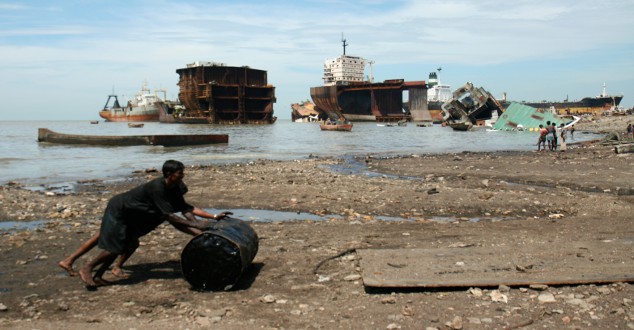
In 2012, 70% of all end-of-life ships were broken in Bangladesh, Pakistan and India on tidal beaches whose soft sands cannot support crucial safety measures such as heavy lifting or emergency response equipment and which allow pollution to seep directly into the delicate coastal zone environment.

New regulation

According to the Commission the new regulation implements the rules of the 2009 Hong Kong Convention for the safe and Environmentally Sound Recycling of Ships.

The Regulation aims to improve ship recycling conditions for EU-flagged ships worldwide by prompting the upgrade of ship recycling facilities to the standards included in the Regulation. This is done by providing a number of requirements to be met by ship recycling facilities which want to recycle EU-flagged ships.

Facilities meeting such requirements will be able to apply for inclusion in the European List of ship recycling facilities, and if they are satisfactory, they will receive a green light to recycle European vessels.

In addition, ships will have to carry on board an inventory of hazardous materials which will enable the recycling facilities to dismantle them safely. According to the Commission this will advance the practical implementation of the standards of the Hong Kong Convention in anticipation of its entry into force.

The Commission will look into further means to incentivise the use of higher standard facilities, and is invited in the proposal to report on the possibilities for a fund for this purpose.


70% of all end-of-life ships were broken in Bangladesh, Pakistan and India on tidal beaches whose soft sands cannot support crucial safety measures such as heavy lifting or emergency response equipment and which allow pollution to seep directly into the delicate coastal zone environment. Image Credit: YPSA 2009
 
Controversy

The new regulations have not been universally welcomed however. The NGO Shipbreaking Platform and European Environmental Bureau (EEB), which represents over 160 environmental, human and labour rights organisations, have both denounced the measures as doomed to failure.

According to the NGOs European shipping interests will continue to make significant financial profits by externalizing environmental and human health costs to the shipbreaking beaches of Bangladesh, India and Pakistan, and to the exploited workforce there.

The organisations claimed that while the regulation may direct a very limited scope of ships registered under an EU flag to ‘green’ listed ship recycling facilities, does nothing to prevent ship owners from jumping register to a non-EU flag prior to sending their ships for breaking in order to avoid falling under the requirements of the new EU law.

In fact, said the NGOs, the regulation may even have the unintended effect of shrinking the number of ships registered under an EU flag, and therefore making the Regulation counterproductive to other EU initiatives aimed at building a more robust EU fleet.

However, the organisations did welcome the fact that the Council accepted the European Parliament’s proposal to bind all ships calling at EU ports to have an inventory of hazardous materials (IHM) that are contained within the vessels’ structure - prerequisite for clean and safe ship recycling.

Scope

The scope of the regulation is limited to EU flagged vessels only, which the NGOs point out represents less than 10% of the vessels sent for breaking.

Already, most European owned vessels broken on the beaches of South Asia are registered under non-EU flags such as Panama, Liberia and the Bahamas.

According to the NGOs, just as ship owners circumvent the current export prohibition under the European Waste Shipment Regulation by not declaring their intent to dispose the vessel whilst at a European port, it is very likely that more ship owners will circumvent the new EU rules by simply flagging out to non-EU flags at end-of-life, so that they avoid extra costs of using safe and environmentally sound ship recycling facilities.

“We fear that the Regulation will end up applying to very few ships,” commented Jeremy Wates, secretary general of the EEB.

“Unless an economic incentive for all ships calling at EU ports is rapidly introduced, circumvention of the law will persist, and the European shipping industry will continue to be at the heart of scandals involving severe pollution of coastal zones and exploitation of vulnerable workers in developing countries,” he warned.

Patrizia Heidegger, director of the NGO Shipbreaking Platform added: “We are concerned that the shortcomings of the Regulation will make it ineffective and worse still, that the EU could be setting a dangerous precedent for other industries that want to avoid being held accountable to international environmental laws.”


The shipping industry was said to have already pledged years ago to equip vessels with such an IHM, yet most ships go for breaking with an unknown amount of hazardous materials on board. Image Credit: YPSA 2009
 
Contradiction

According to a statement by the NGOs, the ship recycling regulation exempts ships from the European Waste Shipment Regulation, which is intended to protect developing countries from the dumping of hazardous wastes, and incorporates the United Nations Basel Convention and its Basel Ban Amendment.

The organisations warned that there are clear and compelling legal opinions proving that this unilateral exemption of ships is a breach of the European Union’s legal obligations to uphold the Basel Convention and its Basel Ban Amendment.

Independent environmental law specialists, Ludwig KRÄMER were also said to have warned of the illegality of the new regulation, as were the European Council Legal Services.

“Not only do the EU institutions create a legal dilemma for themselves, but also for all of the 27 European Member States that are Parties to the Basel Convention. All will have to reconcile the illegality of unilaterally acting in non-compliance with their international obligations,” cautioned Heidegger.

Alternatives

Recent studies have proposed an array of possible mechanisms to implement the polluter pays principle, which would focus on the ship owner, and according to the NGOs have clearly shown that a financial incentive for proper ship recycling is legally feasible, enforceable, and necessary.

The Shipbreaking Platform said that while the EU has failed to provide effective solutions to remedy the global shipbreaking crisis, it is moving ahead with a market based solution in an effort to hold the industry accountable.

The organisation recently launched its data-driven website which lists shipping companies that have commercially benefited from selling their end-of-life vessels for breaking on the beaches of India, Bangladesh and Pakistan.

The aim of the campaign is to forge partnerships with industry leaders - recycling, shipping, cargo owners, etc. - to promote clean and safe ship recycling and to avoid business dealings with companies that continue to opt for beach breaking operations.

“The fight for environmental justice in the shipping industry is far from over,” asserted Heidegger. “When political leadership fails us, it is time to pressure the marketplace by shaming substandard practices and directing customers to the green ship recyclers.”

Source: waste-management-world By Ben Messenger. 4 July 2013