Showing posts with label ship demolition. Show all posts

15 March 2012

Growing ship demolition signals freight market improvement:

“Market to upturn from H2 this year” – Woori Investment

The rapid increases in ship demolition now raise expectations to improve the freight market. 

You, Jae-Hoon, senior researcher of Woori Investment & Securities, said on Mar. 9, “The sustainable demolition of aged ships would accelerate the improved tonnage supply and demand in the shipping market,” predicting that “in consideration of their backlog order volume on hand, Korea’s Big 3 shipbuilding players are expected to receive some speculative orders starting in H2, 2012.” 

According to researcher You, the global ship demolition in 2011 recorded 39.5 million dwt, up 54.5% on 2010. The latest demolition figures over the past three months are more surprising. The demolished tonnage amount during the last three months posted 4.2m-dwt, which is a whopping 54.1% increase on a monthly average demolition of 2.7m dwt during 2009-2001. In particular, last Feb. alone saw the demolition of 5.3m dwt, a monthly record-high, since May 2003 when it recorded the ever highest demolition of 5.6m dwt. 

Mr. You ascribed the latest increase in ship demolition to “the international oil price hike and the steady firm demolition price,” arguing that “the demolition demand for aged vessels which are suffering higher fuel cost increases in line with the prices of steel scrap and demolition steadily staying firm while the demolition of aged ships is growing at the current shipping doldrums.” 

By vessel type, boxships have been demolished at a monthly rate of 19,690-teu over the last three months, which is a jump of 129.9% on the monthly demolition average of 8,566-teu posted during 2010-2011. Tankers further recorded the monthly average demolition of 1.54m dwt over last three months, up 63.3% from the monthly demolition average of 0.9401m dwt during the last two years. The bulker tonnage scrapping which had turned decreasing since H2 last year has lately changed to increasing. 

According to Clarkson Research Intelligence, ship demolition for this year is expected to reach 54.1m d wt. Researcher You foresaw that the ongoing explosive increase in ship demolition will relieve tonnage surplus starting in 2014. As the timing for tonnage expansion required is expected to come starting in 2015, some speculative orders are expected to be placed from H2 this year at the earliest, he said. Newbuilding prices have fallen lowest since the global financial crisis and Korea’s Big three shipbuilding players capable of constructing eco-friendly ships are expected to see their backlog orders on hand start dropping rapidly from this year. In this circumstance they can look forward to securing fresh orders. 

Tonnage replacement demand based on the growing ship demolition is expected to greatly rise in the wake of euro-zone finance ministers’ talks held on last Feb. 21 in which they had discussed the issue of imposing carbon tax. Mr. You estimated that “since the greenhouse gas restriction initiated by IMO is on the table of euro-zone authorities, the timing of enforcement for the regulations of carbon tax or emission trading system (ETS) may come earlier.” 

Those aged vessels over 20 years will create replacement demand for 99 boxships of 3,000 to 6,000-teu each and for 53 tankers of 100,000 to 300,000-dwt class each. Researcher You predicted, “Tonnage replacement demand on a basis of very large eco-friendly vessels is expected to generate fresh newbuilding orders worth US$ 15 billion which are likely to be gradually secured starting in H2 this year.” 

Source: The Maritime Press. By Paul Yoon. 12 March 2012
http://eng.maritimepress.com/news/articleView.html?idxno=1037

22 February 2012

Top 10 countries for sending ships for breaking in 2011:

According to data from the NGO the top 10 countries sending ships for demolition in 2011 are:-
  1. Greece (100 ships)
  2. Norway (24 ships)
  3. UK (13 ships)
  4. The Netherlands (12  ships)
  5. Germany (11 ships)
  6. Italy (9 ships)
  7. Cyprus, Switzerland (5 ships each )
  8. Bulgaria, Denmark, Romania (4 ships each)
  9. Latvia, Lithuania, Poland, Spain, Sweden (3 ships each)
  10. Belgium, Finland, Ireland, Slovenia (1 ship each)
While Panama flagged vessels come top of the list, with Liberia in second and Bahamas and St. Kits and Nevis joint third.

Source: Mersey Shipping. 13 February 2012
http://merseyshipping.blogspot.com/2012/02/top-10-countries-for-sending-ships-for.html

28 January 2012

Demolition activity needs to increase significantly this year as well:

The oversupply of vessels in most shipping sectors is so intense that it’s become clear to ship owners that unless they scrap as many of their older ships as possible, freight rates are expected to remain at break-even lows or even worse. This has become particularly evident in the dry bulk shipping market, where the industry’s benchmark, the Baltic Dry Index has dropped yesterday to just 753 points, down 3.95% on the day and more than 60% since late last year.

Meanwhile, in the demolition market, as Golden Destiny mentions in its latest weekly report, “Bangladesh scrapping ban has been finally lifted, but the government has imposed a new 5% tax on purchasing vessels for scrap that is going to influence scrap buyers appetite on stronger purchases. The Bangladesh Shipbreaking Association is pushing for a reduction in the rate, down to 0.5% that could lead scrap prices to fall by as much as $25/ldt. Scrap prices for dry and wet cargo are close to $500/ldt, but the current freight market environment offers a strong incentive for shipowners to move with overaged vessel disposals and ease the pain of oversupply. India offers the best levels with Bangladesh to follow, $460-$470/ldt for dry and $480-$490/ldt for wet cargo.

The week ended with 17 vessels reported to have been headed to the scrap yards of total deadweight 1,009,630 tons. In terms of the reported number of transactions, the demolition activity has been marked with a 23% week-on-week decline, due to 30% lower volume of demolition transactions in the bulk carrier segment, whereas there has been a 28% increase regarding the total deadweight sent for scrap. In terms of scrap rates, the highest scrap rate has been achieved this week in the tanker segment by India for M/T “BOW PROSPER” with 12,200/ldt at $525/ldt. India has attracted 41% of the total demolition activity with China to follow by winning 5 disposals. At a similar week in 2011, demolition activity was up by 18% from the current levels, in terms of the reported number of transactions, 20 vessels had been reported for scrap of total deadweight 669,529 tons with bulk carriers and tankers grasping 60% of the total number of vessels sent for disposal. India and Pakistan had been offering $465-$475/ldt for dry and $500-$505/ldt for wet cargo, while Bangladesh market had been inactive from the demolition scene” concluded Golden Destiny.

In a separate report, Clarkson Hellas said that the demolition market has remained very active, with many vessels being circulated and subsequently, a big list of sales to report. “However, to judge the market value of a certain ship is becoming increasingly difficult. As evidenced in the sales list, price levels seem like a ‘free for all’ with no actual pattern emerging, clearly highlighting that each vessels value is an individual case by case scenario. On paper, some units seem similar, yet for some reason, a price differential of anything upto USD 10/ldt can be witnessed.

Source: Hellenic Shipping News Worldwide.  27 January 2012

26 January 2012

Stunning photos of ship demolition…


Artistic photography sheds new light on ship dismantling.


Demolition – in its various guises – can be described in many ways; but it is unusual to hear the words demolition and beautiful in the same sentence.


However, thanks to some truly stunning photography by Guillaume Plisson, that could be set to change.


Plisson has produced a truly stunning array of black and white images that capture the demolition and dismantling of the TK Bremens cargo ship.


You can view the full set of photos by clicking the link below……


Source: Demolition News. 24 January 2012
http://www.demolitionnews.com/2012/01/24/stunning-photos-of-ship-demolition/

18 January 2012

Jaguar on fast track for scrap:

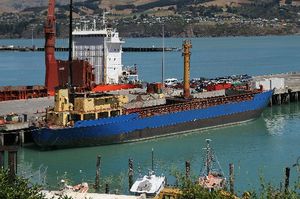
The Jaguar, its bridge, hatch covers, & derricks already gone, will be reduced to scrap metal this month. 
A ship is being scrapped at Lyttelton for the first time in a project that may lead to more demolition work at the port.

The 26-year-old coaster Jaguar, which was brought to New Zealand in 2009 by Black Robin Freighters to serve the Chatham Islands from Timaru, will be put into dry dock next week where it will be cut up into about 450 tonnes of scrap metal.

Lyttelton engineering firm Stark Bros, better known for building and repairing boats and ships, is undertaking the project.

"We are not aware of a ship that has gone into the dry dock and not come out before," said CEO Andrew Stark.

"If it works out OK, there are other ships within New Zealand that we could work on, too - but certainly not the Rena!"

Starks have been stripping out the Jaguar since October and equipment including windows, vents, electric motors, winches, compressors, water maker, and oily water separator have been removed.

The ship's Callesen diesel engine was lifted out yesterday to be sold complete or for parts.

"Anything we can sell or think might be able to be sold, we've hung on to," said Mr Stark.

It might not be as dramatic as the Rena or the Costa Concordia, but there is a sad tale behind the fate of the 63m long Jaguar, completed in 1985 at a Danish shipyard.

Black Robin bought the ship late in 2008 and took it over at Cartagena, Colombia, but a pre-purchase survey of the ship made at Colon had overlooked many deficiencies, and the company was faced with costly and uneconomic repairs.

To complicate the situation further, Black Robin went into receivership on the heels of its finance company South Canterbury Finance.

Starks were a major creditor and held a possessory lien after making repairs to the ship, and eventually bought it last year from the receiver for just $1.

Mr Stark said his company was just hoping to break even on the cost of demolishing the ship.

"If it is debt zero, it will be considered to be a relatively successful project."

It might lead to follow-up work, he said. It was not environmentally sound to tow out to sea and sink vessels like this, and if this project went well and was completed efficiently and safely, it might lead to more deconstruction work at the port even though the cost was high because of environmental and safety standards.

"There are not a lot of positives about what's happened with the Jaguar, but we are trying to turn it into a positive," he said. "We are doing something that hasn't been done at Lyttelton before, and we hope we can do it again."

In dock the ship will be cut up over 10 to 14 days into two to four tonne pieces, which will then go to Sockburn company Metalcorp NZ to be further reduced.

Source: The Star, Canterbury. By Nick Tolerton. 18 January 2012
http://www.starcanterbury.co.nz/news/170112cstgslyttel-ton-jpg-jpg-the-jaguar-its-bridg/1241571/

18 November 2011

Port Executive Admits To Commercial Bribery Charges

TRENTONA maintenance director at Maher Terminals in Union County admitted his role in soliciting and accepting bribes to award contracts for demolition and construction projects at a container ship terminal facility, U.S. Attorney Paul J. Fishman announced Wednesday.

Donald Olesky, 54, of Sayreville, pleaded guilty to 2 counts of using, and causing to be used, the mail in aid of an unlawful activity, specifically commercial bribery under New Jersey law. Olesky entered his guilty plea before U.S. District Judge Freda L. Wolfson in Trenton federal court on Nov. 16.

According to documents filed in this case and statements in court: Olesky served as the director of facility maintenance at Maher Terminals at Port Elizabeth. From 2000 through February 2007, Olesky solicited and accepted in excess of $50,000 in kickbacks from a demolition contractor in exchange for Olesky’s assistance in steering and awarding demolition contracts at Maher Terminals’ facility.

In January and February 2007, Olesky accepted a $22,000 kickback from the demolition contractor for a contract that Olesky steered to that

Tell everyone to get New Jersey News from WWW.NJTODAY.NET contractor in June 2006. From 2000 through Jan. 7, 2011, Olesky solicited and accepted in excess of $50,000 in kickbacks from a general contractor in exchange for Olesky’s assistance in steering and awarding construction contracts at Maher Terminals’ facility. From November 2010 through January 2011, Olesky accepted $13,500 in kickbacks from the general contractor related to a construction contract that Olesky steered to that contractor in July 2009.

The 2 counts to which Olesky pleaded guilty each carry a maximum potential penalty of five years in prison and fine of $250,000 or twice the gross amount of any gain that Olesky derived from the offenses. He is scheduled to be sentenced on May 11, 2012.
Fishman credited special agents of the FBI’s Trenton Field Office, under the direction of Special Agent in Charge Michael B. Ward, for the investigation leading to the guilty plea.

Source: NJ Today. 17 November 2011
http://njtoday.net/2011/11/17/port-executive-admits-to-commercial-bribery-charges/

12 November 2011

Demolition prices could fall, on lower steel prices:

Ship owners could soon have to rush to scrapyards across the Indian subcontinent or other countries, in order to achieve better prices for the sale of their older vessels for scrap. 

In what could trigger more sales of ships for demolition and in that way, help lower tonnage oversupply, a major issue across all shipping segments, CRWeber noted, in a recent analysis that average demolition values in China and the Indian subcontinent have come under pressure lately, with “$/LDT values posting a 7.3% decline since mid‐October. Although global steel prices have gained 4.8% since January, prices have shed 13.9% since reaching a YTD high in March. Given the price discount for steel reclaimed via tanker demolitions in locations with cheap labor relative to global steel prices, demolition values have been less impacted than global steel prices; average China and Indian subcontinent $/LDT values have only lost 2.5% since March.

Several global steel production facilities are reportedly idling production as the European sovereign debt crisis continues to stoke uncertainty in global markets. Accordingly, the gap between global steel price indices and demolition values could narrow, mitigating greater further $/ldt losses Despite a more limited pricing gap, even minor $/ldt losses may present fresh downside risk for tanker markets as the recent progression to newer, double hull tanker demolition sales remain one of several key factors to alleviating overcapacity in the sector” said CRWeber in its report.

It went on to mention, that double hull tanker tonnage accounted for 78.1% of the total tanker tonnage demolished, a figure significantly higher than the average of just 18% during the 1st 3 quarters. “Over the past 2 weeks, however, demolition sales activity has declined markedly, with just one unit reported as sold to such buyers”, concluded CRWeber.

Meanwhile, in the crude freight market, there have been significant changes in the MEG VLCC front, during the past few days, says shipbroker Fearnleys. In its latest weekly report, the shipbroker said that “with more than 130 VLCC fixtures already registered for November loading in the MEG and with additional cargoes still making their appearance, owners are clearly feeling more optimistic and are more confident in their efforts to lift rates further. Charterers, on the other hand, are faced with a thinner selection of tonnage and a more confrontational attitude from owners. Under the circumstances, we deem it likely that MEG VLCC rates could rise somewhat above present levels. We would also advise a careful monitoring of an eventual early start to the December loading programme. The availability of VLCC tonnage in the Atlantic remains slim, but this has so far had little impact on rates due to the relative stability of the Suezmax market in the area. Suezmax activity was stable in WAF and rates have remained at last week´s levels. In the Med/Bsea Suezmax rates were rather flat and could experience further downward pressure as a result of diminishing delays in the Turkish straits which are already at nominal levels. Rates for Aframaxes trading from the Nsea to the Continent remained unchanged from last week at ws100. In the Med and in the Caribs, however, Aframax rates experienced a slight decline as a result of more than sufficient available tonnage for the requirements in play” concluded Fearnleys.

In its analysis of the tanker market during the third quarter, Teekay Tankers said that “crude tanker rates weakened significantly during the 3rd quarter of 2011, primarily due to an oversupply of vessels relative to demand. In addition, a number of isolated and seasonal factors exerted downward pressure on rates during the quarter. The decision by International Energy Agency (IEA) member countries to release 60 million barrels (mb) of oil from government stockpiles impeded tanker demand during the quarter, particularly in the United States where 30 mb of crude oil was released from reserves. In Europe, the ongoing absence of Libyan oil exports as well as oilfield maintenance and unplanned outages in the North Sea further weighed down on crude tanker demand. Tanker rates have remained generally weak in the early part of the fourth quarter to date, though rates in the Mediterranean and Black Sea spiked significantly in October as a result of an increase in transit delays through the Turkish Straits due to stricter regulations on the passage of vessels during non-daylight hours.

The tanker fleet grew by 20.0 million deadweight tonnes (mdwt), or 4.4%, in the first 3 quarters of 2011 compared to a net increase of 14.5 mdwt, or 3.4%, in the same period last year. The level of new tanker ordering remains very low with just 6.4 mdwt of tanker orders placed in 2011 to date, of which 2.0 mdwt was attributed to shuttle tankers, compared to 40.0 mdwt of tanker orders in 2010, of which 0.7 mdwt was attributed to shuttle tankers. As a result, the global tanker order book has fallen to 96 mdwt, the lowest level since March 2006. Expressed as a percentage of the active tanker fleet, the order book is at its lowest level since February 2003 at 20% of the total fleet” concluded Teekay.

Source: Hellenic Shipping News Worldwide. By Nikos Roussanoglou. 11 November 2011
http://www.hellenicshippingnews.com/index.php?option=com_content&view=article&id=57383:demolition-prices-could-fall-on-lower-steel-prices-&catid=1&Itemid=61

02 November 2011

From Single To Double Hull Demolition:

The latest spike in the Aframax/Suezmax markets prompted by the temporary tightening of the Turkish Straits transit rules shows how quickly freight rates can rise from bust to boom and then ease back again. The industry has witnessed a number of similar spikes this year, both in crude and product tanker markets. However, putting aside this inherent volatility, returns so far in 2011 for all vessel sizes above MRs have been extremely poor, with the VLCC market particularly hard hit.

The rapid fleet growth over recent years combined with the ‘loss’ of around 4 million b/d oil demand because of the 2008/09 global recession has led to this situation. However, there has been a lack of new orders for products tankers since the recession started and we are now at the position where fleet expansion for products tankers will be limited over the next few years. Hence the prospects in this sector look more promising. In contrast, there is still a sizeable orderbook for VLCC/Suezmax tonnage and this is a major concern for owners. The anticipated removal of the remaining single hull tankers is unlikely to have any meaningful impact in reducing this oversupply as there are relatively few left and they have virtually no role in the spot market.

Given this, the only  way  the  VLCC/Suezmax  market will get to the same promising position as for products is if demand rises more sharply than forecast or if tanker supply is lower. With any upgrade in forecast demand highly unlikely, it is therefore down to supply. This can come about if not all the current orderbook gets built or if a significant amount of older double hull tonnage is demolished. The cancellation of new orders is an unknown, but we have already seen some double hull vessels being sent to the scrapyard. 

However, so far this has focused on MRs and Aframax and not in the Suezmax and VLCC sectors, where owners need it most. In fact, in the last 2 years only 1 double hull VLCC and 4 double-hull Suezmax have been scrapped, compared with 67 MR/Panamax/Aframax.


There are currently very few double hull VLCC/Suezmax tankers over 20 years old, but there is a combined 139 (14% of the fleet) more than 15 years old. Although historically this has been  considered  as  ‘too young’ to be sent to  the  scrapyard,  it may be  that  low earnings coupled with fairly robust scrap prices are the ‘right’ conditions for a more speedy removal of older and/or the least efficient crude tankers. Whether this is a strong enough trigger for owners to scrap is questionable, but other factors may also come in to play, such as legislation on ballast water treatment.

If these measures are ratified then there will be the requirement for owners to invest in on-board treatment plants. The economics of this at a time of weak earnings may well be enough to push VLCC and Suezmax owners down the scrapping route. Either way, the demolition of older double hull tankers will be one good (and possibly necessary) way to help VLCC and Suezmax owners reverse their fortunes.

Source: GIBSON Tanker Report (www.eagibson.co.uk). 28 October 2011

25 October 2011

Shipbreaking intensifies on low freight rates, higher scrap prices:

NEW YORK (Scrap Monster): More dry bulk ships are destined for demolition and end up in scrap yards for recycling due to a combination of low freight rates, high fuel costs and high prices being offered by shipbreakers to owners.

The demolition of dry bulk ships has already reached record level in deadweight tonnage terms, according a report by Platts. As of October 14, 300 dry bulk carriers, aggregating 19.6 million dwt, had been sold for scrap so far this year, beating by 160% the previous record of 12.2 million dwt set in the whole of 1986, Frangou Angeliki, chairman and CEO of Navios Maritime Partners told analysts on a conference call to discuss the company's third-quarter result, Platts report added.

Meanwhile, the rise in demolition activity has raised concern about the export of hazardous wastes such as asbestos, PCBs, residue oils and heavy metals from developed nations to developing nations. Legal experts and NGOs that attended the 10th Conference of the Parties to the Basel Covention at Cartagena in Colombia voiced the voiced the concern that the IMO’s Hong Kong Convention will not stop hazardous wastes from being exported to the poorest communities and most desperate workers in developing counties. The Hong Kong Convention, which was adopted in 2009, but has not yet been ratified by a single country, has no intention of minimizing the movement of toxic ships to developing countries.

Currently the 1989 Basel Convention is the only legal instrument on transboundary movements of waste, and the only legal tool developing countries can successfully use to stop toxic ships from entering their territorial waters.

The developing countries who wanted the Basel Convention to be in force was supported by the Basel Action Network and the NGO Shipbreaking Platform, a global coalition of labor rights and environmental organizations dedicated to promoting safe and environmentally sound ship recycling and preventing toxic ships from disproportionately burdening developing countries. "The Hong Kong Convention is radically different from the Basel Convention as it puts the costs and liabilities of waste management on the importing state and not the polluter – who in this case is the ship owner", said Ingvild Jenssen, Director of the NGO Shipbreaking Platform.

"The Hong Kong Convention does not even prohibit the dangerous beaching method, a substandard method of ship dismantling whereby ships are broken up on tidal beaches by untrained and unprotected workers, causing severe pollution, injuries and deaths." "The Basel Convention clearly considers that illegal traffic of hazardous waste is a criminal activity. The Hong Kong Convention, however, does not require the criminalization of illegal transfer of hazardous waste", added Dr. Marcos Orellana from the Centre of International Environmental Law (CIEL)

Last year 5.8 million dwt of dry bulk tonnage was sold for scrap, representing just 1.3% of the global fleet. The number of dry bulk carriers sold for demolition so far this year represented 3.65% of the global dry bulk carrier fleet. George Achniotis, senior vice president of business development at Navios Maritime, said an average of 1.2% of the world fleet was committed for demolition each year in the period 2000-2010, inclusive.

Of the 300 dry bulk carriers sold for demolition this year, 64 were Capesize bulkers. At the current level of demolition, Achniotis said, the industry is set to commit 24.9 million dwt of dry bulk tonnage for demolition in the whole of 2011, representing 4.7% of the existing global dry bulk fleet, Platts report added.

Source: Scrap Monster. 25 October 2011
http://www.scrapmonster.com/news/ship-breaking-intensifies-on-low-freight-rates-higher-scrap-prices/1/3538

24 October 2011

Demolition of dry bulk ships hitting new records: Navios execs

Demolition of dry bulk ships has reached record levels in deadweight tonnage terms due to a combination of low freight rates, high fuel costs and high prices being offered by ship breakers to owners, executives with a major listed dry bulk shipowner said Monday.

As of October 14, 300 dry bulk carriers, aggregating 19.6 million dwt, had been sold for scrap so far this year, beating by 160% the previous record of 12.2 million dwt set in the whole of 1986, Frangou Angeliki, chairman and CEO of Navios Maritime Partners told analysts on a conference call to discuss the company's third-quarter results.

The number of dry bulk carriers sold for demolition so far this year represented 3.65% of the global dry bulk carrier fleet, she said.

Last year 5.8 million dwt of dry bulk tonnage was sold for scrap, representing just 1.3% of the global fleet.

George Achniotis, senior vice president of business development at Navios Maritime, said an average of 1.2% of the world fleet was committed for demolition each year in the period 2000-2010, inclusive.

Of the 300 dry bulk carriers sold for demolition this year, 64 were Capesize bulkers, but gave no comparison for prior years, he said.

At the current level of demolition, Achniotis said, the industry is set to commit 24.9 million dwt of dry bulk tonnage for demolition in the whole of 2011, representing 4.7% of the existing global dry bulk fleet.

The ongoing problem of delayed deliveries of new ships from ship builders was continuing this year, with around 31% slippage from the schedule so far in 2011 as of the end of September, he said.

Last year, the size of the global fleet swelled to 536.4 million dwt, up from 459.2 million dwt, Achniotis said. During 2011, the rate of slippage from scheduled deliveries from the yards amounted to 38%.

For 2011, while the amount of new ships entering the market was likely to exceed that for 2010, he said, "the rate of slippage and taking the volume of scrapping so far this year, the net fleet growth may not be as large as seen in 2010."

Around 11.4% of the global dry bulk fleet was over 20 years of age, of which 11.4% is more than 25 years, "which gives scrapping potential for another 106 million dwt," Achniotis said. HIGH INCENTIVE FOR SCRAPPING

Achniotis said the incentive for owners of such ships to scrap, because of low freight rates and the current price levels being offered to shipowners by demolition yards would yield an owner approximately $11 million-$12 million for a Capesize, which was the equivalent to around 30% of the secondhand value of a five-year-old Capesize bulk carrier.

Navios is a major carrier of iron ore, coal and grain, owning and operating 6 Capesize dry bulkers, nine Panamaxes and one Supramax. According to a slide presentation at the analysts' call, Navios Maritime lists Constellation Energy, Rio Tinto, ArcelorMittal and Vitol from the world of metals, mining and energy among its top 15 customers.

The shipowner derived 7.5% of its revenues in Q3 from Constellation Energy, 5.7% from Rio Tinto, 1.09% from ArcelorMittal and 1.3% from Vitol. Its biggest customer was STX Pan Ocean, one of the world's largest vessel owner/operators and carrier of iron ore and coal in its own right, and accounting for 13.2% of Navios Maritime's revenues.

Earlier Monday, the company reported a sharp increase in 3rd-quarter revenues, helped by the effects of operating a larger fleet, but flat income, caused largely by a lower fleet utilization rate.

In the 3 months to September 30, revenues rose to $48 million from $38 million in the corresponding 2010 period, but net income only grew to $16.6 million from $16.3 million a year earlier.

The company said the increase in revenue was largely attributable to operating a fleet with two additional ships in Q3 2011 compared with Q3 2010.

Navios reported fleet utilization in Q3 2011 of only 90.8% compared with 99.9% in Q3 2010. It did not specify what caused the lower utilization rate, other than attributing it to "unspecified off-hires." This cost the company $3.8 million in the quarter, it said.

Lower freight rates resulted in reduced time charter equivalent earnings of $28,992/day per ship in Q3 2011, down from $29,978/day per ship in Q3 2010.

In the first 9 months of the year, revenues rose sharply to $136.5 million from $100.7 million in the corresponding 2010 period. Net income rose to $46.7 million from $42.1 million.

Source: Platts. By Anthony Poole (anthony_poole@platts.com). 24 October 2011
http://www.platts.com/RSSFeedDetailedNews/RSSFeed/Metals/6610809

18 October 2011

Ship demolition prices falling:

According to the Baltic Exchange, the average scrap prices of bulk carriers delivered in China have plunged to $450 per LTD, the 3rd consecutive week of decline. These prices tend to have a positive correlation with the iron ore price, as they both reflect the supply versus demand of the ferrous market.

The iron ore spot price in China began to fall at nearly the same time as the scrap prices. Based on its swap curves, the iron ore price has likely entered a downtrend channel, which implies that scrap prices may drop further.

In September of this year, there were 35 bulk carriers scrapped, amounting to around 2 million deadweight tonnes, lower than the 2.4 million deadweight tonnes in August.

In light of the falling demolition prices, owners’ incentives to scrap vessels may likely be dampened. Combined with the continuously strong pace of new building deliveries, it is possible that the recovery of the dry bulk freight market in short term is cloudy.

Source: Hellenic Shipping News (Sourced from ICAP Shipping). 17 October 2011