21 May 2013

Hundreds wave goodbye to HMS Ark Royal

The aircraft carrier, which was formally decommissioned in 2011, is being taken to Turkey where it will be dismantled by ship recycling firm Leyal.

People lined the harbour walls at Portsmouth, Hampshire, to catch a final glimpse of the warship as it left its home base.

A flotilla of small boats sailed with the Ark Royal as it was pulled by tug boats from the harbour. The tugs sounded their horns which echoed off the harbour walls as the crowds, some waving flags, stood in silence as the huge ship sailed past.

Hundreds gathered to say farewell to HMS Ark Royal as she began her final voyage to the scrap yard from Portsmouth this afternoon.

Among those who turned out was former crew member John Mayer. The 47-year-old former stores assistant from Fareham said: "It's a very emotional day, it's great to see so many people.

"People in Portsmouth always turn up to these things, it shows how much pride people have in her."

He added: "I was one of the first people to serve on board the Ark Royal after she was built. I was 17/18 at the time and it was quite emotional then. She was a fantastic, iconic ship."

On the decision to scrap it, he added: "I thought it was awful, I think she should have been turned into a museum, it would have been fantastic."

Local resident Barrie Anderson, 70, said: "It's a very sad day."

The 22,000 tonne carrier was sold as part of a £2.9 million deal following the 2010 strategic defence review which led to the ship facing the axe five years early and the Harrier jets being sold for spares to the USA.

The decision to scrap the Ark Royal has left the UK without a fully-functioning aircraft carrier for a total of nearly 10 years until the next generation of carriers come into service.

A Royal Navy spokesman said: "Ark Royal, like her sister ships, served this country with great distinction.

"Retiring her five years earlier than planned was a difficult decision but it was the right one that, combined with her sale, has saved over a hundred million pounds.

"A decommissioning ceremony was held in March 2011 to pay tribute to her 31 years' service with the Royal Navy."

Alternative plans for the Ark Royal, including turning it into a diving wreck, a floating casino off Hong Kong, a heliport for London and a nightclub and school in China were rejected by the Ministry of Defence as "not feasible or appropriate".

The Ark Royal was named by the Queen Mother and entered service in 1981.

It served in the Bosnian war and also sailed to the Persian Gulf for the invasion of Iraq in 2003 and was given a hero's welcome when it returned to Portsmouth.

Source: telegraph. 20 May 2013

16 May 2013

San Of Aliaga

Located in a crescent-shaped bay some 60 kilometers north of Izmir, Aliaga (pronounced “Aliag”) is an incongruous fusion of holiday spot and industrial center, home to beach houses and seafood restaurants as well as huge oil refineries, steel plants, and, feeding the latter, a busy scrapyard. Shipbreaking began at Aliaga in the early 1970s and through its portals vanished classics like Turkish Maritime Line’s ANKARA (ex IROQUOIS), KARADENIZ and ISKENDERUN; Chandris Line’s REGINA PRIMA (ex ANCON); Typaldos’ ATHINAI (ex SANTA ROSA); Epirotiki’s burnt-out PALLAS ATHENA (ex FLANDRE) and PEGASUS; STEFAN (ex MAASDAM, STEFAN BATORY); ALICE (ex CITY OF EXETER, MEDITERRANEAN SEA) and even the Great Lakes streamline ferry AQUARAMA, to name just a few. Hundreds of ferries, ro/ros, tankers, bulk carriers, lakers, coasters and tugboats have also been recycled on its pebble-strewn beach.
On the road to Aliaga

There was no more appropriate way to make my first pilgrimage to a place I had only seen in photos than with the man who took those dramatic images. Izmir-based Selim San has visited Aliaga once a week, almost without exception, for decades. The 60-year old has a childlike fancy for ships of all shapes and size, especially classic liners, tugs and tankers.


San, who also photographs working ships (including the one that brought me to Izmir that morning, the MSC DIVINA), lives in an apartment overlooking Izmir Bay. His dramatic images are regularly posted at Shipspotting.com and on a number of European websites as well as being voraciously shared by Facebook and Twitter fans.


Gesturing between turns and indicating occasional points of interest, he cautioned that our visit could get complicated as several shipbreakers were feuding. But then he laughed that others may welcome us just to spite the ones who did not want us in their realm. “We will know…when we get there!”

As a soundtrack of 1980s pop and electronic music chimed on and the rolling greenery and rocky outcrops of the Turkish coastline unfolded before us, we exchanged ship-related stories. Much has transpired since our only prior meeting in 1998 while I was visiting Kusadasi aboard then-Orient Line’s MARCO POLO.

Aliaga approach:  “Welcome to the ship recycling yards.”
We turned off the main highway (which goes as far as Canakkale in the Dardanelles) and drove past a pair of huge oil refineries. Lifeboats, skiffs and machinery carefully gathered along the road portended what lay ahead. Anticipating heavy security, I began to stow my cameras, but Selim assured me that was not necessary. We did not need permits to take photos — our mission was at the mercy of the individual shipbreakers and not a bureaucratic maritime board with a police force. If one breaker told us no, the one next door could tell us yes, so with dozens of yards to choose from, some degree of success was assured in the hours that lay ahead.

As soon as we reached the promontory overlooking Aliaga, I was startled to see an unexpected but very familiar vessel. The sleek, still sparkling 1971-built VENUS lay with a sharp starboard list among a motley collection of coasters, tankers, trawlers and navy ships. With previously announced plans for her return to summer cruise service on a Turkish charter, it was shocking to see that elegant Knud E. Hansen-designed form awaiting the cutting torch. VENUS was originally NCL’s pioneering SOUTHWARD, a handsome 17,000 gt Italian-built vessel that went on to second and tertiary careers as Airtours SEAWING and Louis Cruises PERLA. For me, it was especially sobering that a ship that was so much on the cutting wave of cruising when I first became interested in in the subject was now at the end of her career. I had taken her familiar profile for granted in a number of places over the years, from Los Angeles to Piraeus, Limassol and Istanbul.
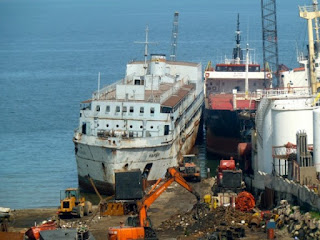
Ukrainian barracks ship.
My original intent in visiting Aliaga was to see the PACIFIC, the famed “Love Boat” PACIFIC PRINCESS, which after an unfinished and botched refit, was laying at a shipyard in Genoa and reportedly sold for scrap. Two Aliaga-based breakers had laid claim to the ship but both were unable to complete their purchase and the PACIFIC was still in Genoa tied up in red tape at the time this report was published in mid-May. Instead, her onetime competitor, the equally sleek VENUS, had taken her place.

Right next to VENUS were the final bits of keel of the 1969-built COSTA ALLEGRA (ex AXEL JOHNSON), which was converted from a container ship into a Costa Line cruise ship in 1992. After an otherwise successful career, the ALLEGRA made headlines for breaking down in the Indian Ocean in February 2012.  Eventually towed back to Italy, the disgraced ship was stripped and sold for scrapping in September, arriving at Aliaga on October 24 under the name SANTA CRUISE. A pile of her debris filled a nearby plot, waiting to be recycled and the battered steel and glass dome that once towered over her atrium was lying next to her tortured keel.


Other interesting ships were the 1964-built ferry AZZURA (ex GRENAA, KALLE, OLAU WEST, CORSICA MARINA, etc), one of many similar Scandinavian ferries topped with domed funnel-like superstructures and twin uptakes that would ultimately morph into an entire generation of cruise ships, including the nearby VENUS/SOUTHWARD.  Mimicking a passenger ship of sorts, an engineless Ukrainian barracks ship that once housed submarine crews had also just arrived.

Throughout the day, workers cheerfully but curiously greeted Selim, who usually came to Aliaga on Wednesdays but who made an exception to accommodate my one and only Tuesday visit.

As the morning progressed, we visited several offices where the breakers proudly showed off impressive collections of navigation equipment, builder’s plates and even artwork from ships they demolished. In one, I recognized chairs from the onetime Ellerman liner CITY OF EXETER, which ended her days at Aliaga under the name ALICE in 1998.

As the morning progressed, we visited several offices where the breakers proudly showed off impressive collections of navigation equipment, builder’s plates and even artwork from ships they demolished. In one, I recognized chairs from the onetime Ellerman liner CITY OF EXETER, which ended her days at Aliaga under the name ALICE in 1998.


Our attempt to get up-close footage of the AZZURRA was curtailed due to a nearby winching operation. We watched from behind a dismembered bulbous bow as giant spools of machinery puffed clouds of diesel and taught cables strained to drag a half demolished ro/ro ship closer up the embankment.

Our next stop yielded more success as we walked to the water’s edge under the port bow of the VENUS. Above us, a crane hoisted workers onto the ship’s fo’c’sle to begin removing fittings. Although Selim assured we’d get even closer later in the afternoon when the sunlight was on the starboard side, we both took plenty of footage, just in case…

In one office, we were made to feel especially welcome. As we sipped potent Turkish coffee, I noticed Selim’s photos of the lovely old ATHINAI and HELLAS on the wall. Our host, Mr. Ozer, was one of Aliaga’s first generation of breakers and these two historic former liners were among the ships he recycled.

The ATHINAI was designed by William Francis Gibbs as the SANTA ROSA, the first in a quartet of luxurious ships commissioned for Grace Line. The 1932-built ship was the first to sport Gibbs’ trademark SAMPAN funnel (just the forward one) which were fitted to a number of liners that would follow, including the AMERICA, UNITED STATES and the SANTA ROSA of 1958. She became Typaldos Line’s ATHINAI in 1958 and was laid up near Piraeus 1968 when that company folded. ATHINAI was renamed TITANIC to serve as a set for the 1980 film Raise The Titanic before returning to layup and ultimately being sold for scrap.

Mr. Ozer shared that when the erstwhile TITANIC arrived at his yard in 1989, her public rooms were battered and covered in green foam to make them appear as though they were under water for decades.

However, some of the former suites were still intact and he was able to salvage a number of walnut dressers, including one that was directly to my left. Before we left, Mr. Ozer presented me with an autographed copy of his book on shipbreaking.

At another office, there was a gold colored panel that had just been removed from the VENUS. Like other artifacts in the room, it was not for sale. I photographed a wall full of photos Selim took of ships that were demolished at that same plot. Moments later, Selim told me the breaker, who maintained a very calm demeanor, wanted us to stop taking photos and “get out”.

The neighboring breaker, who lost a fortune on his deposit for PACIFIC a year before, welcomed us warmly and encouraged us to take photos of his nemesis‘ ship, the very same VENUS, now bathed in the dramatic afternoon light.

We left the breaker’s beach and headed back to the main highway to visit several dealers of shipboard furnishing and equipment. Unlike the roadside marketplace in Alang with its hundreds of lots filled with fittings, Aliaga has just a few dealers. I didn’t find much of interest but was impressed with one friendly dealer who salvaged the wheelhouse from a ro/ro ship and reassembled it with all equipment, including a still functioning Furuno radar, intact.

It was a fascinating day and I felt privileged to have finally witnessed Aliaga with Selim. There was much to compare and contrast with the larger, far more challenging Alang, which I have visited on eight occasions.

Aliaga Aftermath: Two days after our visit, the ANTIC, which was built as Sitmar Cruises FAIRSKY in 1984, was beached at Aliaga. Selim returned on several subsequent Wednesdays and shared some images for this report.

Source: maritime matters. 02 April 2013

Company: Astoria shipbreaking really recycling:

ASTORIA, Ore. (AP) — A partner in a company that wants to dismantle ships at Astoria argues that the practice isn't "shipbreaking" but rather recycling.

The Daily Astorian reports (http://bit.ly/10GXFYv) that Frank Allen of Blue Ocean Environmental spoke Tuesday at a packed meeting of the Port of Astoria Commission.

Allen says vessels are being disposed of without environmental protections, and there are 300 derelict vessels in Oregon and 400 in Washington polluting the environment as they deteriorate.

He says the operation proposed at the Tongue Point facility would start small, with one vessel to show it can be done. He says the facility could eventually handle 50 vessels a year.

Previous shipbreaking proposals in Oregon, including one at Tongue Point, have been run into opposition over fears about hazardous materials being released.

Source: sfgate. 15 May 2013
http://www.sfgate.com/news/science/article/Astoria-shipbreaking-called-be-recycling-4519640.php

Shipbreaking is ‘recycling,’ Port is told:

Company promises jobs, predicts up to 50 vessels a year
“What we’re proposing is not shipbreaking,” said Frank Allen, a partner with Scott Fraser in Blue Ocean Environmental, standing at the front of a packed Port of Astoria Commission meeting Tuesday night.

During a presentation, he talked as much to the audience as he did the Port commissioners.

The abnormally large crowd gathered in anticipation of Blue Ocean’s proposal for recycling the metal from derelict vessels at the Port’s North Tongue Point facility. Several previous applications for shipbreaking on the Columbia River have been rejected in recent years because of widespread fears that toxic materials would pollute fragile salmon areas.

The Port and Blue Ocean had a nondisclosure agreement that was recently lifted.

“I have a job,” said Allen, adding that he works in the international seafood trade. “This is just something that bothers me.”

According to ORS 783.400, shipbreaking means the process of dismantling a ship for scrap or disposal. India breaks the most ships as a country, with the coastal city of Alang a worldwide center for the practice. More than 1,000 ships were recycled last year, according to German news outlet Der Spiegel Online.

There are 300 derelict vessels in Oregon and 400 in Washington deteriorating and polluting the environment, said Allen. Thousands are being disposed of without any environmental concerns, he said.

He said the two options with this issue are to be proactive or do nothing.

“There’s a lot of hurdles to doing this right,” said Allen, who offered to rent a space in Astoria for multiple town halls to discuss how his company wants to recycle vessels. “The true thing is to do this very slowly, very carefully.”

His operation would start with a small, 60- to 70-foot vessel at North Tongue Point. Blue Ocean would bring in specialists to remove the toxic substances, recycle the metal and ship it by barge to Seattle. Steel firm Nucor Corporation (www.nucor .com) will take it for what Allen said would currently be about $19 a ton and reprocess it for use in the U.S.

“We’re working directly under the EPA,” said Allen, adding that the operation’s primary environmental monitor reporting to the state would be the Maul Foster & Alongi engineering firm of Portland. The U.S. Coast Guard would also be involved in permitting Blue Ocean to tow any vessels in.

“We’re doing it to prove a point: that it can be done,” said Allen, adding that it’s going to build up over a number of years and not be a moneymaker to start. He asked for a chance to try the process on a small, possibly local vessel, after which Blue Ocean, the Port and the public could go over the results and decide whether to keep Blue Ocean around.

“The good thing for the community about this … it’s so labor intensive,” said Allen. “It takes so much manpower to get this done. And they’re not minimum-wage jobs.”

Starting with workers from New York to get the operation going and train others, he said he’s looked into training opportunities with Clatsop Community College.

If given a chance, said Allen, people wouldn’t be surprised by the start of the operation. He’d have to go to the city and then the state. “To do it right, it’s got to be methodical and slow and long-term.”

“There’s got to be some way to clean these vessels up,” said Commissioner Bill Hunsinger, adding that he’d like to have a public workshop on the business. “If something like that works here, why wouldn’t we try it to a certain extent?”

Commissioner Floyd Holcom said the four previous proposals were run out of town to look for other locations. “The Daily Astorian is immediately out there kicking you out of town. That’s why we don’t have a lot of jobs.”

He said 90 percent of people probably have no idea what he’s talking about, or that some shipwrecks from Portland were recycled through a former Tongue Point tenant at East West Construction. He added that Blue Ocean should have a chance at its proposal.

In response to questions from union representatives, Allen said he’d be open to negotiating with them for employment. There will not be much monetary support from the government,

“I’d like to see the Port with you … have a really good lease that protects the Port,” said Lori Durheim, adding that she would like affidavits between Ocean Blue and the regulatory agencies involved.

Along with a willingness to give three or four public presentations, Allen said he’ll look into creating an email account specifically for people with questions about his proposal and will provide information to the public that isn’t proprietary. Blue Ocean doesn’t currently have a web site.

“Years down the road, we’d like to work on larger vessels,” said Allen, adding that he sees Tongue Point being able to handle 50 vessels a year at full capacity. “Someone’s got to address this. It can’t keep going the way it’s going.”

Source: dailyastorian. By EDWARD STRATTON. 15 May 2013
http://www.dailyastorian.com/free/shipbreaking-is-recycling-port-is-told/article_c6991d94-bd7e-11e2-bbeb-0019bb2963f4.html

15 May 2013

Galicia allocates EUR 9.5 million for high sea ship scrapping

Spain: The Ministry of Rural and Marine Affairs of the Xunta de Galicia will deliver aid for EUR 9.5 million for scrapping Galician offshore vessels throughout this year.

This amount is similar to that provided in 2012, when it amounted to EUR 9.9 million.

Fishing vessels scrapping. (Photo: Magma)
According to the resolution published in the Official Journal of Galicia (DOG), it will be possible to be eligible for subsidies for those boats that are registered in the community that are over 10 years old.

The vessels will have to have a minimum fishing activity of 90 fishing days in each of the two 12-month periods preceding the application date for the permanent cessation or 120 fishing days during the 12 months preceding the presentation date of the application for a permanent cessation.

The fishermen of the Gran Sol fleet from A Coruña claim that they are undergoing a "bad situation," so they have chosen to stop their activity.

Anyway, maritime workers admit they have "very little chance," since one of the criteria for access to subsidies is the old age of the ship, reports La Opinión.

Only half of the fleet from A Coruña that operates in EU fishing grounds is over 10 years old.

The aids are funded by the European Fisheries Fund (EFF), -- 75 per cent -, and the Member State – 25 per cent.

The order mentions the restrictions imposed for not renewing the fisheries agreement between the European Union (EU) and third countries. This is the case of the Galician cephalopod vessels that were expelled from Mauritania last year, which start with an "advantage" of 26 points to qualify for the aids.

The Shipowners’ Association from A Coruña (Arpesco) estimates that "many of them will ask for aids" and will be more likely to get them, since they are old "enough" to do so.

On the other hand, out of the six boats belonging to Arpesco, only three are over 10 years old. And for the rest, it seems to be that having invested in updating them has not been a good decision, the president of the organization regrets.

Source: 14 May 2013