26 October 2017

First Bangladeshi ship recycling yard gains international certification

First Bangladeshi ship recycling yard gains international certification

International Maritime Organisation Secretary General Kitack Lim lauded the PHP yard as a role model for others in the country

PHP Family Ship Recycling Yard in Chittagong has received a Statement of Compliance with the Hong Kong International Convention for the Safe and Environmentally Sound Recycling of Ships, from international classification society Registro Italiano Navale (RINA).

The yard is the first to achieve Hong Kong Convention compliance certification in Bangladesh, according to a report published by the Maritime Executive on Monday.

International Maritime Organization (IMO) Secretary General Kitack Lim, during his visit earlier this year, lauded the yard as a role model for others in the country.

GMS, one of the major cash buyers in this sector, lauded the achievement as an important development towards a more sustainable ship recycling industry, further raising the bar in the standards for this sector in Bangladesh.

“PHP Family yard has worked hard to improve their safety and environmental standards by following successfully the Hong Kong Convention guidelines, which are enabling the whole ship recycling industry to achieve sustainable goals for ship recycling,” Dr Anil Sharma, President and CEO of GMS said in a statement.

The Hong Kong Convention, adopted in 2009, includes regulations for shipowners, recycling facilities, flag states and recycling states to ensure that end-of-life ships do not pose any unnecessary risks to human health, safety and the environment when being recycled.

The European Union adopted the EU Ship Recycling Regulation in 2013.
The European Commission published its first edition of the EU list in 2016. The next edition of the list, expected to include yards outside Europe, is expected to be published by the end of 2017.

In the neighbouring country India, 41 yards have received Statements of Compliance with the Hong Kong Convention (seven from ClassNK, 30 from RINA and four from IRQS), as of August, 2017.

Source: Dhaka tribune. 24 October 2017

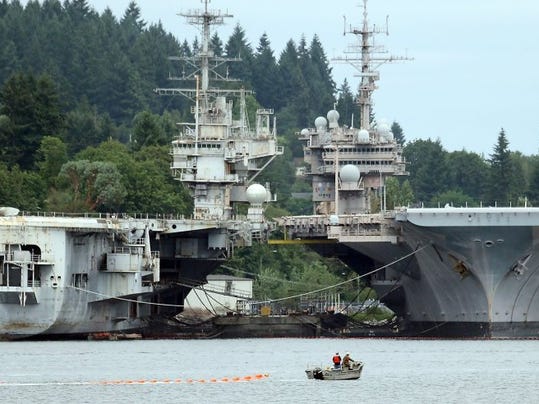
Former USS Kitty Hawk to be disposed of by dismantling

B0016179929--192602.JPG

The fate of the former USS Kitty Hawk — a part of Bremerton's iconic waterfront of mothballed ships for more than eight years — has been determined.

The Kitty Hawk (CV 63) will be disposed of by dismantling, according to Naval Sea Systems Command spokeswoman Colleen O'Rourke.

O'Rourke cited an annual report to Congress that outlines the Navy's five-year shipbuilding plans. In this fiscal year's edition, released in April 2016, the Kitty Hawk was listed as one of the Navy's inactive ships slated for scrapping.

The Navy has not yet determined when the Kitty Hawk will depart its berthing in Bremerton, where the ship will go to be dismantled or what company will be awarded the contract, O'Rourke said.

Previous aircraft carriers berthed at Puget Sound Naval Shipyard, including the USS Independence (CV 62), USS Ranger (CV 61) and USS Constellation (CV 64) were sent to Brownsville, Texas, for scrapping.

The Kitty Hawk was decommissioned at PSNS in 2009 after 48 years of active service. The ship has been held in reserve status at the Inactive Ship Maintenance Facility in Bremerton ever since.

During the ship's active service, the Kitty Hawk participated in combat operations in Southeast Asia during the Vietnam War and in the Arabian Sea during Operation Enduring Freedom and Operation Iraqi Freedom. The Kitty Hawk was the fleet's only permanently forward-deployed carrier in Yokosuka, Japan, from 1998 to 2008.

The Kitty Hawk was the last conventionally powered aircraft carrier in active service in the fleet. There are currently 10 nuclear-powered Nimitz-class carriers and one Ford-class carrier in active service, with construction on two more Ford-class carriers in progress.

Then-Secretary of the Navy Donald Winter sent a letter to Congress in 2008 expressing his intent to hold the Kitty Hawk in reserve status until the USS Gerald R. Ford's commissioning, O'Rourke said. The Ford (CVN 78), the first and namesake of the newest class of nuclear-powered aircraft carriers, was commissioned on July 22. The Naval Vessel Register currently lists the Kitty Hawk as out of commission, in reserve, but it has not been updated since September 2015, two years before the Ford's commissioning.

Over the years, speculation on the Kitty Hawk's fate has ranged from recommissioning the ship back into active service to turning the ship into a museum.

The Navy's 2016 force structure assessment called for increasing the active service fleet size from between 270 to 290 ships up to 355 ships, including increasing the number of active service aircraft carriers from 11 to 12.

Although the Navy had once considered the possibility of recommissioning the Kitty Hawk to increase the size of the fleet, Secretary of the Navy Richard Spencer said that would be cost prohibitive in a recent interview with the Kitsap Sun.

"The business case for the Kitty Hawk would be a fairly big stretch," Spencer said.

O'Rourke said the Kitty Hawk was not selected for possible museum donation and the Navy will not be accepting applications for such a donation, despite numerous groups who have expressed interest in preserving the ship as a museum.

The USS John F. Kennedy (CV 67), a variation of the Kitty Hawk-class carriers, was the last conventionally powered aircraft carrier built. It was decommissioned in 2007 and is currently berthed at the Inactive Ship Maintenance Facility in Philadelphia. Unlike the Kitty Hawk, the carrier is currently eligible for donation as a museum.

Source: kitsapsun. 24 October 2017

23 October 2017

Bangladesh top buyer of scrapped ships

Bangladesh was the top buyer of scrapped ships in the world in the third quarter of 2017, followed by India, according to a study of Brussels-based Shipbreaking Platform.

During the period, 50 scrapped ships were brought to Bangladesh and 44 to India, making South Asia the most preferred destination for scrapping old vessels, which is a hazardous practice for human health and environment.
A total of 227 ships were broken between the months of July and September, 124 of which ended up on the beaches in South Asia, according to the organisation which is a coalition of environmental, human and labour rights organisations.

Greek ship owners sold 11 ships to the beaching yards this quarter, which is the highest, followed by South Korea and Singapore at 6 vessels each. Shipping companies from the US sold 5 vessels.

Singaporean Continental Shipping Line remains the worst corporate dumper, though it currently shares this position with the Greek Anangel Shipping Enterprises and Iran Shipping Lines.

In total, the companies had three vessels each beached in South Asia this quarter.

Bermuda-based Berge Bulk, Greek Costamare, Swedish Holy House Shipping and American SEACOR are close runners-up, with two ships each sold for dirty and dangerous scrapping on the beach.

Brazilian-owned product tanker LOBATO, which was reportedly sold by Petrobras to Indian breakers, ended up on the muddy shores of Chittagong instead, the report said.

Although 33 out of the 124 beached vessels this quarter were European-controlled, only three of these had a European flag when they arrived on the beach.
“All ships sold to the beaching yards pass via the hands of scrap-dealers, also known as cash-buyers, that often re-register and re-flag the vessel on its last voyage,” said the report.

In this regard, flags of convenience, in particular those that are grey- and black-listed, are used by cash-buyers to send ships to the worst breaking locations.

“Almost half of the ships sold to South Asia this quarter changed flag to the grey- and black-listed registries of Comoros, Niue, Palau, St. Kitts & Nevis, and Togo just weeks before hitting the beach.”

The flags are not typically used during the operational life of ships and offer “last voyage registration” discounts.

It is not due to a lack of awareness concerning the dire working conditions that the international ship owners continue to favour in the infamous beaching yards in South Asia, the Shipbreaking Platform said.

“Rather, it is the fact that dirty and dangerous breaking brings in more money.”

There is little or no investment in proper infrastructure to contain pollutants and ensure safe working conditions.

The proper disposal of hazardous wastes is overlooked and the migrant workers exploited, said the Brussels-based organisations.

Moreover, the prices offered for ships this quarter have been high in South Asia, especially when compared to the figures of the first half of the year.
Monsoon rains caused a shortage of local products being available to the domestic steel mills and have, therefore, driven up prices for end-of-life ships, the report added.

Source: hellenic shipping news. 23 October 2017

Ship demolition activity grinds to a halt

The rebound of dry bulk freight rates, as well as ships’ values has resulted in the halt of demolition sales, triggering fresh concerns regarding the long term viability of the market’s rebound. In its latest weekly report, GMS, the world’s leading cash buyer of ships said that “a shocking collapse in price and sentiments over the last few weeks resulted in a grinding halt to a lot of the offerings / ongoing negotiations with end Buyers in the various subcontinent locations this week. Most sub-continent recyclers are entering the dreaded wait and-watch mode to see where prices are headed, before committing themselves on new units”.


GMS added that “depending on which report you rely on, prices have declined anywhere between USD 30/LDT to about USD 50/LDT since the peak seen during August / September. Much of this can be attributed to the fact that local steel plate prices have been rather volatile, resulting in recycled material not moving quick enough from local yards. This has in turn left Recyclers increasingly reluctant to take in new inventory. In China, the Communist Party Conference has seen a halt to virtually all ship recycling activity and the lack of any meaningful negotiations and acquisitions is having a knock on effect throughout the Indian sub-continent and Turkish markets. As local steel plate prices cooled (significantly) over the last few weeks and currencies (in both Turkey and India) depreciated overall as well, a perfect storm of declining prices and negative sentiments sweeps across the industry. Moreover, upcoming Diwali holidays will likely ensure that the lull in activity and sales will continue for at least another week”.

According to GMS, “as such, most cash buyers remain unwilling to commit their unsold tonnage at some of the exploitative numbers currently being tabled by end users. Not all however, is doom and gloom. There has been a noticeable slowdown in potential tonnage for sale as freight rates (in the dry bulk and container sectors) push on. Although down overall, steel prices in China and Turkey too improved marginally this week, in the first green shoots of a possible upcoming recovery and the industry could see a sustained recovery once Diwali and the Communist Party Conference in China conclude from the end of next week onwards, leading into November”.

In a separate report, shipbroker Intermodal noted that “the first cracks that appeared in the demolition market at the end of last month have been slowly transforming into full on pressure on prices, with average bids across the most popular demo destinations moving down for a third week in a row. The shaky Chinese market has been greatly impacting sentiment and lately prices as well in the Indian subcontinent where softer local currencies have brought about additional pressure on the markets there. As a result, activity has been slowly softening, with the number of cash buyers who feel comfortable enough to commit themselves amidst a falling market seriously limited at the moment. The Diwali holidays that will kick off tomorrow are also expected to affect activity in the following days as well, while the one silver lining at the moment is the supply of demo candidates that has been substantially softening amidst improving freight markets in all of the more conventional sectors during the past weeks. Average prices this week for tankers were at around $255-415/ldt and dry bulk units received about 245-395 $/ldt”, said Intermodal.

Similarly, Allied Shipbroking noted that “despite the fact that we continue to see fairly firm prices being quoted by breakers and with appetite holding at firm levels across most of the Indian Sub-Continent, activity has remained relatively slow, compared to the average levels noted in the year so far. The considerable improvement in the dry bulk freight market and the sharp increase in asset prices that have emerged as a consequence has limited the supply of demo candidates from this vital sector. We have seen a fair rise in the volume of tanker vessels being sent to be beached but nothing extra-ordinary, given that the overall tanker fleet has a very limited number of vessels that can be considered overage. This general lack in demo candidates is likely to keep the competition amongst cash buyers at firm levels, helping to support the current highs being noted in terms of prices for scrap for a at least a little while longer”, the shipbroker concluded.

Source: hellenic shipping news. 19 December 2017

22 October 2017

Bangladesh was preferred shipbreaking nation for carriers in Q3

Carriers scrapped the most ships in Bangladesh in the third quarter, followed by India. Altogether, 124 vessels were scrapped in South Asia from July to September, shows a study from NGO Shipbreaking Platform.

Bangladesh was shipowners' preferred destination for scrapping old vessels in the third quarter, shows the latest commercial fleet scrapping review from NGO Shipbreaking Platform. Altogether, 227 vessels were scrapped from July throughout September. Of these, 124 ended on the beaches in South Asia, where they were scrapped at the notorious beaching yards in Bangladesh, India, and Pakistan. At the top of the list is Bangladesh with 55 vessels, while India follows in second place.

As always, Greek carriers in particular make use of the South Asian yards. Altogether, Greek shipowners scrapped 11 vessels, followed by South Korean and Singaporean owners with six vessels each. Beaching yards have been criticized for their bad conditions for both workers and environment. According to Shipbreaking Platform, one yard worker was killed in the third quarter in India's Alang, while another was gravely injured in Bangladesh.

Source: shipping watch. 20 October 2017