29 March 2017

Princess of Acadia to be scrapped:

The federal government has issued a request for proposals to dismantle the old Digby ferry, which it replaced in 2015 with a more modern ship.
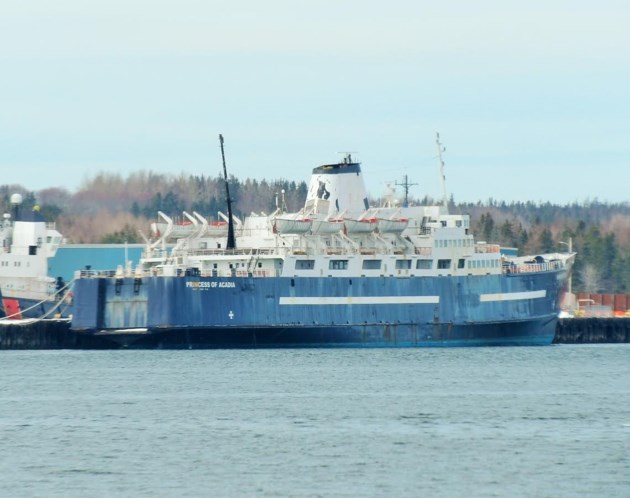
princessofacadia3

The old Digby ferry is heading for the scrapyard.

The federal government has issued a request for proposals to demolish the MV Princess of Acadia, which it replaced in 2015 with a more modern ferry.

“The Princess of Acadia shall be disposed of through ship breaking,” say tendering documents. “The contractor will be required to ship break the vessel in an efficient and environmentally responsible manner that is conforming to Canadian laws and the contract.”

Constructed at Saint John Shipyard in 1971 by Canadian Pacific, the 146-metre-long ship was purpose-built for the run between Digby and Saint John, N.B.

“After decades of service the Princess of Acadia has reached the end of its operational life and is now moored in Sydport, N.S., in an unmanned and cold state,” say tendering documents.

The request for proposals defines ship breaking as “the process of systematically scrapping the entire infrastructure of an obsolete vessel by dismantling and disposing or recycling all of its component parts and hazardous materials.”

There is a bidders conference for companies interesting in doing the scrapping work slated for April 5 at the Canadian Coast Guard College in Sydney. Outfits that want to be considered must let Public Works know by Wednesday.

A mandatory site visit for bidders is slated for April 6 at the college.

Only eastern Canadian companies with ship breaking capabilities are eligible for the scrapping work. The tendering documents cite several laws aimed at restricting the movement of hazardous waste for that stipulation.

The scrapping work must start around July 1, when it is estimated the Princess of Acadia will be towed to the yard that wins the contract, and be completed by June 30, 2018.

Bidders must demonstrate their experience in handling and disposing of hazardous materials, say tendering documents.

Bidders also need to provide at least one example of a project that they have completed in the past decade that required proper handling of a minimum of four of the following items: asbestos-containing materials, metals (including lead) in paint, heavy metals in materials (flashing, solder, anodes), polychlorinated biphenyl (PCB) containing materials, mercury in electronic products, ozone depleting substances, petroleum oil and lubricant residue and radioactive materials.

The outfit that wins the work must be prepared to take the Princess of Acadia from its current berth within 30 days of the contract award, say tendering documents.

Source: local xpress.
https://www.localxpress.ca/local-news/princess-of-acadia-to-be-scrapped-573608

26 March 2017

Could two more navy vessels be heading our way?

qa-25032017-preserver.jpg

LIVERPOOL - The federal government has issued two new public tenders for the ship breaking and disposal of former navy ships – and these ones are close by.

The former HMCS Preserver and the CFAV Quest are located in the Halifax dockyard.

R.J. MacIsaac Ltd. of Antigonish has set up a shipbreaking yard in Liverpool.

So far, the company has been awarded the tenders for the last three naval vessels to be recycled.

The former Protecteur, Iroquois, and Algonquin  were taken to Liverpool from British Columbia as part of a contract worth about $50 million.

According the federal government’s tender document, the Department of National Defence has a requirement dispose of the former HMCS Preserver, a Protecteur-class auxiliary oil replenishment ship, and the former CFAV QUEST, an Auxiliary General Oceanographic Research/Oceanographic Research Ship.

The contractor will be required to prepare the ships for transfer, transfer each to the approved sites, demilitarize the controlled goods, return any museum material, and subsequently dismantle, dispose and recycle the vessels.

The tender will close on April 26.

According to the document, work must be completed on both vessels within 18 months of the contract being awarded. 

R.J. MacIsaac has not commented  on whether it plans to bid on the vessels.

Source: the advance. 25 March 2017

20 March 2017

Navy can’t even give away two old ships because it would cost too much to remove hazardous materials

HMCS Algonquin sits in port with significant damage to her port side hangar at CFB Esquimalt, B.C. on September 1, 2013 following a collision with the HMCS Protecteur. She's now one of four retired veteran ships.

The Royal Canadian Navy considered giving a destroyer and supply ship to another nation instead of scrapping them, but had to nix the idea when it realized how costly it would be to remove hazardous materials from the vessels.

HMCS Protecteur and HMCS Algonquin, both decommissioned in 2015, were considered for donation, according to documents obtained by the Ottawa Citizen. But to move ahead with that plan would have required that the government spend more than $10 million on each vessel to remove all polychlorinated biphenyls, or PCBs.

Instead of spending the $20 million, the decision was made to send the vessels to the scrap heap.

Public Services and Procurement Canada has just put out a new request for bids for the disposal of the former HMCS Preserver, a supply ship, and the former CFAV Quest, a research ship used by the Department of National Defence. Those bids are required by April 26.

But the 2015 disposal documents prepared for HMCS Protecteur and HMCS Algonquin outline the limitations of what can be done with surplus navy vessels.

THE CANADIAN PRESS/Chad Hipolito

The Royal Canadian Navy considered either giving HMCS Algonquin to another nation or donating it to a museum or similar outlet. “A gratuitous transfer to another nation was considered and deemed not to be a viable option due to numerous hazardous materials embedded through the ship, such as polychlorinated biphenyls,” said the navy planning records, obtained by the Citizen through the Access to Information law.

PCBs were in HMCS Algonquin’s cabling and insulation. Because of international rules on PCBs, the material would have to be removed from the vessel before it could be transferred to another nation, according to the navy.

“(The ship’s) only value is for recycling of her metal,” the navy documents stated, adding that the government would receive $400,000 to $600,000 for the scrap metal.

HMCS Protecteur, commissioned in 1969 and damaged by a major fire in 2014, also had PCBs on board and faced similar issues.

The Navy also decided against donating the ships to non-profit groups or museums. That was deemed to be “the most risky and costly option” to the federal government since not only did the military have to remove hazardous materials but would still have a degree of responsibility over the vessels.

“If (Protecteur) is to be displayed alongside a given jetty and poor maintenance results in the ship sinking, the Navy will likely have to assist financially or physically in the recovery of the ship,” the navy warned.

The disposal documents also pointed to past problems. HMCS Fraser was transferred to a private organization in 1998 but legal and other issues forced the navy to buy the ship back. It was eventually dismantled in 2011.

During the disposal of the former HMCS Annapolis, the navy had to pay $1 million to remove PCBs. It was then sold for $20,000 and was used as an artificial reef, according to the navy documents.

The submarine Onondaga was transferred to a museum but, after the boat rolled on its side, the navy had to send a team of experts to deal with the problem. During that 2008 operation, a navy diver narrowly escaped being crushed, the documents point out.

Source: national post. 19 March 2017

Russia will subside ship recycling and boost shipbuilding

Russia will subside the ship recycling to recover part of the cost of acquiring or building new merchant vessels. For the current year, the government will allocate 400 million rubles and the measure will last until 2030. The Russian Ministry of Industry and Trade plans to consolidate the requirements for the priority placement of orders for the construction of ships at domestic shipyards, which will boost the local sector and expected to start benefiting the economy from 2020, as the measure is good only with the full technical modernization of domestic enterprises and need technical period for modernization of the yards.

“The Ministry of Industry and Trade has developed a ship recycling grant in the form of subsidies to organizations to recover part of the cost of acquiring or building new merchant vessels in exchange for ships that have been scrapped. This year, the planned subsidy is 400 million rubles. Financing of the ship recycling grant will last until 2030”, said the Russian Industry and Trade Minister, Denis Manturov.

The Russian government also plans to boost shipping industry in the country, as the coastal transportation within Russian territorial waters should be carried out only under the Russian flag vessel and ships built at Russian shipyards.

Source: maritime herald. 19 March 2017

Ship for scrap triggers green concerns

Officials say all statutory environmental rules, directives will be complied with


Every time a ship for scrap reaches the Steel Industries Kerala Ltd. (SILK) unit at Azhikkal here, there are apprehensions about environmental pollution.

And it is not likely to be any different this time when a 1,300-tonne cargo ship has been brought to the public sector vessel dismantling unit located on the bank of the Valapattanam river, if the concerns aired in a section of the media are any indication.

The cargo vessel from Male reached the SILK unit here recently for dismantling.

SILK officials have said all statutory environmental rules and directives will be complied with before the work for dismantling the vessel starts.

They said that this was the first vessel brought at the unit for breaking after completion of the ship-breaking activities amid protests by an action committee of local residents and environmental activists a few years ago. They had then demanded its closure saying that the ship-for-scrap work causes environmental and health hazards.

When contacted, SILK Managing Director J. Chandrabose told The Hindu over the phone that all statutory rules and directives from the Pollution Control Board will be complied with before the breaking starts. The dismantling work will be done in the workshop of the unit with roofing and concrete floor as required under the rules, he said adding that concrete flooring ensures that not a single drop of oil or grease from the ship reaches the waters.

The Azhikkal unit of SILK had been started for building boats as well as breaking vessels for generating steel required for recycling.

The public sector company is said to be running on accumulated loss, though the Azhikkal unit is surviving with orders for ship for scrap.

The latest order for dismantling coincides with the attempts to secure an order from the Kerala State Water Transport Corporation for building passenger boats. The SILK officials confided that the order is now at the stage of tendering.

The unit can stay afloat if it gets three or four vessels for dismantling every year, they said. Ship breaking is also for reuse of iron used in ships, they added.

All licences

N. Mohammed, senior manager of the SILK, said the unit has all the licences from the Pollution Control Board and the local panchayat for carrying out its operations.

Source: the hindu. 17 March 2017