20 March 2017

Please, Get Real with Ship Recycling


Last week five European ship recycling yards announced that they signed an agreement that establishes the European Ship Recyclers Group (ESR). In its statement ESR said: “Our first target is to create awareness of the recycling capacity in Europe which today is over a million ton. We have to ensure that our member yards are on the top of the ship-owners’ list for dismantling their ships. Our message is a clear one. If we can handle them let’s keep the E.U. flagged ships in Europe.”

Furthermore, the Group says that it aims to speak with one voice to the European Commission, which is responsible for the implementation of the new E.U. Ship Recycling Regulation, and to unite all European recycling.

The day following the establishment of ESR, the NGO Shipbreaking Platform issued an announcement: (1) welcoming this initiative; (2) alleging that ship owners are rejecting European recyclers under the false pretext that there is no recycling capacity in Europe; (3) reaffirming ESR’s claim that the European Union yards have a combined capacity of 1.1 million LDT; (4) stating that almost all European yards had said to the Platform that, if they would be promised an increased market share of the commercially owned vessels, they would invest to enlarge their facilities; and (5) calling for European legislation to oblige all ships visiting European ports to pay a Ship Recycling Licence to finance the closing of the price gap with South Asia.

It is understandable that European ship recyclers wish to maximize any opportunity that the European Ship Recycling Regulation may offer them. However, I think that the new organisation is getting carried away with its own marketing and the views of the Platform.

The starting point for understanding the market for the recycling of commercial ships is to study the scrap steel market. The European Union has been the largest net exporter of scrap steel in the world, having overtaken the U.S., which is currently the second largest net exporter.

Seen in this light, the idea of recycling ships for their steel in Europe (or in the U.S.), in order to export ferrous scrap to Turkey1 (which is the destination of 58.8 percent of E.U.’s scrap steel exports in 2015), to India (10.4 percent of E.U.’s exports) and to Pakistan (7.2 percent) is plainly absurd and not worth serious consideration. Nevertheless, this is exactly what the ESR and the NGO are saying in their public statements.

Each of the 18 European recycling yards that applied and that have already been included in the European List of approved yards, had to declare in their applications the maximum annual tonnage they have recycled in the last decade. This is what is termed as the ship recycling capacity by the European Regulation, as well as by Hong Kong Convention.

Naturally, this metric results in an overestimate of true current capacity as, for some of the yards their maximum annual tonnage may reflect capacity of a few years ago that is no longer there. In fact, amongst the 18 E.U. yards currently appearing in the European List there are yards that are not currently recycling ships. In any case, the self declared maximum annual capacity of the 18 European yards is 303,065 LDT2, and definitely not the wishful figure of 1.1 million LDT that is claimed by ESR and the NGO.

We have to assume that the people who run the European ship recycling yards must be capable businessmen. How then can they keep a straight face when saying they have to ensure that their member yards are on the top of the shipowners’ list for dismantling their ships? Even forgetting Chinese and South Asian yards, why on earth should any owner of an ocean-going ship not sell his ship to a Turkish recycling yard for multiples of the price offered by E.U. yards?

The European ship recycling yards are not, and will not be the destination for end of life ocean-going commercial ships. Instead, the real market for European ship recyclers is made up of: E.U. government ships; ships that are immobilised in E.U. ports because of damage; and, primarily, the plethora of smaller European based ships and boats for which repositioning to South Asia, China and even Turkey would be impractical and economically prohibitive.

To get a feel of the magnitude of the small ship market we may examine the size distribution of the world fleet3. At the end of December 2015 there were 111,806 ships over 100 Gross Tons in the world. If we make the reasonable assumption that ships below 3,000 GT are not likely to travel a great distance to a recycling yard, this means that 75,998 ships between 100 GT and 2,999 GT, or 68 percent of the world fleet’s ships, will be recycled in local yards.

A similar proportion of the fleet trading in European waters should also be expected to be recycled in European yards. To these ships one should add the vast number of boats below 100 GT. This is the natural market for European ship recyclers, and it would appear wiser for ESR to concentrate on these ships rather than support the unreal propositions of the Platform.

Dr Nikos Mikelis is non-executive director of cash buyer GMS.

1 “World Steel Recycling in Figures 2011-2015” Bureau of International Recycling, Ferrous Division.

2 ec.europa.eu/environment/waste/ships/list.htm

3 “World Fleet Statistics 2015”, IHS Maritime & Trade 2016

Source: maritime-executive. 15 March 2017

All statutory rules being followed: SILK

Every time a ship for scrap reaches the Steel Industries Kerala Ltd. (SILK) unit at Azhikkal here, there are apprehensions about environmental pollution.

And it is not likely to be any different this time when a 1,300-tonne cargo ship has been brought to the public sector vessel dismantling unit located on the bank of the Valapattanam river, if the concerns aired in a section of the media are any indication.

The cargo vessel from Male reached the SILK unit here recently for dismantling.

SILK officials have said all statutory environmental rules and directives will be complied with before the work for dismantling the vessel starts. They said that this was the first vessel brought at the unit for breaking after completion of the ship-breaking activities amid protests by an action committee of local residents and environmental activists a few years ago. They had then demanded its closure saying that the ship-for-scrap work causes environmental and health hazards.

When contacted, SILK Managing Director J. Chandrabose told The Hindu over the phone that all statutory rules and directives from the Pollution Control Board will be complied with before the breaking starts. The dismantling work will be done in the workshop of the unit with roofing and concrete floor as required under the rules, he said adding that concrete flooring ensures that not a single drop of oil or grease from the ship reaches the waters.

The Azhikkal unit of SILK had been started for building boats as well as breaking vessels for generating steel required for recycling.

The public sector company is said to be running on accumulated loss, though the Azhikkal unit is surviving with orders for ship for scrap.

The latest order for dismantling coincides with the attempts to secure an order from the Kerala State Water Transport Corporation for building passenger boats. The SILK officials confided that the order is now at the stage of tendering. The unit can stay afloat if it gets three or four vessels for dismantling every year, they said. Ship breaking is also for reuse of iron used in ships, they added.

N. Mohammed, senior manager of the SILK unit at Azhikkal, said the unit has all the licences from the Pollution Control Board and the local panchayat for carrying out its operations. No contamination of water is possible as the vessel is not being dismantled in the water but inside the workshop with concrete floor. The unit also does steel fabrication work for other agencies, he added.

Source: hellenic shipping news. 18 March 2017

12 March 2017

European Recyclers Form Ship Recycling Group

Photo: NGO Shipbreaking Platform

Five European ship recycling yards have joined forces to effectively raise awareness of existing best practice and the fact that there is capacity in Europe to properly recycle ships.

The newly established European Ship Recyclers Group (ESR), set up under the umbrella of the International Ship Recycling Association (ISRA), aims at reaching out to ship owners that are looking for clean and safe ship recycling.

The NGO Shipbreaking Platform can only welcome this step and vows to support their efforts in attracting more business as long as they maintain sustainable practices.

The European Union approved 18 ship recycling facilities with a total capacity of 1.1 million LDT under the EU Ship Recycling Regulation in December last year. All 18 facilities are located within the EU and the newly established ESR represents five of these yards – from France (Port of Bordeaux), Belgium (Galloo), Denmark (Smedegaarden), the Netherlands (Scheepssloperij) and Spain (DDR).

The European Commission is currently revising 18 additional applications from facilities located outside the EU. To make it on the EU list of approved facilities, yards need to prove that they are able to contain pollutants, ensure safe working conditions and the environmentally sound management of all wastes derived from the recycling activities. Facilities that operate on tidal beaches are not expected to make it on the EU list.

Whilst ship recycling facilities in Europe, as in the US and China, currently operate under-capacity because they are unable to compete with the higher prices offered by the beaching yards in South Asia, the EU list comes with a promise of raising the profile of yards that have already invested in infrastructure and technologies to ensure safe and clean practices.

“ESR’s main goals are to unite all European ship recycling yards and let the ship owners know that there is capacity for ship recycling in Europe. Our message is a clear, if we can handle them, let’s keep the EU-flagged ships in Europe,” says Peter Wyntin of Galloo, chairman of ESR. “ESR will be in close contact with local and EU governments to make sure substandard and unlicensed recycling practices also within Europe are ended,” Wyntin added.

Ship owners are regrettably quick in rejecting European recyclers under the false pretext that there is no capacity in Europe.

European yards today primarily recycle government-owned and smaller vessels, but questioned by the NGO Shipbreaking Platform in 2013, almost all European yards expressed that a promise of an increased market share of the commercially owned vessels would prompt investments to enlarge their facilities, or use currently dormant locations, to enable the recycling of also the largest ships.

Source: marine link. 10 March 2017

11 March 2017

EU ship recyclers join voices to promote clean and safe practices

Five European ship recycling yards announced yesterday that they have joined forces to effectively raise awareness of existing best practice and the fact that there is capacity in Europe to properly recycle ships. The newly established European Ship Recyclers Group (ESR) aims at reaching out to ship owners that are looking for clean and safe ship recycling. The NGO Shipbreaking Platform can only welcome this step and vows to support their efforts in attracting more business as long as they maintain sustainable practices.

The European Union approved 18 ship recycling facilities with a total capacity of 1.1 million LDT under the EU Ship Recycling Regulation in December last year. All 18 facilities are located within the EU and the newly established ESR represents five of these yards – from France (Port of Bordeaux), Belgium (Galloo), Denmark (Smedegaarden), the Netherlands (Scheepssloperij) and Spain (DDR). The European Commission is currently revising 18 additional applications from facilities located outside the EU. To make it on the EU list of approved facilities, yards need to prove that they are able to contain pollutants, ensure safe working conditions and the environmentally sound management of all wastes derived from the recycling activities. Facilities that operate on tidal beaches are not expected to make it on the EU list.

Whilst ship recycling facilities in Europe, as in the US and China, currently operate under-capacity because they are unable to compete with the higher prices offered by the beaching yards in South Asia, the EU list comes with a promise of raising the profile of yards that have already invested in infrastructure and technologies to ensure safe and clean practices.

“ESR’s main goals are to unite all European ship recycling yards and let the ship owners know that there is capacity for ship recycling in Europe. Our message is a clear, if we can handle them, let’s keep the EU-flagged ships in Europe,” says Peter Wyntin of Galloo, chairman of ESR. “ESR will be in close contact with local and EU governments to make sure substandard and unlicensed recycling practices also within Europe are ended,” Wyntin added.

Ship owners are regrettably quick in rejecting European recyclers under the false pretext that there is no capacity in Europe. European yards today primarily recycle government-owned and smaller vessels, but questioned by the NGO Shipbreaking Platform in 2013, almost all European yards expressed that a promise of an increased market share of the commercially owned vessels would prompt investments to enlarge their facilities, or use currently dormant locations, to enable the recycling of also the largest ships.

To effectively push ship owners towards using EU approved yards, the NGO Shipbreaking Platform is calling for an incentive that will help close the financial gap between dirty and dangerous shipbreaking and proper ship recycling. The shipping industry needs to internalise the environmental and human costs of shipbreaking. The recently proposed Ship Recycling Licence does exactly that [1] and received support from the European Economic and Social Committee that in October adopted an opinion calling for “a financial mechanism to end beaching”.

“Ship owners cannot continue to ignore European recyclers and companies that have the capacity and will to provide solutions that can put an end to the scandalous conditions we are witnessing in South Asia. Only last week two more workers were killed at the shipbreaking yards in Chittagong, Bangladesh – the destination where most end-of-life gross tonnage was scrapped in 2016. [3] Commitment to use EU listed facilities is what we expect from any shipping company that calls itself socially responsible,” said Ingvild Jenssen, Director and Founder of the NGO Shipbreaking Platform.

Source: hellenic shipping news. 11 March 2017

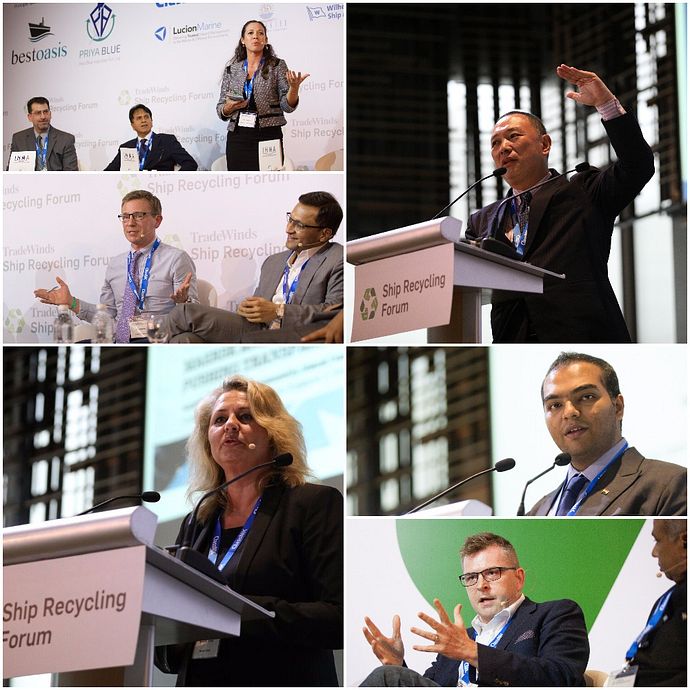
Record attendance at TradeWinds' Ship Recycling Forum


A record number of more than 200 breakers, brokers and buyers and service providers at the cutting edge of ship demolition descended on Singapore last week for the TradeWinds Ship Recycling Forum including the heads of the Indian, Bangladesh and Pakistan national recycling associations.

A packed afternoon workshop discussed improvements at the waterfront including the growing number of Alang shipbreakers certified as holding a Statement of Compliance with the Hong Kong Convention. Health, safety and environmental standards in Bangladesh, Pakistan, Turkey, China and the USA were also discussed and debated by an expert panel including John Stawpert of ICS, Francesca Carlsson of NGO Shipbreaking Platform, Jim Heath of Lloyd’s Register, Henning Gramann of GSR Services, Nitin Kanakiya of Triveni Ship Breakers and Chetan Patel, owner of Shree Ram Group.

Differences were put aside for a few hours as participants enjoyed an evening with views over Marina Bay hosted by Dani Patel, Director of Dubai-based Al Salam Insurance and Junichi Hirata of Japan’s ClassNK.

Source: my news desk. 10 March 2017