24 February 2019

Two killed in shipyard blast


Yet again, poor workplace safety exposed; authorities allegedly tried to cover up

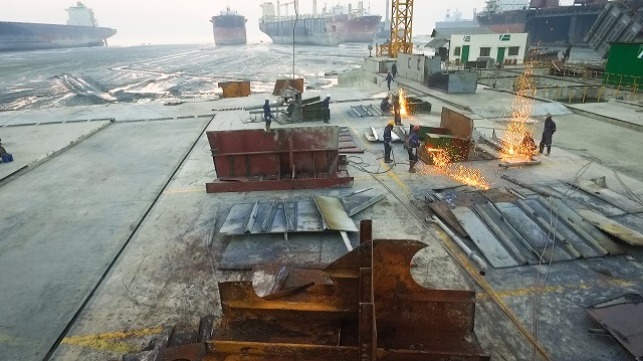
Two workers were killed and another was injured in an oil tanker explosion at a ship-breaking yard in Chattogram's Sitakunda upazila yesterday.

The deceased are Md Jalil, 32, and Bipul Chandra, 30, of Barishal's Babuganj upazila. The injured, Md Masud, 26, was undergoing treatment at Sitakunda Upazila Health Complex.

An oil tanker of MTS Warrior, weighing around 38,000 tonnes, exploded when 17 workers were cutting the tanker around 8:30am at Sagorika Shipyard, said Proddut Ghosh Chowdhury, sub-inspector of Sitakunda Police Station.

Earlier, four workers died in two incidents there in 2012 and 2013.

Mostafijur Rahman, inspector of Chattogram directorate of environment, said the shipyard did not follow the guideline for safety, causing the accident.

The explosion happened when sparks came into contact with the oil of the tanker, he added.

However, Shamsul Alam, owner of the shipyard, claimed that they ensured utmost safety for workers. This was an accident. “Two-thirds of the ship have already been dismantled.”

Some 27 workers were killed and nine others wounded in different incidents at shipyards in Sitakunda in the last three years since 2016, according to a report of Bangladesh Environmental Lawyers Association (Bela).

Jahirul Islam, inspector of Chattogram Medical College Hospital police outpost, told The Daily Star that Jalil was admitted to the hospital in the morning and Bipul in the afternoon. Both died soon after their admission.

After the incident, the shipyard authorities did not allow outsiders to enter there.

All the workers were forced to leave the yard and asked them not to talk to the media, shipyard sources said.

Pabon Chandra, a nephew of deceased Bipul Chandra, told this correspondent that his uncle had no training on ship-breaking, though it was mandatory.

“We heard a loud bang in the morning. When we rushed to the shipyard entrance, they [shipyard authorities] told us that Bipul did not join the work. In the afternoon, they informed us that my uncle was found dead at CMCH,” he said.

His uncle suffered burn injuries from head to waist, Pabon added.

Talking to this correspondent, Shipyard manager Md Harun and supervisor Sahabuddin admitted to the death of Jalil but said Bipul did not join work yesterday.

According to a High Court order in 2010, a ship which will be dismantled needs clearance from the explosives department.

Tofazzal Hossen, inspector of the explosives department in Chattogram, said they issued clearance for breaking the ship two and a half months ago after inspection.

Within the time, gas could form in the tanker, he added.

Source: the daily star. 19 February 2019

President of Gadani ship-breaking workers union dies in police custody


The president of Gadani ship-breaking workers union, Babu Karim Jan, died under mysterious circumstances in Karachi on Sunday morning, soon after being arrested by police from his residence in Metroville, located in the city's SITE area.

The man was allegedly dragged and thrown into the vehicle where police claim he suffered a heart attack. — File 

Police claimed that Jan, who was in his late 60s, was wanted in two attempted murder cases and died after suffering a "heart attack".

According to the deceased's relatives, Iqbal Market police conducted a raid in Metroville at around 1:30am and detained Karim Jan and his son, Amin.

They allegedly dragged and threw him into the police mobile where he died under mysterious circumstances. Later on, the police abandoned his body there and tried to disappear when the residents of the area gathered and made videos of the vehicle which were then shared on social media.

The deceased’s son, Amin, told media that when the police conducted a raid on their home, he informed the police that his father was a heart patient, but they allegedly did not pay heed to his request.

“They (the police) dragged him and threw him into the mobile,” the son alleged.

West SSP Shoukat Ali Khatian while talking to Dawn confirmed that police had arrested the deceased.

“There were two FIRs registered against him over charges of attempted murders and the police arrested him in the same cases,” the officer said. However, the senior officer did not elaborate further.

The body was shifted to Abbasi Shaheed Hospital to fulfil legal formalities.

A post-mortem examination was conducted in the presence of the magistrate concerned by a team of doctors comprising Additional Police Surgeon Dr Saleem Shaikh, Dr Abid Haroon, and Dr Pervez Makhdoom.

The additional police surgeon told Dawn that the cause of death will be determined after a histopathological and chemical examination.

On Sunday evening, the relatives and community members held a protest outside the Karachi Press Club.

The protesters accused the police of "brutally torturing" and killing the elderly man. They demanded the arrest of, and registration of a murder case against, the police party involved.

Meanwhile, National Trade Union Federation leader Nasir Mansoor said the death of a nearly 70-year-old trade union leader was the latest example of “police brutality” in the city and other parts of the country.

He too demanded the arrest of the policemen involved in the incident.

Source: the dawn. 18 February 2019

31 December 2018

Recent fires at Gadani yards prompt authorities to shut down all shipbreaking activities


NGOs call for the relocation of the industry to facilities equipped for safe and clean recycling
 
Brussels/Islamabad, 19 October 2018 - On 11 October a tanker caught fire at the Gadani shipbreaking beach that holds a deplorable record of life threatening accidents. Fortunately, no casualties were recorded. Only a few days later, on 14 October, yet another oil tanker named KRITI (IMO 9270737) caught fire, this time injuring seven workers, three of which are in a critical condition.

The Platform has reported a series of accidents following the catastrophic explosion that killed at least 29 workers and injured 58 on the 1st of November 2016. Since then, there have been at least five more fires caused by unsafe cutting operations. Difficult access for firefighters, a severe lack of ambulances and no hospital in the close vicinity of the yards aggravate the conditions, as reported by trade unions.

Following the major blast in 2016, Pakistani authorities imposed a ban on the import of tankers in addition to a ban on cutting operations. The ban on import was however lifted in April 2018 after 18 months’ freeze. Due to the use of the low-cost method of beaching and the favorable steel market conditions, the Gadani yards offer high prices for end-of-life ships, and soon 22 tankers were waiting for the cutting ban to also be repealed. One local breaker nonetheless started scrapping the VLCC ADA before the authorities lifted the cutting ban, and a fire erupted onboard the tanker in July. Despite the accident, and the fact that few measures had been put in place to ensure safe working conditions, the government issued cutting permissions in late August, putting the life of the workers in danger and prompting the import of additional vessels.

“Ship owners should be held accountable. They carelessly sell vessels to cash buyers that bring the ships to the Pakistani yards. The high profit margin is a clear indicator of destination: the higher the price, the worse the yard”, says Ingvild Jenssen, Director of NGO Shipbreaking Platform. “We are concerned over the political clout ship owners seem to enjoy: Greek owners alone are responsible for 1/3 of the ships that are currently beached in Gadani, yet Greece is pushing hard to undermine European laws aimed at improving practices globally”, she adds.

In contrast to the fire that broke out in July onboard a vessel that had not received cutting permission, the Balochistan Environmental Protection Agency (EPA) had approved the breaking of both vessels that caught fire last week. The two accidents underpin that not only the ship owners and yard operators fail to take necessary precautions, but also that the Balochistan EPA acted negligently when approving the work to start. Fires occur when vessels that are not properly cleaned from highly inflammable residual oil are cut with blowtorches.

“Without having conducted a proper inspection, the Balochistan Environmental Protection Agency first issued NOC (no objection certificate) for the breaking of the Kriti crude oil tanker. After the blast that injured seven workers, they issued a ban on all shipbreaking activities in Gadani, leaving hundreds of workers unemployed. We call on the authorities to take serious steps to move the industry away from the Gadani beach and to a location where proper infrastructure can ensure safe working conditions and pollutants can be controlled”, says Dr Muhammad Irfan Khan, professor at the Islamabad University and Board Member of the NGO Shipbreaking Platform.

44216937_329775401120876_1444444711925317632_n
 (Shipbreaking Workers Union and NTUF jointly organized a protest rally in Gadani against the increase in accidents and the closure of the yards)


CONTACT

NGO Shipbreaking Platform
Tel.: +32 (0) 26094419  

27 December 2018

China to ban imports of waste foreign vessels for ship recycling


China will ban imports of waste foreign vessels to protect the environment, China Daily reported on Dec 24.

The country’s ship-breaking yards, which have been tearing apart the world’s retired vessels from both civil and military sectors, and turning them into piles of steel scrap bound for mills for repurposing, will henceforth focus only on domestic ships.

Many ship-breaking yards and nearby beaches were heavily polluted by heavy metals, oil and other toxic substances, said the report.

The new measures of banning imports were announced in April and will take effect on Dec 31. They cover 32 types of solid waste imports, including ships, auto parts, stainless steel scrap, titanium and wood.

Source: Hellenic shipping news.

26 December 2018

Ship Recycling: No Sleepless Nights for the E.U.


Since 2014 I have provided The Maritime Executive with an end-of-year review of developments in the ship recycling industry and with some thoughts on what we may expect to see in the new year. In preparing this year’s review I felt that, before setting out my expectations for 2019, it would be appropriate first to recall the expectations I had for 2018 in my article of January 7 and to compare these with what actually took place in the year.

A year ago, I expected that in 2018 we would see a number of countries ratify Hong Kong Convention and I was bold enough to suggest that Germany, the Netherlands, Italy, Estonia, Japan and India would most probably ratify the Convention and bring much closer its entry into force. With regard to the European Union and its Ship Recycling Regulation I had suggested that, if the European Commission continued to be ambivalent about approving yards in South Asia, they would have a lot of sleepless nights because of the lack of ship recycling capacity for the practical needs of European shipowners. At that time, I had also wondered about the prospects of China’s ship recycling industry which had been experiencing a dramatic decline.

Looking back now, the quality of my predictions was as disappointing as were some of the developments:

(1) Not a single ratification of Hong Kong Convention was deposited to the Secretary General of the IMO during 2018. The Convention still has only six contracting States (Belgium, Congo, Denmark, France, Norway and Panama) whose combined fleet constitutes 21 percent of the world’s tonnage and 0.04 percent of the world’s recycling capacity (compared to the entry into force requirement of a minimum of 15 States with no less than 40 percent of the world’s tonnage and a proportionate recycling capacity).

(2) The European Commission does not appear to have had any sleepless nights, as they seem to be at peace knowing that from December 31, 2018 European flagged ships will have to be recycled in one of only three three yards that the Commission has managed to approve following the receipt of numerous applications more than three years ago, or in a yard located in the E.U. Two of the approved yards are in Turkey and one in the U.S., which as anyone who knows anything will confirm that the U.S. is not a realistic destination for the recycling of non-U.S. ships. A further 22 facilities in the latest version of the European List are E.U.-based and luckily for them do not require the Commission’s approval. According to common knowledge, these facilities are not known for the recycling of ocean-going ships, and in their busiest year since 2013 they recycled all together only 65,000 LDT, presumably of coastal and inland waterways tonnage.

(3) The Chinese government, having subsidized heavily its ship recycling industry for the last three to four years, suddenly decided in April to ban the import of ships for recycling from the end of the year, this way removing at a stroke of a pen from the international market around one quarter of the world’s ship recycling capacity and an even larger share of the so called green ship recycling capacity.

(4) In March, a Dutch court, in the first successful prosecution of a shipping company under the European Regulation on Shipments of Waste, found guilty the Seatrade Group and issued heavy fines and a 12-month professional ban against two directors for having sent four ships for recycling to Bangladesh, India and Turkey in 2012 without permission. The case, which is being appealed, sent shockwaves to the shipping industry. 

Against these adverse regulatory and legal developments, the ship recycling industry managed to maintain some progressive developments. In India, 72 out of 120 yards in Alang are now certificated by IACS classification societies as compliant with the technical requirements of Hong Kong Convention. At the end of last year there were 57 compliant yards in India, while at the end of 2016 there were 20.

PHP Family yard in Bangladesh

PHP Family yard in Bangladesh 


Also, the only ship recycling yard in Bangladesh with a Hong Kong Convention Statement of Compliance so far, the PHP Family, received its first green vessel for recycling from Vale (VLOC Ore Vitoria), and soon after its second from Greenpeace (the Rongdhonu, ex Rainbow Warrior II)! Thereafter the usual NGO politics ensued with the result that Greenpeace issued a public apology to the Shipbreaking Platform and also the promise “to urgently adopt an end-of-life ship policy, drafted with the help of the Shipbreaking Platform, to help ensure such errors do not occur in future.” I believe this was a wasted opportunity to take an ethical stance and show leadership.

On a more positive note, half of the ships sold by GMS to Indian yards in 2018 were recycled in accordance with the requirements of Hong Kong Convention, with Ship Recycling Plans and with Inventories of Hazardous Materials developed by GMS’s qualified experts.

Having been confronted with the Dutch court’s decision on the Seatrade case and with the imminent implementation of the European Regulation on Ship Recycling, more shipowners started paying attention to the challenges of ship recycling. During the year, GMS facilitated at least seven visits to India for shipowners who wanted to see for themselves the yards and the improvements that have taken place in Alang. Also, through the year shipowners and shipowners’ associations have campaigned for the Hong Kong Convention’s entry into force (this being the rather unusual situation of the regulated campaigning for regulation).

What will 2019 bring to our industry? There are 12 Indian and six Turkish yards whose applications are at various stages of review by the European Commission and its consultants. A first major juncture in 2019 will be around spring time when the European Commission is expected to announce whether the first two Indian yards that were audited last autumn are approved and included in the European List, or not. If they are approved, more yards in India will work hard to also gain approval, and in doing so will make available more real recycling capacity for shipowners of E.U. flagged ships.

If on the other hand the Indian applications are turned down, or the Commission’s decision is postponed over convenient technicalities, then owners of end-of-life E.U. flagged ships will have little option but to flag-out. This is because the one thing I can predict with certainty is that the idea promoted by Brussels, that the ocean-going fleet of Europe can be recycled in European Union yards, will not materialize. Therefore, looking ahead, there are two European scenarios for 2019: a successful and effective implementation of the European Regulation or a failed implementation that leads to evasion.

If the European Regulation is implemented successfully in 2019 it will disseminate its underlying technical standards (which are those of Hong Kong Convention) to the wider world and in this way will support the global acceptance of the Convention’s standards. On the other hand, a failure of the European Regulation could very well result in accelerated ratifications of the Hong Kong Convention by European countries who will be justifiably pressured by their own shipping industries.

Already it has been announced that Germany has secured ratification through its Parliament, as also has Turkey. It is also understood that the Netherlands, Estonia and possibly Italy are making progress towards ratification. Japan’s ratification is expected very soon, and no doubt other countries may well be getting close to ratifying the Hong Kong Convention. Furthermore, open registers, such as Liberia and Marshall Islands, can easily ratify the Hong Kong Convention, and I believe that they will do so as soon as the shipping industry confirms that the large tonnage of these registers is not going to hinder the recycling capacity condition of the Hong Kong Convention’s entry into force from being satisfied.

At the end of the day, the entry into force of the Hong Kong Convention is ultimately dependent on its ratification by India plus one other major ship recycling country (Bangladesh, Pakistan and China - who for the next few years will continue having legacy capacity).

Let us then hope that 2019 will deliver continuing improvements in the industry and some of the necessary ratifications of the Hong Kong Convention.

Source: the maritime-executive. 25 December 2018