Showing posts with label nuclear submarine. Show all posts

15 March 2012

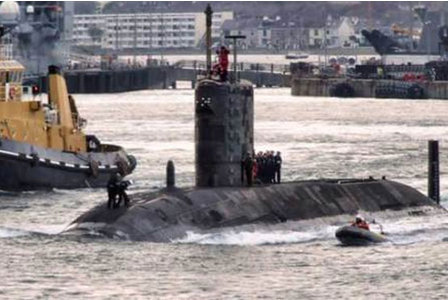
Only 32 people respond to plan to scrap nuclear submarines in Plymouth


A CONSULTATION exercise on proposals to cut up decommissioned nuclear submarines in Devonport has received just 32 responses since it was launched in October.

The most recent figures obtained from the Ministry of Defence (MoD) reveal that only 72 feedback forms have been submitted.

34 queries have been logged by the MoD, as well as the 32 'responses', and a total of 3,000 consultation documents have been handed out.

Since October a series of public exhibitions on the controversial Submarine Dismantling Project have been staged in Plymouth and across the country.

An MoD spokesman told The Herald that approximately 1,200 people have attended the events.

The consultation exercise ends next Friday when MoD officials will study the responses before making a decision at a later date.

Members of the public keen to express their views on the proposals are being urged to do so before it's too late.

So far the MoD has received a mixed reaction to the plans.

On consultation forms some people say they are in support of it, while others say they are against it.

"No way should this be happening," one person states. Another adds: "Devonport is too highly populated for this. I do not agree."

But another person states: "The submarines should be dismantled in Devonport to keep employment in this part of England."

As revealed in The Herald last year dismantling decommissioned nuclear submarines in Devonport is the "more reasonable proposition" – according to the MoD.

Documents issued to the public by the MoD state that the "proposed option" is to undertake initial dismantling at both Devonport and Rosyth Dockyards – the two sites originally earmarked for the work.

But it adds that an option to use Rosyth Dockyard only is the "least attractive" in terms of cost.

The reason for it being the least attractive option is because it would "require 20 submarines to be moved north and, in the longer term, there would be no similar work with which to share overheads".

The document adds: "Dismantling at Devonport only, on the other hand, remains a more reasonable proposition."

An assessment of all three dismantling site options will be revisited in light of public consultation responses.

Last year Plymouth City Council leader, Vivien Pengelly, and Devonport Dockyard's trade union boss, Peter Smith, spoke out in support of the proposals.

For further information on the Submarine Dismantling Project visit www.mod.uk/submarinedismantling.

Source: Plymouth Herald. 11 February 2012
http://www.thisisplymouth.co.uk/32-people-respond-plan-scrap-nuclear-submarines/story-15198109-detail/story.html

28 October 2011

Consultation to start on nuclear sub dismantling:

Seven disused submarines are stored at Babcock's Rosyth dockyard in Fife
A public consultation on the dismantling of the UK's retired nuclear submarines is set to get under way.

Rosyth in Fife and Devonport in Plymouth are the two preferred sites being considered as locations for removing the radioactive material from the vessels.

The consultation, which gets under way on Friday, will look at how and where this process will be carried out.

It will also consider where the waste should be stored initially.

Babcock's Rosyth dockyard is currently home to seven nuclear submarines, while a further 10 are stored at Devonport.

The storage of submarines at Rosyth currently supports about 100 jobs, though safety concerns are being expressed locally about what will happen to the submarines' nuclear fuel.

Rear Admiral Simon Lister, of the MoD's Defence Equipment and Support organisation, said the cost to the taxpayer of maintaining the submarines was "rising significantly" and space to store them was running out.

"Developing a solution now, rather than leaving future generations to do so, is the responsible course of action," he said.

"There is no reason to believe there will be any increased health risk from submarine dismantling activities.

"Submarine dismantling, like all nuclear work, will be robustly regulated to stringent standards by the Office for Nuclear Regulation and the environment agencies."

He added: "We are keen to hear the views of as many people as possible during this public consultation, to help us make the right decisions about how to dispose of our nuclear submarines."

The consultation is due to run for 16 weeks.

It will include a series of local events which will take place in Plymouth, Torpoint, Saltash, Rosyth, Dunfermline and Edinburgh, as well as national events in Birmingham and Glasgow.

Source: BBC. 27 October 2011
http://www.bbc.co.uk/news/uk-scotland-edinburgh-east-fife-15478628

11 October 2011

Fifers promised voice over dismantling of nuclear subs:

Rosyth will have its say on the government's plans to dismantle the country's fleet of nuclear submarines.

The Ministry of Defence will launch a major public consultation exercise this month, before making any decisions.

The news prompted North East Fife MP Sir Menzies Campbell to say: ''This is the right decision but the public will want to be assured that this is a genuine consultation.''

The Westminster government has already announced that Rosyth or Devonport—or a combination of the 2 yards—are the candidate sites for where radioactive waste is to be removed from the submarines.

And Peter Luff, the Minister for Defence Equipment, Support and Technology, has pledged in a letter to politicians that there would be an emphasis placed on consultation with the communities surrounding the 2 bases.

''Although we will be carrying out national consultation, there will be a particular focus on consultation in the Devonport and Rosyth areas, and in areas adjacent to them,'' he said.

There are 7 decommissioned subs at Rosyth. The Ministry of Defence starting laying them up afloat at the Fife yard over 25 years ago and their storage in Fife has proved highly controversial over the decades.

The issue of what to do with the rusting hulks has led to widespread fears Rosyth could be turned into a ''nuclear graveyard''— not only for vessels currently stored there, but for those 11 stored at Devonport and others still in service once they come to the end of their active life.

The MoD is undertaking the Submarine Dismantling Project to develop the solution for disposing of 27 of the UK's nuclear submarines after they have left the Royal Navy's service.

The project, to extend over a 60-year period, encompasses the provision of facilities to dismantle the 27 defuelled submarines and store the resulting intermediate-level radioactive waste until a least 2040. At this point it is intended it will be transferred to the UK's planned geological disposal facility.

Mr. Luff said the MoD was ''committed'' to carrying out public consultation ''before any major decisions are made.''


This 16-week process will begin on Friday, October 28 and will be based around 3 key decisions.
  • The first will look at how the radioactive material is to be removed from the submarines.
  • The second is where the radioactive waste will be removed and
  • The last will be to discuss the options for storing the waste, specifically intermediate-level radioactive waste, which cannot be disposed of immediately.
''It is our intention to make proposals around these 3 decisions, based on our detailed options analysis, and offer the public he opportunity to comment on both our analysis and the conclusions we have reached.

''They will also be given the opportunity to comment on the findings of the strategic environmental assessment we have carried out and on the project more generally,'' the minister said.

Source: The Courier. 11 October 2011
http://www.thecourier.co.uk/News/Fife/article/17889/fifers-promised-voice-over-dismantling-of-nuclear-subs.html

25 April 2011

Opposition to Rosyth 'submarine graveyard':

Rosyth Community Council has expressed opposition to nuclear submarines being sited at the town's dockyards and wants them removed.

The Ministry of Defence has still to announce whether more will join the seven decommissioned vessels, but it is understood that the choice is west Fife or Devonport, Plymouth.

There has been anxiety from councillors and the community about the submarines, with fears raised concerning possible leaks.

The community council has added its opposition to them being stationed at the dockyards, describing them as a "subs' graveyard."

Chairman Mike Shirkie said, "We are against the subs being located here but there is no decision yet regarding the waste from them until a disposal route has been agreed.

"As far as we know there is no further action until that has been looked at. I understand, although this has not been confirmed, that a campaign has started down in Devonport as they don't want the extra subs.

"We have seven submarines here at Rosyth and there are 11 down in Devonport, so we do not wish any more here."

Mr Shirkie said, "There are many politicians that do not want the subs and we don't want them either. It should not be treated as political. I believe it's apolitical.

"It does not benefit the local community having the subs here but we need to get heads together on this to sort it out."

An MoD spokesman said that no decision had been made on the future of the nuclear submarines.

He said, "The submarine dismantling project is currently in the assessment phase during which it is seeking to identify and develop the recommended options to satisfy its requirements.

"These options involve the site for initial dismantling, the technical approach to be adopted and the solution for storage of intermediate-level radioactive waste until a suitable disposal facility is available.

"We will work with industry to satisfy the requirements of the aims of the project.

"To do this, we are undertaking relevant technical, environmental and value-for-money studies that will form the basis of a public consultation and subsequent decisions. No major decisions will be taken until we have completed public consultation."

The spokesman added, "The environmental work we are carrying out is known as a strategic environmental assessment (SEA).

"SEA is a formal and legally-defined process that assesses any potentially significant environmental, health, or socioeconomic effects of the SDP options, and their wider implications for sustainable development.

"This assessment, and the resulting environmental report, will be presented as a key element of the public consultation."

Source: The Courier. By Paul Reoch. 25 April 2011
http://www.thecourier.co.uk/News/Fife/article/13263/opposition-to-rosyth-submarine-graveyard.html

18 April 2011

No nuclear leak threat at Rosyth, says MoD:

By The Ministry of Defence (MoD) has strenuously denied that there have been any leaks from the seven decommissioned submarines based at Rosyth and says that no threat is posed to the area from intermediate level radioactive waste (ILW).

Part of the dockyard at Rosyth
It has been claimed by SNP councillors Bill Walker and Ian Chisholm that radioactive waste may be completely removed from the west Fife site by 2015.

There are 7 decommissioned subs at Rosyth, including the Polaris vessels Revenge, Resolution, Renown and Repulse.

All of the subs have had their highly toxic fuel removed, but parts of the vessels, including the reactor compartments, are still contaminated.

The Courier previously revealed that 2 of the subs sprang leaks in their outer hulls, but these were later plugged.

It's believed that it costs the MoD around £1 million to store the vessels at Rosyth.

The MoD states that no decision has been made about where ILW arising from dismantled submarines will be stored and that it is still "considering" sites that are potential candidates for the initial stages of submarine dismantling, for which Rosyth has been identified as a potential location.

The MoD also denied that the ILW poses any threat to Rosyth and its surrounding area.

A spokesman said, "There are well-established methods for storing ILW in a safe and secure manner.

"As for all nuclear-related activities that the MoD undertakes, the management of ILW would be strictly regulated by the defence nuclear safety regulator, the Health and Safety Executive (HSE) and either the Environment Agency (EA) or the Scottish Environment Protection Agency (SEPA)."

He continued, "There have been no nuclear or radiological incidents related to the nuclear submarines stored afloat at either Rosyth or Plymouth.

"Furthermore, the EA and SEPA set strict limits for radioactive discharges from all nuclear-related activities at the sites, and we consistently operate significantly below those limits."

The spokesman said that potential candidate sites for the storage of radioactive waste have not been identified at this stage.

This was due to the developing nature of the national strategy.

"The secretary of state for defence has confirmed in parliament that submarine dismantling activities will not be undertaken before an ILW storage solution has been established," he added.

"Whichever site is selected for interim ILW storage, it will be strictly controlled in accordance with the relevant safety legislation and regulations.

"Rosyth has existing facilities and processes for the storage and management of ILW, which meet all the requirements currently placed on them.

"As the MoD has not yet conducted site-specific assessment of interim ILW storage sites, it is too early to say whether these would be suitable for storing ILW from submarine dismantling," the spokesman concluded.

Source: The Courier. By Paul Reoch. 18 April 2011
http://www.thecourier.co.uk/News/Fife/article/13024/no-nuclear-leak-threat-at-rosyth-says-mod.html

03 March 2011

SNP group believes submarines at Rosyth create ever-present radioactive risk:

Part of the dockyard at Rosyth 
Three west Fife SNP politicians have demanded that all nuclear waste be removed from Rosyth as part of the submarine dismantling project (SDP).

Councillors Douglas Chapman, Ian Chisholm and Bill Walker all believe there are ongoing problems caused by the seven decommissioned nuclear submarines at Rosyth.

The project has looked into the possibility of dismantling around 27 subs at the west Fife base and Devonport in Plymouth.

Rosyth has a licensed store on its site. Fears have been raised that low-level radioactive materials may continue to be stored on site at Rosyth if dismantled subs continue to be kept there.

It is believed the contract to dismantle the decommissioned subs may safeguard jobs at the Fife dockyard, but it has also sparked environmental concerns.

The Courier previously revealed that two of the vessels sprang leaks in their outer hulls. The leaks were subsequently plugged. It has been estimated that it costs the Ministry of Defence (MoD) around £1m to store the submarines at Rosyth.

Babcock Support Services Ltd runs the privatised former royal dockyard in Fife and has seven decommissioned subs at the site, including the Polaris vessels Revenge, Resolution, Renown and Repulse.

All of the subs have had their highly toxic fuel removed but parts of the vessels, including the reactor compartments, are still contaminated.

Mr Chapman, who is one of the representatives for the Rosyth ward, said he has concerns that more submarines could be destined for Rosyth.

Magnet for submarines

He said, "The real danger for Rosyth is that, following the break-up of one or two submarines, not only is the intermediate nuclear waste being kept here but then Rosyth becomes a magnet for the 11 submarines at Devonport and then becomes an international nuclear breakers yard for old subs worldwide,"

"Babcock have said that if the seven hulks are removed from the dockyard basin then that might open up new commercial opportunities here. That's more of a positive vision for Rosyth and that's the vision we support."

Mr Chisholm said the three SNP politicians will be meeting the Ministry of Defence on March 11 to try to resolve the issue.

He said, "We will listen to their reasons why nuclear waste should remain in Rosyth. The huge issue, however, is if we start breaking up old submarines at Rosyth, then how much new nuclear waste will be stored at Rosyth?

"We believe this is a backward step for Rosyth, as Babcock are trying to decommission the nuclear storage facility and remove nuclear work from the dockyard.

"We fully support Babcock Plc in the way that they are moving the dockyard from being reliant on defence-related work and into diverse commercial activity.

"The way that they propose to use the redundant Trident refit RD 57 'hole in the ground' to create a container port should be welcomed and, for Rosyth, that's the way forward."

Mr Walker added, "There is no doubt in my mind that since Devonport got the Trident refit work in 1993, then they should also take the responsibility for the rest of the submarine fleet."

A spokesman for the Royal Navy said they could not comment on the matter as nothing had been decided on the future of the decommissioned subs at Rosyth.

Source: The Courier. By Paul Reoch. 3 March 2011
http://www.thecourier.co.uk/News/Fife/article/11430/snp-group-believes-submarines-at-rosyth-create-ever-present-radioactive-risk.html

06 November 2009

Fears over sub scrapyard decision:

Eight disused submarines are already being stored at Devonport 
An anti-nuclear campaigner has raised concerns officials have already decided Plymouth should be a scrapyard for decommissioned nuclear submarines.

Ian Avent, who sits on the Submarine Dismantling Project (SDP) consultation advisory group, said he feared it was a "done deal" for Devonport Dockyard.

His concerns come after the SDP panel, which is to recommend how to dispose of submarines, lost two members.

The government said that no decision had been taken yet.

The UK currently has a fleet of 27 nuclear submarines.

Eight disused vessels are being stored at Devonport, ahead of being dismantled, while seven are at Rosyth, in Fife.

The SDP panel has to decide how to deal with the radioactive and non-radioactive hazardous wastes from the submarines in the short and long-term.

However, earlier this week, government adviser Peter Lanyon resigned from it in protest at the sacking of his colleague, Dr Jane Hunt.

Mr Lanyon said his position was no longer tenable as his views and those of his dismissed colleague were not being considered.

Mr Avent, who is on the SDP panel and is a member of the local pressure group CANSAR (the Campaign Against Nuclear Storage And Radiation), said he was concerned Dr Hunt was sacked because the government was given advice it did not want to hear.

He said: "I'm frightened that it's a done deal. I'm frightened that the consultation might be just window dressing.

"If that's the case, what are we left with? We're left with our councillors and our MPs to defend us."

The government said that it did listen to scientists' advice.

Ed Miliband, the Secretary of State for Energy and Climate Change, who was at the Met Office in Exeter on Friday, said: "We do listen to scientists, including on that issue.

"In the end, government has to make its decisions on the basis of the best scientific evidence available to it.

"We should be by guided by the science and that is the approach that we'll take."

Source: BBC. 6 November 2009