27 December 2017

GMS Market Commentary on Shipbreaking in Week 51 - GOOD CHEER SPREADS!

As the holiday season approaches and Ship Owners and Brokers take time off to spend with their loved ones, an imminently quieter few weeks ahead are perhaps rather welcomed, given what have been a frantic few weeks of recycling activity, with much of the (recycling) focus falling on the wet and offshore sectors of late.

Moreover, even though the markets recently witnessed a flurry of early-to-mid 90s built Capesize bulker sales from the Korean market (ones that were coming off government charters and being sold for scrap), it has been remarkably quiet on the dry (and container) recycling fronts this year as freight rates in both these sectors have made decent recoveries.

The general feeling is that the pain being felt in the wet and offshore sectors is set to last a little longer and even going into 2018, an expectedly large volume of VLCCs (those on storage and otherwise) seem destined to come under the torch. In fact, this year alone, the markets have seen 14 VLCCs and about 25 Aframax tankers committed for scrap so far, most of which have ended up in Bangladesh.

On the industry front, given the large number of tankers sold for recycling this year and a slowdown on the dry side as well, it has been an exceptionally challenging (and frustrating) period for Gadani recyclers who have found themselves regularly paying over the odds (often as the highest placed sub-continent market), just to secure any of the working (dry) units that have made it for sale thus far.

In fact, for the past 3-4 months, there have been whispers that the Pakistani market will open up for tankers again, albeit with stricter gas free for hot works standards (similar to those India and Bangladesh). However, discussions / meetings with the Pakistani government and PSBA are still ongoing as to how soon local authorities will permit tankers into the local market once again, after the tragic accident which cost scores of lives earlier in the year.

Source: steel guru. 27 Dec 2017

26 December 2017

EMSA studies two hazardous substances on ship-recycling

EMSA issued a study on the two hazardous substances, PFOS and HBCDD, included in the annexes of regulation (EU) 1257/2013 on ship recycling, aiming to close knowledge gaps regarding requirements in EU Ship Recycling regulation.
The EU Ship Recycling Regulation, that entered into force on 30 December 2013, aims at facilitating early ratification of the Hong Kong Convention 2009, both within the EU and in other countries, by applying controls to ships and ship recycling facilities. It aims to ensure that vessels are recycled in EU-approved facilities worldwide.

EU legislation sets additional requirements compared to the Hong Kong Convention for the Inventory of Hazardous Materials (IHM), by including the substances Perfluorooctane sulfonic acid (PFOS) and Hexabromocyclododecane (HBCDD) in the list of hazardous substances.

PFOS

As explained, firefighting foam is expected to have the highest concentration of PFOS and the most relevant material to analyse and check for inclusion in the IHM Part I.

Protective coatings for fabrics such as carpets, textiles, upholstery and electronics such as semiconductors not integral to ship in operation, is also relevant, however falling out of scope with regards to IHM Part I in general. Paint and coatings may be relevant but it is not expected to find PFOS in paint and coatings because other surfactants are probably used and it is not detected in paint in any samples looked at (inventories in 21 ships).

For PFOS in firefighting foam, global, regional and national legislation as well as shelf life need to be taken into consideration.

After 2010, PFOS containing firefighting foams is less likely on board vessels at all, unless vessels built in China, where it at that time and still is legal to produce and sell. Having in mind that the reporting limit is set to 0,001%, incomplete emptying of tanks and hoses, previously holding PFOS containing foam concentrate, may contaminate new non-PFOS containing foam above the threshold level, hence sampling and analysis is recommended.

Sampling should in general follow the EMSAS’s Best practice guidance on the inventory of hazardous material (2016) and the IMO resolution MEPC.269(68) Guidelines for inventory of hazardous material. Health, safety and environmental (HSE) aspects during sampling should be focused on proper ventilation, especially if working in confined spaces, use eye protection and gloves and have available safety data sheets and eye wash bottles.

The Basel Convention technical guidelines for the environmentally sound management of wastes consisting of, containing or contaminated with PFOS, its salts and PFOSF, list two methods for destruction and irreversible transformation:

- Cement kiln co-incineration and
- Hazardous waste incineration.

Destruction and irreversible transformation methods applicable for the environmentally sound disposal of wastes with a content of PFOS, its salts or PFOSF at or above 50 mg/kg.

HBCDD

HBCDD in polystyrene foam (EPS and XPS) is the most relevant area of use. HBCDD is found in textiles (carpets) in IHM’s and can be found on board all vessels types and should in particular be considered in the IHM Part I for insulation used in the walls and ceiling of cold provision rooms.

Special attention is recommended to insulation on board reefers, insulation in refrigerated containers and tank insulation of LPG, LEG and LNG cargo tanks.

As for PFOS, sampling should in general follow the EMSAS’s Best practice guidance on the inventory of hazardous material (2016) and the IMO resolution MEPC.269(68) Guidelines for inventory of hazardous material. Particular HSE aspects have not been identified for sampling, as the most relevant is polystyrene foam.

No standards exist for analysis of HBCDD. Existing standards used in IHMs is for brominated flame retardants in general and it is uncertain to what extent these standards are quantitative for HBCDD, and they cannot discriminate between the most common “types” of HBCDD.

As described for PFOS, the same methods listed by Basel Convention are applicable to HBCDD as well.

Link of the study repot:
https://www.green4sea.com/wp-content/uploads/2017/11/EMSA-Study-on-the-two-hazardous-substances-PFOS-and-HBCDD-included-in-the-annexes-of-regulation-EU-1257.2013-on-ship-recycling-2017_11.pdf 

Source: 22 November 2017

Iconic USS Ranger Dismantled

A two-year project to dismantle and recycle the decommissioned U.S. Navy vessel USS Ranger (CV-61) has recently concluded.

(Photo: EMR)

Ordered in 1954 and commissioned in 1957, the Ranger was the first U.S. carrier vessel built as an angled-deck ship from inception. She served in the Pacific, the Indian Ocean and the Persian Gulf, and earned 13 battle stars for her service in the Vietnam War. During her 37 years of service, she also appeared in blockbuster films such as Top Gun and Star Trek IV: The Voyage Home.

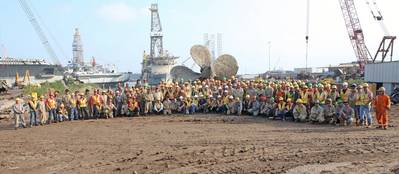
After her arrival on July 12, 2015, the Ranger was dismantled for recycling in Brownsville, Texas, at a metal recycling yard operated by International Shipbreaking, part of the EMR group. The dismantling project, which has taken just over two years, has recovered and recycled over 56,000 tons of material from the Forrestal-class “supercarrier”, with most of the recycled metal recovered sold to be melted down at domestic mills. Some of the repurposed new metals will be used in U.S. Department of Defense contracts.

Remaining recycled materials from the USS Ranger will also be given a new lease of life, as over five tons of historic items from the ship have been donated to the USS Lexington Museum in Corpus Christi, Texas, for display and preservation.

The dismantling project was completed on November 1, 2017, 34 years to the day since a fire broke out inside USS Ranger Main Machinery Room 4 (MMR4), claiming the lives of six U.S. Navy sailors and injuring 35. A moment of silence was held at 9:50 a.m. by the crew at the yard as the final section of the USS Ranger was removed to honor all those who served on the ship. All artifacts from the MMR4 Control Room have been donated to the USS Ranger Association for use in a museum exhibit honoring the six servicemen who perished during the 1983 fire.

The recycling operation has also enabled veterans and military enthusiasts to own a piece of naval history, with a USS Ranger commemorative dog tag being minted from brass and copper recycled from the mighty ship. Engraved flight deck sections are also available for purchase on the company’s eBay store.

Chris Green, International Shipbreaking COO, commented, “The USS Ranger has a distinguished record of service to our country, and we were honored to give her the respectful send off she deserves. We have a long history of dismantling military vessel, and have invested heavily in our Brownsville ship-breaking facilities to ensure our recycling processes are safe and environmentally sound. Even though the Ranger’s journey as a US Navy vessel has come to an end, we’re proud that she will continue to serve her country and live on to honor her brave crew.”

International Shipbreaking has recently taken delivery of another distinguished military vessel, the USS Independence, following a contract win with the U.S. Navy to dismantle and recycle the aircraft carrier.

Source: marine link. 22 November 2017

Tanker delivery/newbuilding profile causes problems

This year is on track to be the second largest 12 months for dirty tanker deliveries on record, behind 2009, according to an industry note from McQuilling Services.

Through the first 10 months of the year, the consultancy recorded 133 DPP tankers entering the market, compared to 84 over the same period in 2016. At the same time, 54 vessels exited the trading fleet, bringing the net growth to 79 ships year-to-date (end October).

This represents an acceleration of deletions when compared on a year-on-year basis to both 2016 and 2015.

Over the final two months of 2017, McQuilling expected another 32 DPP vessels to join the fleet, while four are on track to be removed. In total, the DPP fleet is expected to grow by 104 vessels or 4.6% in 2017, representing the highest year of growth on a net basis since at least 2000.

Within the VLCC sector, 44 vessels have hit the water, while about 22 were removed from the trading fleet. The average age of the departing ships was 19.7 years. The deletion activity was evenly split with 11 vessels sold for demolition and 11 converted to storage operations.

Through the remainder of this year, nine more VLCCs are set to join the fleet, while just one  is likely to be removed.

The Suezmax fleet has experienced the greatest net growth year-to-date with 52 additions and 11 deletions, or a net total of 42 ships. Frontline and Anangel Shipping were major contributors taking delivery of six and four Suezmaxes, respectively.

Regarding those vessels removed from the fleet, the average age was 21.4 years and just one ship , ‘Front Ardenne’ was sold for conversion, while the remaining vessels were sold for demolition. The last two months of 2017 are expected to bring 12 more ships into the market, while one vessel is projected to be deleted.

Turning to dirty Aframaxes, 33 vessels have joined the fleet, while 19 were removed since the beginning of the year. On a net basis, McQuilling forecast another nine vessels will join the fleet before the end of this year, which would meet its full year expectations of 44 additions and 21 deletions. The 2017 expectations for Panamax fleet growth were fulfilled with three more ships on the water this year, while two were sold for demolition.


Regarding the clean segment, 64 tankers were added to the fleet, while just 16 ships exited, resulting in a net growth of 48 units year-to-date. Over the same period last year, net fleet growth was 38 vessels with 48 additions and just 10 deletions.

Full year fleet growth is likely to remain above the 2016 figures, as another 26 deliveries and 12 deletions are expected through the final two months of 2017.

LR fleet growth has also trended above last year’s figures with 43 additions and four deletions year-to-date, a net growth of 39 vessels, which compares to 37 over the same period of 2016.

Of the 43 deliveries this year, 30 have been LR2s and 13 were LR1s, while the four deletions have been split evenly between the two sectors. Over the November/December period, another nine LR2s will join the fleet and three will exit, while the LR1 fleet is on track to add another six vessels.

As for MRs (excluding chemical tankers), a net fleet growth of 11 ships is forecast, as MR2s expand by 14 units, while the MR1 fleet is on track to fall by three units this year. Some 18 MR2s were delivered year-to-date, while 10 ships were reported sold for demolition or conversion. Over the same period, three MR1s were delivered and two exited; however, McQuilling said it expected another four to be removed before the year ends.

Year-to-date, 165 tanker orders were placed with 54% being in the DPP segment. The VLCC sector saw 47 vessels ordered through the first 10 months of 2017, which is more than double seen over the whole of 2016 (21 vessels).

For Suezmaxes, 18 vessels were contracted, including12 taken by the Chinese Bank of Communications. Newbuild contracting in the Aframax sector also remained healthy with 25 orders through October, compared to 23 orders placed in the whole of 2016.

On the clean side, 12 LR2s were ordered, while no activity was witnessed in the LR1 newbuilding market year-to-date. Most of the clean ordering activity involved MRs with 52 MR2s and 11 MR1s contracted, which compares to 45 over the whole of 2016.

October was an interesting month, as no vessels >27,500 dwt from the DPP and CPP sectors were ordered. McQuilling said that we have not seen the end of newbuild contracting for this year with a potential to increase over the winter months, on the back of historically low asset prices, which presents attractive investment opportunities, as well as upcoming regulatory constraints.

The consultancy also forecast that in 2018, there is likely to be a slowdown in average inventory net fleet growth to 3.3% for the DPP sector, with 139 deliveries and 103 deletions projected; however, this is still well above the historical average of 2.3%.

On this basis, freight rate weakness is likely to persist next year, as supply growth out paces demand. Beyond this point, an accelerated deletion profile is on track to negatively pressure fleet growth further, dropping to 1.6% in 2019, helping to re-balance markets, McQuilling said.

For the CPP sector, average net fleet growth, this year, is on track to remain relatively flat when compared to 2015/2016, at 2.5%. In concert with the DPP sector, net fleet growth is forecast to fall beyond 2017 as higher deletions are forecast on the back of an ageing MR fleet.

In 2018, net fleet growth is projected at 1.3%, the lowest level seen since 2002, which is on track to provide some upward pressure for freight rates.

Additional support will stem from a significant decline in the growth of the chemical tanker fleet, which is projected to expand by 5.1% in 2018, well below the historical average of 11.9%. This comes after 10.4% growth projected for this year, McQuilling concluded.

Source: tanker operator. 24 November 2017

Demolished fishing vessel at Kasimedu harbour sealed

CHENNAI: A fishing vessel that was illegally demolished at Kasimedu harbour has been sealed by government officials after a report appeared in these columns on Saturday last.

South Indian Fishermen Welfare Association president K Bharathi said that on the same day the report appeared, a team of officials covered the demolished vessel with a tarpaulin and put a seal on it. The report had the desired effect stopping further damage to the environment, he said.

The association also filed a complaint with the state environment department last week. The environment department, in a letter, instructed officials to inspect the place to check the damage caused by the demolition. In case of violations of the Coastal Regulation Zone Rules 2011, necessary action should be taken, the letter said. The action taken report has to be sent to the complainant and the director of environment department, Tamil Nadu, it further said.

Fishermen in the area said another tug and a fishing vessel, which are waiting to be broken down, remain anchored at the harbour. The authorities have to seize these two boatsbefore the demolition begins, they said.

The Kasimedu fishing harbour was originally a ship repairing yard for the Coast Guard. With the increase in the number of boats, fishermen requested the authorities to allocate space which led to the yard being marked as a fishing harbour, a fisherman said.

Fishermen are now worried that the demolition of ships here will set a wrong precedent and encourage others wanting to dispose of their vessels. Already the volume of their catch is going down due to pollution and releasing waste from a condemned ship will further pollute the environment. All fishermen are against allowing demolition of ships in the harbour, said Fishermen Murpokku Sangam president Jagadeesan.


Source: times of india. 17 November 2017