29 October 2017

anker packed with 1,000 tonnes of fuel pierces torpedo after dropping anchor at sea off Dorset coast

Demolition experts from the Royal Navy were called to the scene as test torpedo may have contained highly flammable propellant.

EMOLITION experts rescued a fuel tanker carrying 1,000 tonnes of oil after the ship's crew accidentally pierced a torpedo with an anchor.

The vessel was on its way to deliver the fuel to Portland Harbour, Dorset, when it dropped anchor in 15 metres of water off the south-west coast of Britain.

An eagle-eyed member of the crew spotted that the anchor had caught something as it was being winched back on board.

The item turned out to be a test torpedo that was heavily corroded and thought to be a few decades old.

The crew then called the authorities who dispatched the South Diving Unit of the Royal Navy based in Portsmouth.

The team, led by Lieutenant Commander Jonathan Campbell, raced to the scene where they evacuated most of the crew.

The fuel was pumped to the rearmost holding tanks of the ship while a small group of crew members remained on board in case a fire broke out.

Lt Cdr Campbell said: "The tanker was carrying approximately 1000 tonnes of fuel or oil.

"The fuel cargo was pumped into the aftermost possible tanks to reduce the effects of any explosion, and fire hoses were charged and ready to deploy if needed.

"We directed the ship to use her other anchor to steady her, before lowering the fouled anchor, and the torpedo, to several metres below the waterline."

Specialist explosives officers then examined the munition before removing it from the anchor and safely destroying it.

Lt Cdr Campbell added: "Working parts inside the torpedo could be seen from where the anchor fluke had ruptured it.

"The entire bomb disposal team were professional and got on with the job in hand."

 A test torpedo became snagged on the anchor of a fuel ship off the coast of Dorset
A test torpedo became snagged on the anchor of a fuel ship off the coast of Dorset

The rescue and disposal operation took around seven hours for the diving team to complete.

Authorities said the test torpedo was likely made in this country and used at a test range in Portland which closed in the 1980s.

Although there was no war head on the torpedo it still presented a credible threat because it could have contained highly flammable propellant.

Source: the sun. 14th October 2017

GMS Week 41 – PERFECT STORM!

A shocking collapse in price and sentiments over the last few weeks resulted in a grinding halt to a lot of the offerings / ongoing negotiations with end Buyers in the various sub-continent locations this week. Most sub-continent recyclers are entering the dreaded wait-and-watch mode to see where prices are headed, before committing themselves on new units. Depending on which report you rely on, prices have declined anywhere between USD 30/LDT to about USD 50/LDT since the peak seen during August / September.

Much of this can be attributed to the fact that local steel plate prices have been rather volatile, resulting in recycled material not moving quick enough from local yards. This has in turn left Recyclers increasingly reluctant to take in new inventory. In China, the Communist Party Conference has seen a halt to virtually all ship recycling activity and the lack of any meaningful negotiations and acquisitions is having a knock on effect throughout the Indian sub-continent and Turkish markets.

As local steel plate prices cooled (significantly) over the last few weeks and currencies (in both Turkey and India) depreciated overall as well, a perfect storm of declining prices and negative sentiments sweeps across the industry. Moreover, upcoming Diwali holidays will likely ensure that the lull in activity and sales will continue for at least another week. As such, most cash buyers remain unwilling to commit their unsold tonnage at some of the exploitative numbers currently being tabled by end users.

For week 41 of 2017, GMS demo rankings / pricing for the week are as below:


Source: hellenic shipping news. 17 October 2017

Platform publishes South Asia Quarterly Update #14

Brussels, 19 October 2017 - There were a total of 227 ships broken in the third quarter of 2017. Of these, 124 ships ended up on beaches in South Asia for dirty and dangerous breaking [1]. Between July and September, one worker lost his life at a shipbreaking yard in Alang, India. Another worker was reported seriously injured in Chittagong, Bangladesh.  

Due to the annual monsoon season, activities remained slow at the South Asian shipbreaking yards over the summer months. However, when the breaking took up again in September, one worker, Ashok Yadav, was reported killed whilst at work at shipbreaking plot no. 14 in Alang, India. Following his death, a letter denouncing the unsafe working conditions at the shipbreaking yards in Alang was sent to Indian Government officials by Toxics Watch Alliance. Around the same time, Md. Shohag - 21 years old - was seriously hurt while torch-cutting a vessel at Zuma Enterprise in Chittagong, Bangladesh, when an iron plate hit him on the left foot and stomach, causing severe injury.

It is not due to a lack of awareness concerning the dire working conditions that ship owners continue to favour the infamous beaching yards in South Asia. Rather, it is the fact that dirty and dangerous breaking brings in more money, as there is (1) little or no investments in proper infrastructure to contain pollutants and ensure safe working conditions; (2) the proper disposal of hazardous wastes is overlooked; and (3) migrant workers are exploited.

Moreover, the prices offered for ships this third quarter have been high in South Asia, especially when compared to the figures of the first half of the year. Monsoon rains caused a shortage of local product being available to the domestic steel mills and have, therefore, driven prices for end-of-life ships up. Whilst a South Asian beaching yard can pay about USD 400/LDT, Turkish yards are currently paying slightly less than the USD 250/LDT offered by Chinese yards.

Greek ship owners have, unsurprisingly, sold the most ships to the beaching yards with 11 beached vessels this quarter, followed by South Korea and Singapore with 6 vessels each. Shipping companies from the United States sold 5 vessels. Singaporean Continental Shipping Line remains the worst corporate dumper, though it currently shares this position with the Greek Anangel Shipping Enterprises and the Iranian Iran Shipping Lines. In total, these companies had three vessels each beached in South Asia in this quarter. Bermuda-based Berge Bulk, Greek Costamare, Swedish Holy House Shipping, and American SEACOR are close runner-up’s, with two ships each sold for dirty and dangerous scrapping on the beach. Brazilian-owned product tanker LOBATO, which was reportedly sold by Petrobras to Indian breakers, ended up on the muddy shores of Chittagong instead. Notably, no tanker was sold to the Gadani yards in Pakistan following the ban on tankers due to the major explosion on the ship ACES on the 1st of November of last year.

Although 33 out of the 124 beached vessels this quarter were European-controlled, only three of these had a European flag when they arrived in South Asia. All ships sold to the beaching yards pass via the hands of scrap-dealers, also known as cash-buyers, that often re-register and re-flag the vessel on its last voyage. In this regard, flags of convenience, in particular those that are grey- and black-listed under the Paris MOU, are used by cash-buyers to send ships to the worst breaking locations. Almost half of the ships sold to South Asia this quarter changed flag to the grey- and black-listed registries of Comoros, Niue, Palau, St. Kitts & Nevis, and Togo just weeks before hitting the beach. These flags are not typically used during the operational life of ships and offer ‘last voyage registration’ discounts. Importantly, they are grey- and black-listed due to their poor implementation of international maritime law.

Efforts to counter the shipping industry's crave for cash at the detriment of workers and the environment in South Asia are being brought to the attention of enforcement authorities and Courts. In Bangladesh, the Platform has been successful in taking legal action to halt the breaking of the FPSO North Sea Producer, which was illegally exported from the UK in 2016. Moreover, German authorities have been asked by the Platform to hold ACL, a subsidiary of Italian Grimaldi Group, liable for the illegal export of two ships, the Cartier and the Conveyor, to India. 

NOTES

[1] During the third quarter of 2017, the following number of vessels were broken in other locations: 42 in Turkey, 35 in China, and 26 in the rest of the world.

CONTACT
Ingvild JENSSEN
Director and Founder
NGO Shipbreaking Platform
Tel.: +32 (0)26094419


Source: NGO Shipbreaking Platform. 19 October 2017

First Bangladeshi Ship Recycling Yard Certified:

PHP Family

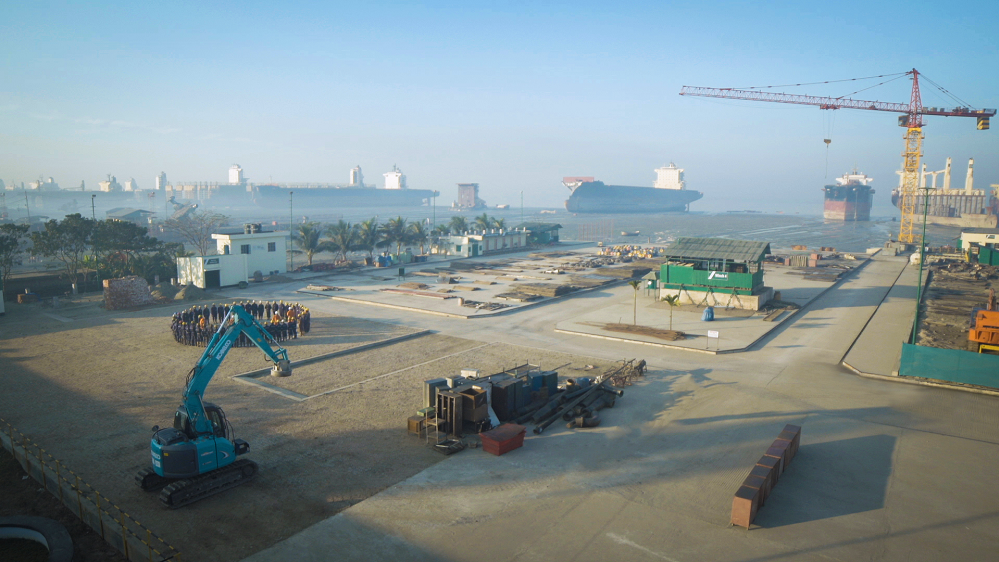
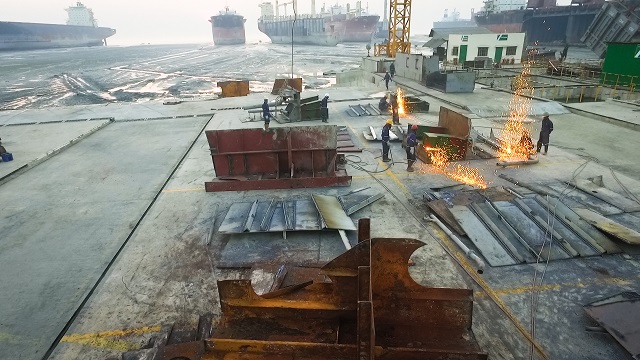
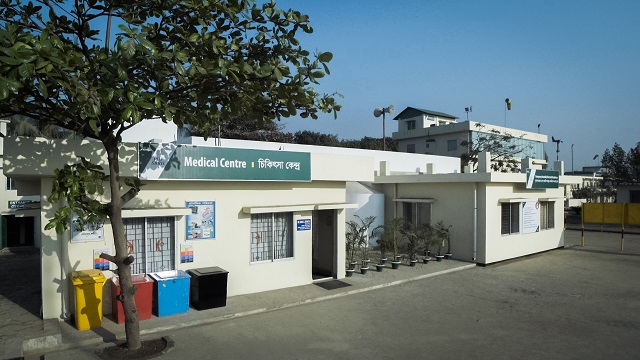
PHP Family recycling yard in Chittagong, Bangladesh has just received a Statement of Compliance with the Hong Kong Convention, for the Safe and Environmentally Sound Recycling of Ships from international Classification Society RINA. The yard is the first to gain Hong Kong Convention compliance certification in the country.

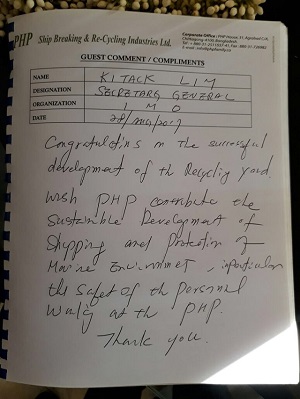
IMO Secretary General Kitack Lim visited the yard earlier this year and said the yard is a role model for others in the country.


Cash buyer GMS says it is an important development towards a more sustainable ship recycling industry, further raising the bar in the standards for this sector in Bangladesh. Dr. Anil Sharma, President and CEO of GMS, said: “PHP Family yard has worked hard to improve their safety and environmental standards by following successfully the Hong Kong Convention guidelines, which are enabling the whole ship recycling industry to achieve sustainable goals for ship recycling. We sincerely hope that this great achievement will attract more shipowners to yards that are endorsing responsible ship recycling and lead as an example for the rest in Bangladesh.”

The Hong Kong Convention, adopted in 2009 but not yet entered into force, includes regulations for shipowners, recycling facilities, flag states and recycling states to ensure that end-of-life ships do not pose any unnecessary risks to human health, safety and the environment when being recycled.

The European Union adopted the E.U. Ship Recycling Regulation in 2013. It brings forward the requirements of the Hong Kong Convention and applies them to end of life ships flagged with E.U. Member States. According to the regulation, owners of ships flying the flag of E.U. Member States will have to ensure that their ships are recycled in facilities included on the E.U. list of approved ship recycling facilities.

The European Commission published its first edition of the E.U. list in 2016. The next edition of the list, expected to include yards outside Europe, is expected to be published by the end of 2017.

Dr. Mikelis, Non-Executive Director of GMS, said: “A decision is awaited for the yards that are outside the E.U. and have applied for inclusion in the E.U. approved list of recycling facilities. These yards are already holding Statements of Compliance with the Hong Kong Convention, so they have proven that they meet the high safety and environmental standards laid out in the Hong Kong Convention through significant investment, training and development within the region. Excluding these yards would create an insurmountable divide within the industry based solely on their geographic location and threaten to halt the positive progress made by the Hong Kong Convention in South Asia.”

In India, as of the end of August, 41 yards have received Statements of Compliance with the Hong Kong Convention (seven from ClassNK, 30 RINA and four from IRQS). Another 15 yards are progressing towards obtaining their Statement of Compliance.

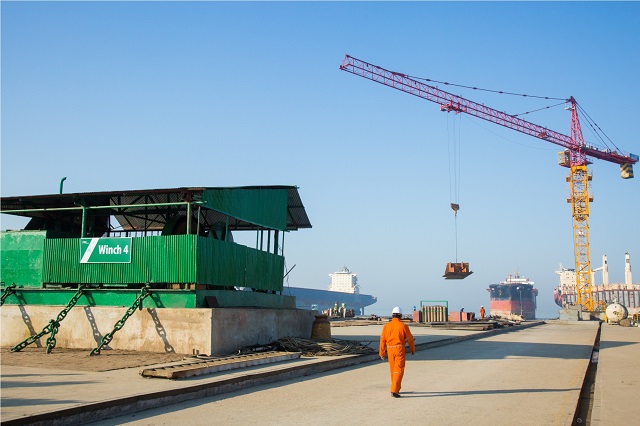
PHP Family recycling yard:


Source: maritime-executive. 23 October 2017

$111m Upgrade Plans for Alang-Sosiya Ship Recycling Yards In India:

The Government of India signed a loan deal worth $76 million with the Japan International Cooperation Agency (JICA), for a project to upgrade the environment management plan at Alang-Sosiya ship recycling yards.

The total cost of the project will be $111 million, out of which $76 million will be provided as a soft loan from JICA.

Out of the remaining amount, $25 million will be borne by Government of Gujarat and the balance $10 million will be shared by Ministry of Shipping & Government of Gujarat. The project will be executed by Gujarat Maritime Board (GMB) and is likely to be completed by 2022.

According to the Indian government, the project will help the Alang-Sosia ship-recycling yards to comply with international safety & environmental regulations.

It is hoped that this will attract more business at the recycling facilities at Alang, thereby further consolidating India’s share in the global ship-recycling industry.

It is also hoped that the project will also help in safeguarding the marine and coastal environment. The use of advanced decontamination technology will rule out the possibility of fire accidents in oil and chemical tankers, thereby ensuring workers safety.

Source: hellenic shipping news. 26 September 2017