21 January 2017

Pakistan Shipbreaking: NA committee seeks fresh briefing on Gadani fire

ISLAMABAD: The National Assembly's Standing Committee on Human Rights on Monday showed displeasure over the report of the Balochistan government on the Gadani ship-breaking yard incident and sought fresh briefing in the next meeting of the committee.

The committee met under the chairmanship of Babar Nawaz Khan and discussed the incident, besides reviewing measures taken to avoid such incidents in the future. The representatives from the departments concerned - except the Balochistan Labour and Manpower Department - could not attend the meeting. Moreover, those from Labour Department could not satisfy the committee members with their briefing.

The committee showed its displeasure over the briefing and directed them not to repeat the 'mistakes' next time. The committee initially recommended that their (Labour and Manpower Department officials') travelling and other expenses be cut from the salaries, but later on withdrew the recommendation on some members' request.

The committee directed all the departments, including the Ministry of Ports and Shipping, to attend the next meeting, in which the Gadani incident issue would again be taken up.

Briefing the committee on the incident, the Balochistan Labour Ministry's additional secretary and other representatives said that the shipping industry did not come in their domain.

They said that the department was only looking after safety measures related to the industry. They said that 28 people were killed in the incident. Ministry of Human Rights Secretary Rabiya Javeri Agha informed the committee that ship-breaking was not a regular industry.

MNA Essa Nori from Balochistan said that labourers' condition was miserable at the Gadani ship-breaking industry. He said that he had the bodies photographed, and more than 90 percent of them had been burned. He said that the labourers associated with the ship-breaking industry were also not registered with the Labour Department. He also demanded discussion on the issues related to population census in the panel.

He said that the government had announced the schedule for holding the population census and for the registration the Computerised National Identity Card (CNIC) was compulsory.

Source: daily times. 17 January 2017
http://dailytimes.com.pk/pakistan/17-Jan-17/na-committee-seeks-fresh-briefing-on-gadani-fire

After multiple tragedies, NTUF prepares draft for ship-breaking code

KARACHI: After consultation with government officials, the National Trade Union Federation (NTUF) has prepared a draft of a ship-breaking code, it emerged on Sunday.

Labour leaders and trade unionists had been insisting on creating a ship-breaking code, on the lines of the one in India, to prevent the growing number of accidents at the yard, claiming more than 32 lives in the last three months.

Speaking about the draft, deputy general secretary of the NTUF Nasir Mansoor said a ship-breaking code had been discussed at an earlier meeting with the Kalat division commissioner, Muhammad Hashim, in December 2016. It was discussed that a code would ensure that hiring would be based on contracts, by a person or an institution having the legal authority, and a registered company, to hire skilled workers on a ship. “The draft is ready, which may be changed and amended if needed,” said Mansoor. “We are ensuring that the basic grievances are covered so the workers are not at risk when they begin working.”

The draft includes the oft-repeated demands of the workers, most of whom come from Khyber Pakhtunkhwa. These demands were also covered during the meeting in December. The draft also says that any worker employed in the yard will be given a card or a ticket specifying the category of work assigned to him. Every worker at the time of appointment will be given an appointment letter in compliance of the terms and conditions of employment as prescribed in the Industrial and Commercial Employment of the Standing Orders Ordinance.

At the same time, any yard hiring more than 10 workers will have to insure the workers in case of natural death, disability and injury according to the Workmen Compensation Act 1923.

Earlier, labour activists demanded that health facilities be ensured at the ship-breaking yard. During multiple press conferences at the Karachi Press Club, the NTUF and Pakistan Institute of Labour Education and Research (Piler) demanded enforcement of basic safety guidelines. The demands included helmets, gloves, shoes and goggles to protect the workers’ eyes. The government did provide health gear which was shown in media reports.

Executive director of Piler Karamat Ali pointed out that the ship-breaking yard was the only industry which did not fall under any ministry or labour department. It fell under the Balochistan Development Authority, which, he added, failed to ensure safety of the workers.

Earlier, a fact-finding commission led by the Human Rights Commission of Pakistan (HRCP) pointed out the negligence of authorities. The report added that timely intervention could have averted accidents. Based on the accounts of eyewitnesses, the report mentioned that the number of workers killed in the Nov 1 incident could be more than 80.

There are 12,000 workers currently working at the ship-breaking yard in Gadani. The sector is often neglected, according to trade unionists, as a majority of the workers are migrants, 70 per cent of whom belong to KP. Another neglected community is the Pakistanis known as Bengalis and Burmese, who form 20 per cent of the work force, and are assigned tasks that might compromise their safety, according to union president Bashir Mehmoodani, “as they belong to a vulnerable group who can’t speak up for themselves.”

Twenty-six workers were killed on Nov 1 when a decommissioned oil tanker, Aces, docked at yard 54, exploded during a gas welding job. Four persons are still ‘missing’ since the incident in which many on board the fateful ship were injured.

On Jan 8, 24-year-old Dilshaad fell from the emergency lifeboat of the ship named Snowdon, at yard 69. According to eyewitnesses, the emergency lock on the boat broke. Just a day later, Jan 9, five workers were burnt to death in a fire that erupted at an LPG container on a ship named Chaumadra, at yard 60. A similar incident had happened at the same yard on Dec 22 though workers had managed to quickly disembark the ship at that time. Trade unions reiterated their demand that all the owners be arrested and punished for their negligence.

Source: dawn. 16 January 2017

Alphaliner: 2017 Could Break Record High Box Ship Scrapping Levels Set in 2016

Alphaliner, in its latest weekly report, says 2017 could be a record year for container ship scrapping, with projections suggesting that as much as 750,000 TEU could be on track for demolition.

The new projections come just weeks after it was reported that 2016 already saw a record high volume of container vessel scrapping.

"A total of 42,000 TEU has already been removed from the fleet in the first three weeks of this year, with a further 113,000 TEU due to follow in the coming weeks," stated Alphaliner of the year so far.

Last week, Alphaliner said that, while only 17 large scale international container carriers remain as of January 2017, compared to 20 a year ago, in a market still plagued by overcapacity and low rates, Hong Kong's Orient Overseas Container Line (OOCL) may be on the verge of becoming the latest box shipping major to be swallowed up by consolidation.

This week, as Reuters reports, Taiwan's Yang Ming Marine Transport (Yang Ming) batted away suggestions that it would consider a merger with another line, adding that it believes that the market's oversupply is likely to ease in 2017.

"A merger has never been an option for Yang Ming, and it won't be," said Yang Ming's chairman Bronson Hsieh.

"Over the past 10 years, the five shippers with the highest profit margins have been smaller players. Smaller companies do not necessarily have to be merged."

As Ship & Bunker reported on Monday, David Arsenault, Hyundai Merchant Marine's (HMM's) former CEO for the Americas, suggests that if global container shipping's new mega alliances that are set to launch in April do not ensure freight rate increases, the industry could see more bankruptcies and mergers.

Source: ship and bunker. 19 January 2017

With scrapping rates on the up, containership owners weigh anchors in lay-up

© Joe Myerscough scrapping_59078439

The containership demolition market has started this year as it ended the last – with an abundance of candidates looking to take advantage of robust scrapping rates.

According to the latest report from shipbroker Braemar ACM, 35 container vessels, equating to 119,500 teu, have been scrapped in 2017 already; there were just nine, 27,000 teu, by the same time last year.

2016 was a record for containership demolition. Braemar estimates 658,000 teu scrapped, although previous reports have suggested that the figure was nearer to 700,000 teu.

The Indian government’s decision in November to ban the use of the country’s most widely used banknotes in a crackdown on corruption could have had some impact on what is a cash-based industry, causing delays to transactions.

Last year also saw the youngest containership ever to be sent to a breakers’ yard for demolition. The seven-year-old, 2009-built, 4,250 teu classic panamax India Rickmers arrived at a ship-breaking yard at Alang, India on 31 December.

It was reportedly sold at $305/LDT (light displacement tonnage), but there is some evidence of a firming of rates recently, which will encourage owners of redundant container tonnage to look at the scrapping option.

Indeed, Braemar reports that the 4,500 teu Al Enterprise, built in 2003, was sold last week in Davao (Philippines) for $336/LDT, with sufficient bunkers to reach the Indian subcontinent.

And 2016 was a disastrous year for the charter market, especially for the panamax sector of 4,000-5,100 teu, with ship values plunging some 60% over the year as a consequence of extremely weak demand.

By the end of December, hire rates for panamax ships that could find charters were down to some $4,000 a day – a figure below vessel operating levels, even before finance costs are taken into account.

Notwithstanding the 52 panamax ships scrapped in 2016, according to Alphaliner, 88 more were idled as at 31 December, with 37 of these in long-term lay-up in Asia, eyeing scrapping as seemingly the only viable option.

Meanwhile, Alphaliner reports, flexible charters now “reign supreme” with time periods of one-to-six months and two-to-12 months becoming the norm in many containership sectors.

As a consequence, ocean carriers are phasing-out many of their long-term fixed-rate charters and returning these ships to owners, as and when newbuilds are delivered, and or picking up replacement ships at much cheaper rates on more flexible terms.

While the market remains over-tonnaged, the non-operating owners of containerships are at a greater risk than carriers, which are in a more flexible position than hitherto to adjust supply to demand.

Source: the loadstar. 17 January 2017

MARAD Hosts Ship Recycling Forum

*Former Maritime Administrator Chip Jaenichen recently visited Brownsville, TX, a city that dominates the U.S. ship-recycling industry. Today, we share his comments on the importance of the industry the area as well as the Maritime Administration’s continuing efforts to dispose of excess government owned vessels in an environmentally responsible manner.

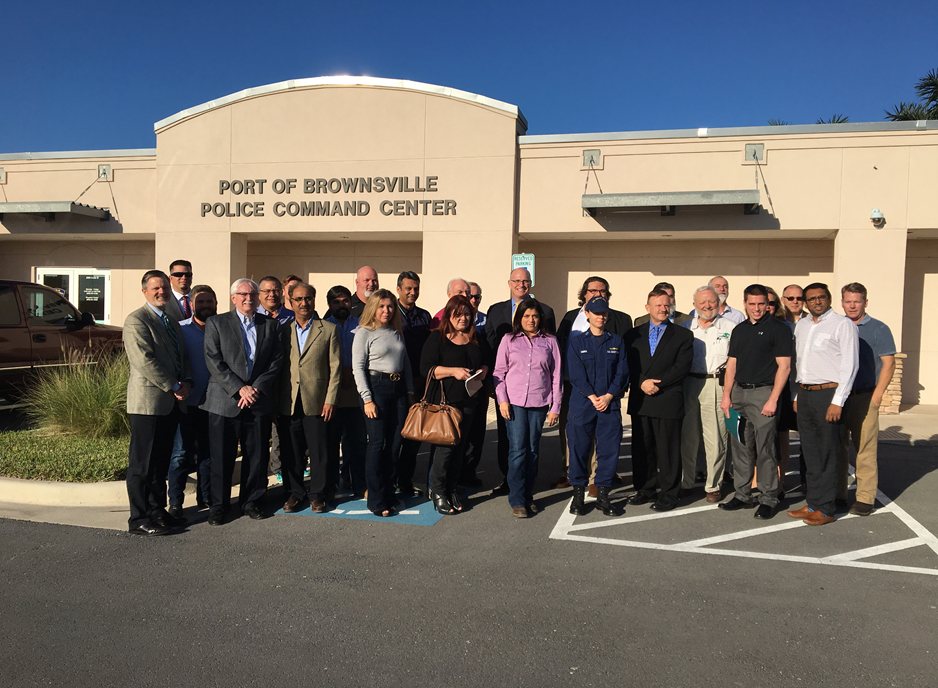
In early December we had the distinct privilege of participating in the 3rd Annual Maritime Administration ship recycling town hall meeting in Brownsville, Texas.  The venue brought together federal ship disposal programs, government safety and environmental agencies and domestic ship recycling industry representatives with direct involvement in the disposal of U.S. Government-owned obsolete ships into a forum where the current issues impacting federal agencies and ship recycling industry are addressed and discussed.

MARAD provided to the domestic recycling industry an overview of existing and future planning for federal ship recycling activities, including ship disposal forecasts, vessel downgrades for disposal, potential budgetary impacts and safety and environmental concerns.  The meeting offered an opportunity to listen to industry concerns, issues and suggestions related to ship disposal activities, including the impact of scrap steel prices, future price trends, vessel disposal solicitations and safety and environmental issues.


Domestic ship recyclers provide an important and invaluable industrial base for the disposal of obsolete Government owned vessels.  Consider the following:

- Ship recycling is the most cost effective and expeditious ship disposal method and has significantly contributed to the disposal of approximately 219 obsolete MARAD ships since2001.

- Obsolete vessels are recycled in compliance with Environmental Protection Agency , Occupational Safety and Health Administration and state and local laws and regulations, which helps to protect the environment and worker health and safety.

- Recycling assists federal agencies in protecting the environment of fleet anchorages by removing obsolete ships before they become an environmental liability.

- Ship recycling provides good jobs to local workers and specialty remediation companies and contributes to the success of the local economies in Brownsville, Texas, Amelia, La., and New Orleans.

Following the town hall, representatives from federal agencies and the state of Texas toured the recycling facilities located within the Port of Brownsville and offered insights into the impact of worldwide and domestic scrap metal prices in relation to each recycler’s strategy for acquisition of obsolete government and commercial vessels for dismantlement, facility improvements to continually gain production efficiencies and reduce costs, adherence to safety and environmental practices and the constant juggling of the myriad variables that are factored into estimating future scrap steel pricing when tendering offers for recycling projects.  Visible within the ship recycling facilities were federal and commercial barges and ships and oil rigs all in various stages of dismantlement, which attests to the diversification of recycling projects the industry has undertaken.

Domestic ship recycling is a dynamic industry that provides an important service in disposing of obsolete U.S. Government and commercial vessels.  The town hall meeting and ship recycling facility tours provide ongoing opportunity to forge better partnerships and understanding with regard to the impacts of the scrap steel markets, business forecasting and focus on protecting workers and the environment.  These types of industry forums are essential to MARAD making a positive contribution within the maritime community. We want to personally thank the entire domestic recycling community, the Port of Brownsville and our federal partners for working together to make these town hall meetings a success.

Source: transportation.gov. 18 January 2017
https://www.transportation.gov/fastlane/marad-hosts-ship-recycling-forum